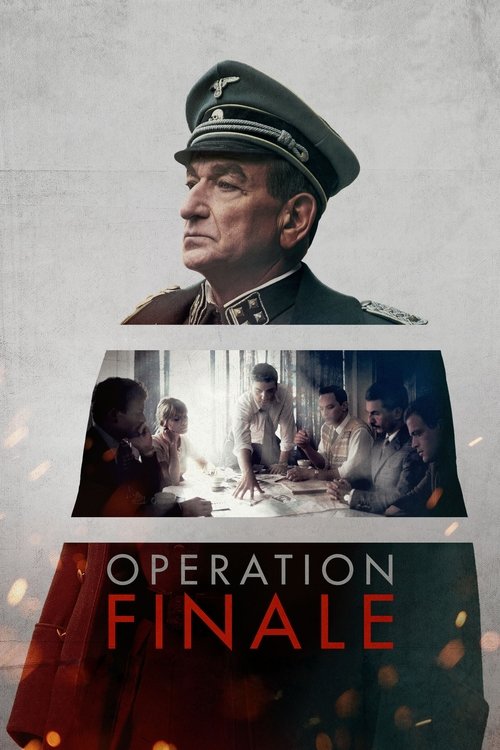
Operation Finale (2018)
Directed by Chris Weitz
No — Operation Finale is not woke, scoring 10 out of 100 on our wokeness meter.
Operation Finale arrives with the sober bearing of a film that knows it is important.
Consciousness Markers
Moral weight accumulates around the trial and survivor testimony in the epilogue, but the film mostly dramatizes rather than preaches.
A largely white, mostly Jewish cast (Oscar Isaac, Ben Kingsley, Mélanie Laurent) plays historical real-life figures as written; no deliberate diversity-driven casting agenda is evident.
Sylvia Hermann drives the initial discovery and Hanna serves on the team, giving women functional roles, but the film has no articulated feminist thesis.
The subject is the Holocaust and Jewish survival, which is morally serious but not modern racial-justice consciousness; it doesn't count as the 2020s marker.
The film hews closely to documented history; its humanized portrayal of Eichmann follows Hannah Arendt's 'banality of evil' rather than revising the record.
No LGBTQ+ characters, relationships, or themes appear anywhere in the plot.
Climate change is entirely absent from this Cold War-era espionage narrative.
Eichmann's 'following orders' bureaucracy is dramatized but never framed as a critique of capitalism or class.
No body-positive themes, body diversity messaging, or related content present.
No neurodivergent characters or themes are depicted.
Why it received this score
Operation Finale arrives with the sober bearing of a film that knows it is important. Chris Weitz directs the 1960 abduction of Adolf Eichmann from Buenos Aires with workmanlike patience, and Oscar Isaac supplies the furrowed brow of a Mossad agent carrying dead relatives in his memory. Ben Kingsley plays Eichmann as a fussy, put-upon bureaucrat, which is the correct historical read and also the only genuinely interesting choice the movie makes. The casting is what it is: a largely white, largely Jewish company playing documented historical figures, with no visible agenda beyond fidelity to the record.
The women in the ensemble, Sylvia Hermann and the doctor Hanna, do real work here. Sylvia's courtship of Klaus Eichmann sets the entire plot in motion, and Hanna keeps a sedated prisoner alive across two continents. Neither is asked to announce a thesis, and the film offers none. The subject is the Holocaust, which is morally serious without being contemporary in its sensibilities. Jewish survival is not the same thing as a modern racial-justice framework, and the movie never confuses the two. There is no climate anxiety, no body-positive messaging, no neurodivergent subplot, no queer romance. Eichmann's Argentina is a place of stucco and suspicion, not a metaphor for anything.
What the film does with Eichmann is faithful and a little sly. He claims to have managed logistics and followed orders, and the screenplay lets him sit in that excuse without editorializing. This is Arendt, not a rewrite of the record. The moral weight accumulates only at the end, when survivor testimony plays over the trial and the film briefly remembers it has a lesson to deliver. Mostly it dramatizes. A solid, well-meaning procedural that respects its audience enough not to lecture them, which in this climate is a modest virtue.
Analysis generated by our Consciousness Algorithm


Synopsis
In 1960, a team of Israeli secret agents is deployed to find Adolf Eichmann, the infamous Nazi architect of the Holocaust, supposedly hidden in Argentina, and get him to Israel to be judged.
Questions about Operation Finale
Is Operation Finale woke?
No — Operation Finale is not woke, scoring 10 out of 100 on our wokeness meter. That earns it a verdict of Ultra Based.
Does Operation Finale have any woke elements?
Very few. None of the 10 markers reaches 30, the level where a marker counts as present; the highest is Lecture Energy at 25.
How does Operation Finale compare to other 2018 movies?
It ranks #191 of the 325 films from 2018 we've scored; their average is 20. The wokest is Return (92).
How is the Woke Score calculated?
An AI-assisted process researches the film and its reception, scores it 0–100 on ten markers, then combines those into one 0–100 Woke Score. It measures a specific set of 2020s cultural themes, not film quality.