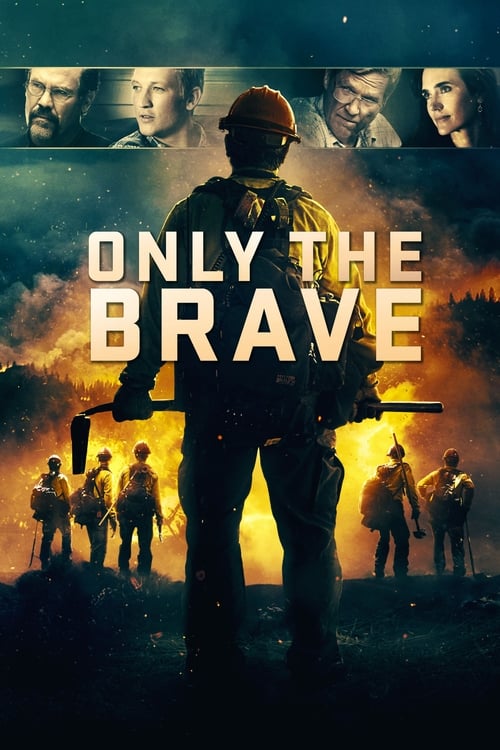
Only the Brave (2017)
Directed by Joseph Kosinski
No — Only the Brave is not woke, scoring 8 out of 100 on our wokeness meter.
Only the Brave arrives as a monument, and monuments are not built to argue.
Consciousness Markers
Jennifer Connelly's Amanda gets a few scenes of pushback and the widows' grievances are noted in criticism, but the film is a male-centric brotherhood drama with no feminist thesis.
The film carries an earnest memorializing tone and moral weight about sacrifice, but it preaches heroism rather than social-justice messaging.
The ensemble is overwhelmingly white, reflecting the actual Granite Mountain crew; no deliberate diversity casting or commentary on representation is present.
Wildfires are the setting and antagonist, but the film frames them as natural disasters to be fought, not as a climate-change parable or call to action.
The crew's makeup is treated as incidental; race is never a subject of the narrative or its themes.
No LGBTQ+ characters, themes, or subtext appear anywhere in the film.
No critique of capitalism, class, or wealth appears; the film is a straightforward tribute to working-class heroism.
No body-positivity themes or messaging are present.
Addiction (heroin, alcohol) is a plot element, but it is framed as personal struggle and redemption, not as neurodivergence or a neurodiversity theme.
The film dramatizes real events with acknowledged embellishments, but it does not rewrite history to serve an ideological revisionist agenda.
Why it received this score
Only the Brave arrives as a monument, and monuments are not built to argue. Joseph Kosinski assembles the Granite Mountain Hotshots from a roster of weathered white men, which is a fair approximation of the actual crew and also a casting decision nobody in the production felt compelled to justify. There is no commentary on who is missing from the frame. Race never rises to the level of subject. The film simply plants its flag in Prescott, Arizona, and lets the faces speak for a demographic reality that the screenplay treats as incidental.
Jennifer Connelly's Amanda gets a handful of scenes in which she pushes back against her husband's silences, and the widows who later challenge the town's treatment of them hover somewhere in the margins, but the camera keeps returning to the brotherhood. The fires themselves are the antagonist, a force of nature to be outmaneuvered with controlled burns and grit, never a parable about a warming planet or a summons to policy. Miles Teller's recovering addict is offered redemption through labor and fatherhood. His heroin is a personal demon, not a diagnosis, and the film has no interest in the language of neurodiversity.
What the film does preach, at length and with a straight face, is sacrifice. It is earnest to the point of devotion, an altar to working men who died on a hillside, and it asks nothing of the audience beyond grief. There is no critique of the economy that put them there, no interrogation of the bureaucracy that failed them, no body politics, no queer life, no rewriting of the record. The end credits show photographs of the real dead beside the actors who played them, which is the film's entire thesis: look at these men, remember them, and ask no further questions.",
Analysis generated by our Consciousness Algorithm


Synopsis
Members of the Granite Mountain Hotshots battle deadly wildfires to save an Arizona town.
Questions about Only the Brave
Is Only the Brave woke?
No — Only the Brave is not woke, scoring 8 out of 100 on our wokeness meter. That earns it a verdict of Ultra Based.
Does Only the Brave have any woke elements?
Very few. None of the 10 markers reaches 30, the level where a marker counts as present; the highest is Feminist Agenda at 15.
How does Only the Brave compare to other 2017 movies?
It ranks #184 of the 309 films from 2017 we've scored; their average is 19. The wokest is I Am Not Your Negro (92).
How is the Woke Score calculated?
An AI-assisted process researches the film and its reception, scores it 0–100 on ten markers, then combines those into one 0–100 Woke Score. It measures a specific set of 2020s cultural themes, not film quality.