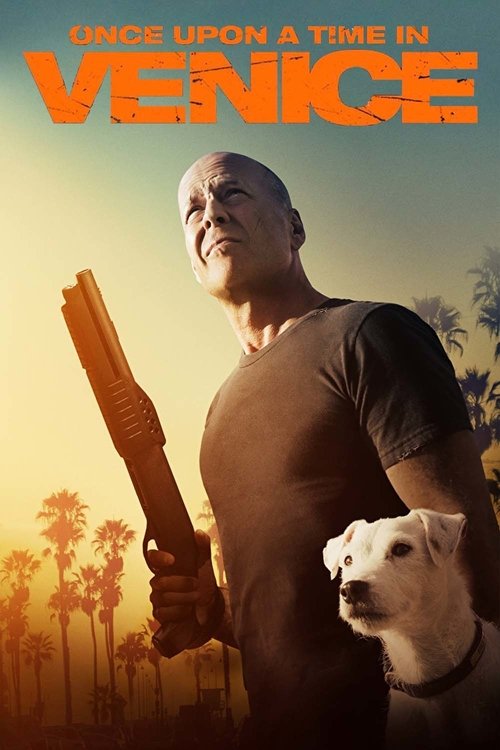
Once Upon a Time in Venice (2017)
Directed by Mark Cullen
No — Once Upon a Time in Venice is not woke, scoring 13 out of 100 on our wokeness meter.
Once Upon a Time in Venice arrives as a 2017 crime comedy in which Bruce Willis plays a Venice Beach private investigator whose dog is stolen by a drug lord played by Jason Momoa.
Consciousness Markers
The cast is notably multiethnic (Jason Momoa, Wood Harris, Kal Penn, Stephanie Sigman, Adrian Martinez, Ron Funches), but these are natural, unremarked roles in a Venice Beach crime comedy with no representational agenda or commentary.
A cross-dressing character appears briefly as a comedic obstacle who subdues the protagonist, played for a gag rather than as any affirmative LGBTQ+ theme.
The film is aggressively retrograde in its gender politics: the hero is 'good with the ladies,' sleeps with a woman he was hired to find, and the plot treats women as props or prizes.
No engagement with racial themes or consciousness whatsoever; the diverse cast exists without any racial commentary.
No environmental or climate content of any kind.
No critique of capitalism or wealth; the plot revolves around stolen cash, cocaine, and a real estate developer's graffiti problem, all treated as neutral genre furniture.
No body positivity themes; the film trades in standard tough-guy and comedic physicality without any body-image messaging.
No neurodivergent characters or themes present.
No historical revisionism; the film is a contemporary crime comedy with no historical subject matter.
The film makes no attempt to lecture or moralize; it is a low-stakes dog-napping caper with no social messaging.
Why it received this score
Once Upon a Time in Venice arrives as a 2017 crime comedy in which Bruce Willis plays a Venice Beach private investigator whose dog is stolen by a drug lord played by Jason Momoa. The plot requires him to retrieve stolen cash, stolen cocaine, and eventually the dog. It grossed under a million dollars internationally and earned a 21 percent approval rating, a reception that spares the critic the burden of a contrarian defense. There is no thesis here. There is no message. There is a man, a dog, and a series of errands.
The cast is genuinely multiethnic, with Momoa, Wood Harris, Kal Penn, Stephanie Sigman, Adrian Martinez, and Ron Funches appearing in roles the screenplay never bothers to frame as anything other than people who happen to live in Los Angeles. No commentary attaches to any of them. This is representation without a press release, and we may note it without assigning it much credit. Elsewhere the film is content to indulge its genre's least ambitious instincts. The hero is described as good with the ladies, sleeps with a woman he was hired to locate, and the women around him function as props, prizes, or obstacles. A brief cross-dressing figure exists to subdue him for a laugh. That is the whole of its engagement with gender, and it is not a flattering one.
What remains is a caper with no interest in economics, ecology, body image, neurology, or the past. The stolen cash and the cocaine are furniture. The real estate developer with the graffiti problem is a plot device, not a symbol. Nobody lectures. Nobody learns anything of consequence. The film simply ends, having accomplished its errands, and leaves the classification desk with very little to file. A sommelier would call it a thin vintage, poured without ceremony, and would move on to the next bottle.
Analysis generated by our Consciousness Algorithm


Synopsis
Steve Ford is a private detective in Venice Beach, Calif., who's good with the ladies, bad with the punches and wild about his dog Buddy. When local thugs steal Buddy, Ford turns to Spyder, their devious leader, and forges an unlikely alliance. With help from his best friend, Steve pulls out the big guns to retrieve Spyder's stolen cash and cocaine and save Buddy.
Questions about Once Upon a Time in Venice
Is Once Upon a Time in Venice woke?
No — Once Upon a Time in Venice is not woke, scoring 13 out of 100 on our wokeness meter. That earns it a verdict of Ultra Based.
Does Once Upon a Time in Venice have any woke elements?
1 of the 10 markers register at 30 or above, led by Representation Casting (30). On Representation Casting: The cast is notably multiethnic (Jason Momoa, Wood Harris, Kal Penn, Stephanie Sigman, Adrian Martinez, Ron Funches), but these are natural, unremarked roles in a Venice Beach crime comedy with no representational agenda or commentary.
How does Once Upon a Time in Venice compare to other 2017 movies?
It ranks #134 of the 309 films from 2017 we've scored; their average is 19. The wokest is I Am Not Your Negro (92).
How is the Woke Score calculated?
An AI-assisted process researches the film and its reception, scores it 0–100 on ten markers, then combines those into one 0–100 Woke Score. It measures a specific set of 2020s cultural themes, not film quality.