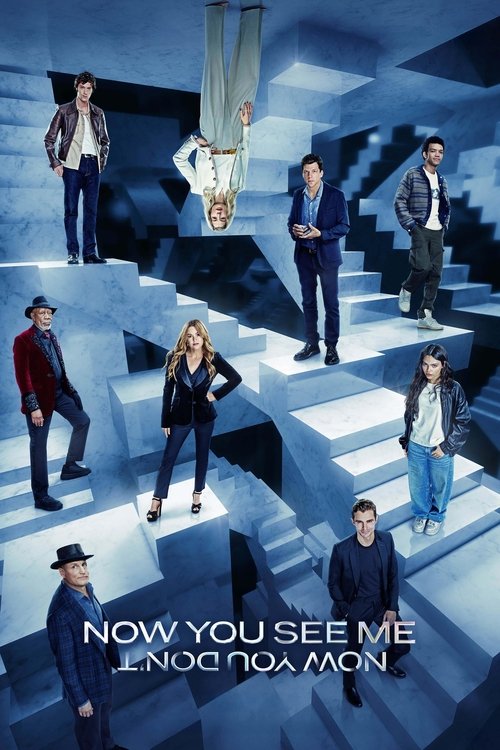
Now You See Me: Now You Don't (2025)
Directed by Ruben Fleischer
No — Now You See Me: Now You Don't is not especially woke, scoring 23 out of 100 on our wokeness meter.
Now You See Me: Now You Don't arrives as the third course in a franchise that has always preferred misdirection to depth.
Consciousness Markers
The new generation of illusionists is a deliberately diverse trio (Justice Smith, Dominic Sessa, Ariana Greenblatt), and the cast includes a South African supporting player, though the diversity is presented as natural ensemble composition rather than a stated theme.
The villain runs a South African diamond empire built on laundering and trafficking, and the hero pledges to return the stolen proceeds 'to the people of South Africa,' giving the heist a mild post-colonial wealth-redistribution framing.
The targets are a corrupt crypto exchange owner and a diamond heiress running a criminal money-laundering empire, and the heroes redistribute stolen funds, though this is standard heist-genre Robin Hood framing rather than an explicit economic critique.
Women occupy capable roles (Greenblatt's lockpicker, Fisher's escapologist, Caplan's disguise specialist) and the antagonist is a powerful female heiress, but the film makes no explicit feminist argument.
The film is primarily a twist-driven caper, with only a brief closing gesture toward justice for South Africa's exploited diamond wealth rather than sustained moralizing.
No LGBTQ+ characters, relationships, or themes appear anywhere in the plot or cast.
No environmental or climate themes are present in the story.
No body-positivity themes or messaging appear in the film.
No neurodivergent characters or themes are depicted or referenced.
The film is a contemporary fictional heist with no historical revisionism.
Why it received this score
Now You See Me: Now You Don't arrives as the third course in a franchise that has always preferred misdirection to depth. The original Horsemen reunite, older and wearier, beside a new trio played by Justice Smith, Dominic Sessa, and Ariana Greenblatt. This generational handoff is diverse in a quiet, matter-of-fact way. A South African supporting player appears without fanfare. The film treats this as casting, not as a thesis. No one pauses to explain why the ensemble looks the way it does, which is its own small mercy. The plot concerns a diamond heiress, a corrupt crypto exchange owner, and a heist that moves from Antwerp to Abu Dhabi with the efficiency of a luxury rail timetable.
Women in the film are competent without being argumentative about it. Greenblatt picks locks, Isla Fisher escapes restraints, Lizzy Caplan disappears into disguises, and Rosamund Pike's Veronika Vanderberg runs a criminal empire with cold assurance. The screenplay never converts these facts into a manifesto. Its racial conscience is similarly glancing. Veronika's South African diamond company launders money and traffics in misery. Charlie's final pledge to return stolen proceeds to the people of South Africa gives the caper a faint post-colonial accounting. The economic politics are standard Robin Hood material. Rich crooks are robbed, funds are redistributed, and the audience is invited to feel good about the arithmetic. A brief closing gesture toward justice is the film's only sustained sermon, and it lasts about as long as a card trick.
The absences are as telling as the presences. There are no LGBTQ themes, no climate anxieties, no body-positive messaging, no neurodivergent characters, and no revisionist history. This is a contemporary fictional heist, not a historical corrective. The result is a mixed bag that opened at number one and will likely be remembered as a sequel with better timing than ideas. It wants credit for a conscience it wears lightly. The film is not preachy. It is merely polite about its progressive touches, like a host who has placed a single organic grape on an otherwise conventional cheese board.
Analysis generated by our Consciousness Algorithm
Part of


Synopsis
The original Four Horsemen reunite with a new generation of illusionists to take on powerful diamond heiress Veronika Vanderberg, who leads a criminal empire built on money laundering and trafficking. The new and old magicians must overcome their differences to work together on their most ambitious heist yet.
Questions about Now You See Me: Now You Don't
Is Now You See Me: Now You Don't woke?
No — Now You See Me: Now You Don't is not especially woke, scoring 23 out of 100 on our wokeness meter. That earns it a verdict of Based.
Does Now You See Me: Now You Don't have any woke elements?
3 of the 10 markers register at 30 or above, led by Representation Casting (42), Racial Consciousness (35) and Eat the Rich (30). On Representation Casting: The new generation of illusionists is a deliberately diverse trio (Justice Smith, Dominic Sessa, Ariana Greenblatt), and the cast includes a South African supporting player, though the diversity is presented as natural ensemble composition rather than a stated theme.
How does Now You See Me: Now You Don't compare to other 2025 movies?
It ranks #87 of the 217 films from 2025 we've scored; their average is 26. The wokest is STRAW (92).
Is Now You See Me: Now You Don't the most woke Now You See Me movie?
Yes. It scores highest of the 3 Now You See Me films we've scored.