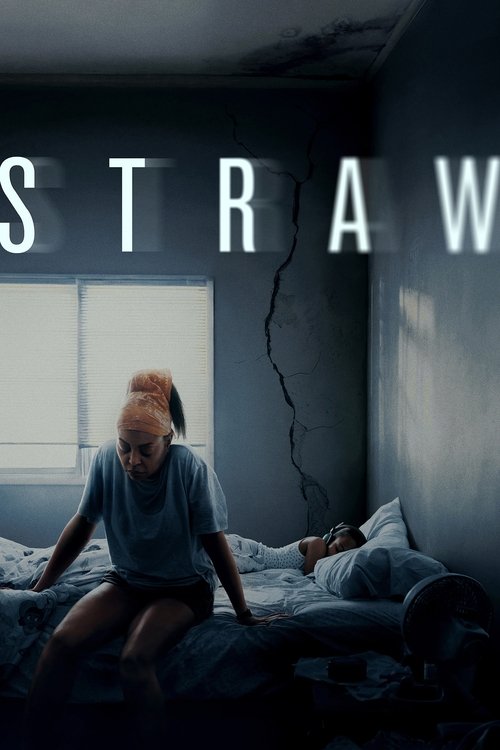
STRAW (2025)
Directed by Tyler Perry
Yes — STRAW is very woke, scoring 92 out of 100 on our wokeness meter.
Tyler Perry's STRAW arrives as a catalog of indignities arranged in ascending order of severity.
Consciousness Markers
The plot is a cascade of systemic injustice visited on a Black single mother: police intimidation, CPS removal, WIC humiliation, and a public rally demanding 'Free Janiyah.' The criminal-justice and welfare systems are framed as structurally hostile.
A predominantly Black ensemble led by Taraji P. Henson, with a Black director and Black production studio, centering a Black community's story. The casting reflects the narrative's world rather than a self-conscious diversity checklist, keeping it below the highest tier.
The film indicts economic systems throughout: a landlord threatening eviction, a boss withholding paychecks, WIC bureaucracy, and a bank refusing to cash a check. The grinding machinery of money against the poor is the engine of the plot.
Tyler Perry's social-issue melodrama is built to make the audience feel systemic injustice, with the livestreamed standoff and public sympathy functioning as an explicit moral broadcast.
A single mother's struggle anchors the film, and women repeatedly support and protect one another (Nicole staying with Janiyah, the female detective and bank manager). The focus is maternal sacrifice and survival rather than an explicit feminist thesis.
The protagonist's grief-induced hallucination of her dead daughter is a psychological-thriller device rather than a depiction of neurodivergence as identity or advocacy.
No LGBTQ+ characters, relationships, or themes appear anywhere in the plot or cast.
No environmental or climate themes are present.
No body-positivity themes or messaging appear.
The film is a contemporary fictional drama with no historical revisionism.
Why it received this score
Tyler Perry's STRAW arrives as a catalog of indignities arranged in ascending order of severity. Taraji P. Henson plays Janiyah, a single mother in Atlanta whose day begins with a landlord's eviction threat and ends with a hostage standoff in a bank lobby. Between those poles sit a WIC dispute at the grocery store, a boss who withholds her paycheck out of spite, a school that summons Child Protective Services, a traffic stop engineered by a vengeful off-duty officer, and an eviction that scatters her furniture onto the sidewalk. The construction is deliberate. Each scene tightens a vise, and Perry wants us to feel the tightening.
The political architecture is unmistakable. Welfare bureaucracy, wage theft, predatory landlords, and the criminal justice apparatus all receive their moment in the dock. The film does not argue that these systems malfunction. It argues that they function. When a crowd gathers outside the bank chanting for Janiyah's release, and when a teller secretly livestreams the standoff to a sympathetic public, the movie converts private catastrophe into public referendum. The sermon arrives without a pulpit. Perry simply stacks the evidence until the audience has no room left to doubt the verdict. A Black ensemble carries the whole weight, led by Henson and supported by Sherri Shepherd, Teyana Taylor, and Glynn Turman, and the casting feels like the world of the story instead of a quota sheet.
Then comes the twist, which reframes everything. Aria, the ill daughter who motivates every frantic decision, died the night before. She was a hallucination. This is a psychological device, not an argument about mental health, and the film treats grief as narrative machinery. Instead, the quiet solidarity of women lingers: Nicole the bank manager who stays behind, the detective who negotiates, the neighbor who offers money. The film has no use for queer lives, no interest in the climate, no comment on body image. Its obsessions are narrower: money, race, mothers, and the American habit of punishing the poor for being poor. Exhausting, sincere, and entirely certain of its own righteousness.
Analysis generated by our Consciousness Algorithm


Synopsis
What will be her last straw? A devastatingly bad day pushes a hardworking single mother to the breaking point — and into a shocking act of desperation.
Questions about STRAW
Is STRAW woke?
Yes — STRAW is very woke, scoring 92 out of 100 on our wokeness meter. That earns it a verdict of Peak Woke.
What makes STRAW woke?
5 of the 10 markers register at 30 or above, led by Racial Consciousness (75), Representation Casting (65) and Eat the Rich (60). On Racial Consciousness: The plot is a cascade of systemic injustice visited on a Black single mother: police intimidation, CPS removal, WIC humiliation, and a public rally demanding 'Free Janiyah.' The criminal-justice and welfare systems are framed as structurally hostile.
How does STRAW compare to other 2025 movies?
It is the wokest of the 217 films from 2025 we've scored; their average is 26.
How is the Woke Score calculated?
An AI-assisted process researches the film and its reception, scores it 0–100 on ten markers, then combines those into one 0–100 Woke Score. It measures a specific set of 2020s cultural themes, not film quality.