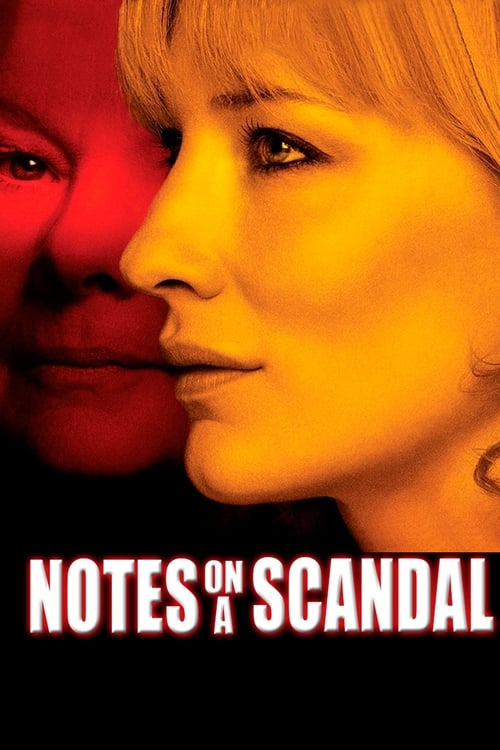
Notes on a Scandal (2006)
Directed by Richard Eyre
No — Notes on a Scandal is not woke, scoring 12 out of 100 on our wokeness meter.
Notes on a Scandal arrives from 2006, which in the taxonomy of contemporary cultural markers is roughly the Jurassic.
Consciousness Markers
Barbara's obsession with Sheba is explicitly coded as repressed lesbian desire, confirmed by her sister's pointed insinuation and her own 'I need more than a friend' declaration. The theme is central but framed as pathology rather than affirmation.
The film is built around two complex female leads, but its subject is obsession, manipulation, and self-deception rather than any feminist thesis. Strong female characters alone do not constitute an agenda.
The film offers faint class observation of British liberal-left middle-class life, but it is descriptive anthropology rather than an anti-capitalist or eat-the-rich polemic.
Sheba's young son is described as having special needs, a background detail that adds domestic strain but is never explored as a neurodivergence theme.
The film is a cold, unsentimental chamber drama that observes its characters' moral failures without preaching. It is deliberately 'post-politically correct' and offers no didactic messaging.
The cast is almost entirely white British, with no meaningful racial or ethnic diversity in the principal or supporting roles. Casting reflects the source material's milieu without any representational intent.
No engagement with race, racial identity, or racial politics whatsoever. The narrative is confined to a white, middle-class London setting.
No environmental or climate themes appear in the film.
No body-positivity themes or messaging are present.
The film is a contemporary psychological drama with no historical revisionism or reframing of past events.
Why it received this score
Notes on a Scandal arrives from 2006, which in the taxonomy of contemporary cultural markers is roughly the Jurassic. Richard Eyre directs a chamber piece about Barbara Covett, a history teacher nearing retirement with a diary and a grudge, and Sheba Hart, the new art teacher who is sleeping with a fifteen-year-old pupil while her older husband waits at home. Judi Dench and Cate Blanchett circle each other for ninety minutes with the patience of two predators who have read the same book. The film is cold, precise, and entirely uninterested in instructing its audience.
The single strand of modern sensibility here is Barbara's desire, which is unmistakably romantic and unmistakably denied. Her sister asks pointed questions at Christmas. Barbara stiffens. Later she says she needs more than a friend. The film treats this as a symptom of loneliness curdling into predation, not as an identity to be celebrated, which is why it registers as a theme without registering as advocacy. Two formidable women at the center of a story, meanwhile, does not a thesis make; the subject is obsession, blackmail, and self-deception, and the film knows it.
Elsewhere the cupboard is bare. There is no racial consciousness, no climate anxiety, no body politics, no reimagining of history. A special-needs son provides domestic strain and nothing more. The Washington Post read the whole thing as anthropology of the British liberal middle class, which is fair, though anthropology is not a manifesto. And crucially, the film refuses to sermonize. It hands us a teacher who commits a crime and a colleague who weaponizes it, and it refuses to tell us which one to despise. The final scene, with Barbara selecting her next young woman from a newspaper, suggests the lesson will not be learned. Some films lecture. This one just watches.
Analysis generated by our Consciousness Algorithm
Part of


Synopsis
A veteran high school teacher befriends a younger art teacher, who is having an affair with one of her 15-year-old students. However, her intentions with this new "friend" also go well beyond platonic friendship.
Questions about Notes on a Scandal
Is Notes on a Scandal woke?
No — Notes on a Scandal is not woke, scoring 12 out of 100 on our wokeness meter. That earns it a verdict of Ultra Based.
Does Notes on a Scandal have any woke elements?
1 of the 10 markers register at 30 or above, led by LGBTQ+ Themes (40). On LGBTQ+ Themes: Barbara's obsession with Sheba is explicitly coded as repressed lesbian desire, confirmed by her sister's pointed insinuation and her own 'I need more than a friend' declaration.
How does Notes on a Scandal compare to other 2006 movies?
It ranks #60 of the 211 films from 2006 we've scored; their average is 11. The wokest is An Inconvenient Truth (92).
How is the Woke Score calculated?
An AI-assisted process researches the film and its reception, scores it 0–100 on ten markers, then combines those into one 0–100 Woke Score. It measures a specific set of 2020s cultural themes, not film quality.