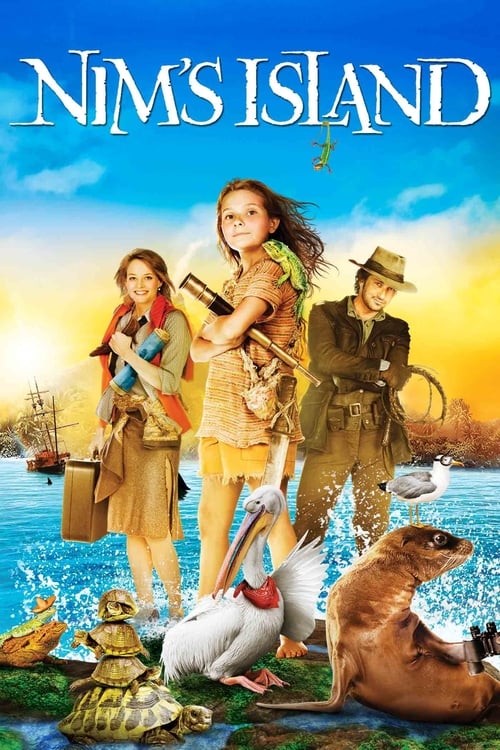
Nim's Island (2008)
Directed by Jennifer Flackett
No — Nim's Island is not woke, scoring 15 out of 100 on our wokeness meter.
Nim's Island arrives from 2008, a year before cultural criticism became a full-contact sport, and it carries the soft progressive instincts of its era like a cardigan worn to a beach.
Consciousness Markers
Co-directed by Jennifer Flackett and centered on a resourceful young girl and a woman overcoming her fears, the film offers mild female-empowerment framing but never articulates a feminist thesis.
Jodie Foster's Alexandra Rover is a prominent agoraphobe whose anxiety disorder is central to her arc, though the film frames it as a personal hurdle rather than neurodivergent identity.
The cruise-liner crew scheming to turn the pristine island into a tourist resort is treated as villainy, giving a mild anti-development, anti-tourism streak without any systemic critique.
The cast is predominantly white, with a few supporting actors of color (Alphonso McAuley, Jay Laga'aia) present without any commentary on their presence; diversity is incidental rather than a stated aim.
The story carries gentle morals about courage and family, but it delivers them through adventure rather than preachy sermonizing.
A marine-biologist father and a nanoplankton discovery gesture at environmental science, but the film makes no climate or ecological argument.
The Pacific-island setting and a handful of non-white supporting players exist as backdrop; race is never examined or made a theme.
No LGBTQ+ characters, themes, or subtext appear anywhere in the film.
No body-image or body-positivity themes are present.
The film is a contemporary children's fantasy with no historical subject matter to revise.
Why it received this score
Nim's Island arrives from 2008, a year before cultural criticism became a full-contact sport, and it carries the soft progressive instincts of its era like a cardigan worn to a beach. Jennifer Flackett co-directs and co-writes, the protagonist is an 11-year-old girl with abundant resourcefulness, and the adult lead is a woman who must conquer her own terror to function. These are gestures toward empowerment. They are never assembled into an argument. The film is content to let a girl be capable and a woman be brave, which is agreeable and costs nothing.
The supporting architecture is similarly gentle. Jodie Foster's Alexandra Rover is an agoraphobe whose condition drives the plot, and the film treats her anxiety as a personal obstacle to be overcome with the help of a hallucinated adventurer, not as an identity to be honored. A cruise crew schemes to turn the island into a resort, which supplies a faint anti-development tingle without a single systemic thought behind it. The Pacific setting and the handful of non-white crew members exist as scenery. No one remarks on any of it. A marine biologist father chases nanoplankton, which nods at science without making a case for anything.
The result is a children's adventure that delivers its morals about courage and family through shipwrecks, sea lions, and a volcano, never through a lecture. That restraint is to its credit. It is a pleasant, harmless, mildly confused piece of filmmaking, and its cultural footprint is roughly that of a tide pool. The sequel recast everyone and vanished, which feels about right.
Analysis generated by our Consciousness Algorithm

Synopsis
A young girl inhabits an isolated island with her scientist father and communicates with a reclusive author of the novel she's reading.
Questions about Nim's Island
Is Nim's Island woke?
No — Nim's Island is not woke, scoring 15 out of 100 on our wokeness meter. That earns it a verdict of Ultra Based.
Does Nim's Island have any woke elements?
Very few. None of the 10 markers reaches 30, the level where a marker counts as present; the highest is Feminist Agenda at 25.
How does Nim's Island compare to other 2008 movies?
It ranks #56 of the 212 films from 2008 we've scored; their average is 12. The wokest is Milk (68).
How is the Woke Score calculated?
An AI-assisted process researches the film and its reception, scores it 0–100 on ten markers, then combines those into one 0–100 Woke Score. It measures a specific set of 2020s cultural themes, not film quality.