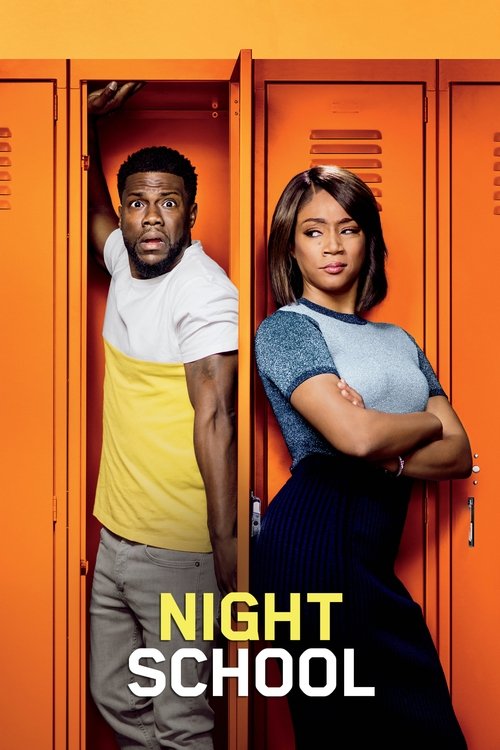
Night School (2018)
Directed by Malcolm D. Lee
No — Night School is not especially woke, scoring 32 out of 100 on our wokeness meter.
Night School arrives as a mainstream studio comedy with a predominantly Black ensemble, a fact the film treats as unremarkable, which is both to its credit and the whole of its ambition on that front.
Consciousness Markers
The central plot turn is Teddy's diagnosis with dyslexia, dyscalculia, and processing issues, and the film explicitly destigmatizes learning disabilities and the testing that identifies them.
A predominantly Black ensemble led by Kevin Hart and Tiffany Haddish anchors the film, a notable mainstream studio comedy casting choice, though the film makes no explicit comment on representation.
Tiffany Haddish's Carrie is a competent, assertive teacher and Theresa is a hardworking single mother, but the film advances no feminist thesis and treats these as comedic character traits rather than a platform.
The cast is majority Black, but the narrative is a class-clown buddy comedy that never engages race as a subject or theme.
Teddy's graduation speech about second chances and the learning-disability arc carry a mild moral, but it is delivered as light comedy rather than sermon.
A classmate is noted as having been fired from a factory and replaced by a robot, a faint gesture at economic precarity, but the film has no anti-capitalist argument.
No LGBTQ+ characters, themes, or subtext appear anywhere in the film.
No environmental themes or climate content of any kind.
No body positivity themes or messaging present.
No historical revisionism; the film is a contemporary original comedy.
Why it received this score
Night School arrives as a mainstream studio comedy with a predominantly Black ensemble, a fact the film treats as unremarkable, which is both to its credit and the whole of its ambition on that front. Kevin Hart plays Teddy Walker, a grill salesman whose career detonates along with a gas tank, sending him back to a night school classroom to earn the GED he abandoned seventeen years earlier. Tiffany Haddish teaches him. The pairing should produce more sparks than it does. The commitment to a majority Black cast in a broad Universal comedy is a genuine mainstreaming gesture, unstated and uncelebrated. The film never turns that casting into an argument, and it never turns it into a joke. It simply is. There is quiet progress in that, and also a quiet nothing.
The engine of the plot, once the slapstick settles, is Teddy's diagnosis of dyslexia, dyscalculia, and assorted processing issues, a revelation handled with an earnestness that edges toward public service announcement. Learning disabilities are named, tested, and destigmatized in sequence, and the film is at its most sincere when it is explaining them. Elsewhere the social consciousness thins out. A classmate loses a factory job to a robot, a glancing nod toward economic displacement that the screenplay declines to pursue. Haddish's teacher is competent and assertive, and a classmate is a single mother of several children, but the film mines both for laughs and moves along. No environmental themes surface. No LGBTQ characters surface. No body positivity messaging surfaces. The historical record is left undisturbed.
A moral arrives gently in the final act, a graduation speech about second chances that preaches without raising its voice. The film wants to be liked. Mostly it is.
Analysis generated by our Consciousness Algorithm
Part of


Synopsis
Teddy Walker is a successful salesman whose life takes an unexpected turn when he accidentally blows up his place of employment. Forced to attend night school to get his GED, Teddy soon finds himself dealing with a group of misfit students, his former high school nemesis and a feisty teacher who doesn't think he's too bright.
Questions about Night School
Is Night School woke?
No — Night School is not especially woke, scoring 32 out of 100 on our wokeness meter. That earns it a verdict of Based.
Does Night School have any woke elements?
2 of the 10 markers register at 30 or above, led by Neurodivergence (70) and Representation Casting (60). On Neurodivergence: The central plot turn is Teddy's diagnosis with dyslexia, dyscalculia, and processing issues, and the film explicitly destigmatizes learning disabilities and the testing that identifies them.
How does Night School compare to other 2018 movies?
It ranks #66 of the 325 films from 2018 we've scored; their average is 20. The wokest is Return (92).
How is the Woke Score calculated?
An AI-assisted process researches the film and its reception, scores it 0–100 on ten markers, then combines those into one 0–100 Woke Score. It measures a specific set of 2020s cultural themes, not film quality.