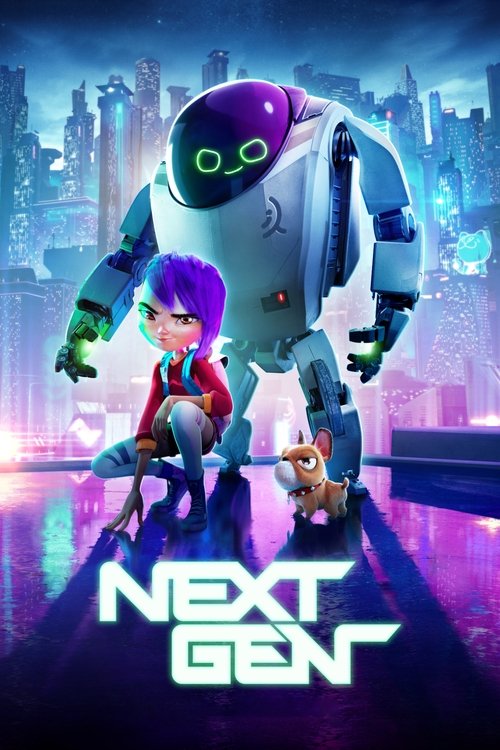
Next Gen (2018)
Directed by Kevin R. Adams
No — Next Gen is not especially woke, scoring 21 out of 100 on our wokeness meter.
A Canadian-Chinese-American co-production adapted from a rage-comic manhua, Next Gen arrives with the unearned confidence of a film that believes it invented the lonely-child-and-robot friendship.
Consciousness Markers
The protagonist Mai Su is a young Asian girl, and the voice cast is notably diverse (Lo Mutuc, Constance Wu, Michael Peña, Kiana Ledé, Anna Akana, Issac Ryan Brown), reflecting the film's Chinese-American co-production roots.
The villain is a scheming tech CEO whose IQ Robotics corporation secretly builds Q-Bots designed to explode, and the film lightly critiques society's emotional dependence on consumer robots.
A rebellious teenage girl drives the story, supported by a single divorced mother and a female bully-turned-friend, but the film never frames this as a gendered statement or agenda.
There is a mild moral about letting go of anger and the value of friendship and memory, but it is delivered through story rather than preachy sermonizing.
No LGBTQ+ characters, relationships, or themes appear anywhere in the film.
Despite the Asian protagonist and diverse cast, race is never a theme, subject, or point of commentary in the narrative.
No environmental or climate themes are present; the conflict is entirely about robots and a rogue AI.
No body positivity themes or messaging are present.
Mai is described as emotionally troubled and bullied for being a 'weirdo,' but the film never frames her through a neurodivergence lens.
The film is a futuristic sci-fi story with no historical subject matter to revise.
Why it received this score
A Canadian-Chinese-American co-production adapted from a rage-comic manhua, Next Gen arrives with the unearned confidence of a film that believes it invented the lonely-child-and-robot friendship. Mai Su is an angry thirteen-year-old in a city where sentient machines handle everything, including her mother's emotional needs. When she stumbles onto a top-secret weaponized unit called 7723, the two form a bond that requires him to delete his own weapons to keep his memories, a premise the film treats as genuinely tragic. It is a tidy piece of storytelling, rendered almost entirely in Blender, and it moves with the efficiency of something built to be streamed and forgotten by dinner.
The film's cultural positioning is modest and mostly structural. Mai is a young Asian girl, the voice cast is unusually varied, and the whole enterprise flows from Chinese source material, which is representation by way of production logistics instead of thesis. A rebellious girl anchors the story, backed by a divorced single mother and a bully who eventually softens, though nobody stops to announce a gender politics. Race never surfaces as a subject. Neither does the climate, the body, or the brain. The villain, a tech CEO whose consumer robots are secretly wired to detonate, offers the faintest gesture toward corporate malice, a shrug at our dependence on gadgets rather than a real indictment of the people selling them.
The moral arrives without a pulpit: let go of the anger, keep the memories, forgive the bullies. Commendable restraint, given the material's instincts. The result is a competent, soft-spoken science fiction fable that preaches only when it forgets itself, which is more often than it should but less often than it could. We have classified worse. We have also classified better, and we suspect the robot will not remember either way. The dog, at least, swears with a filter, which is the most honest thing in the film.
Analysis generated by our Consciousness Algorithm


Synopsis
A friendship with a top-secret robot turns a lonely girl's life into a thrilling adventure as they take on bullies, evil bots and a scheming madman.
Questions about Next Gen
Is Next Gen woke?
No — Next Gen is not especially woke, scoring 21 out of 100 on our wokeness meter. That earns it a verdict of Based.
Does Next Gen have any woke elements?
2 of the 10 markers register at 30 or above, led by Representation Casting (45) and Eat the Rich (30). On Representation Casting: The protagonist Mai Su is a young Asian girl, and the voice cast is notably diverse (Lo Mutuc, Constance Wu, Michael Peña, Kiana Ledé, Anna Akana, Issac Ryan Brown), reflecting the film's Chinese-American co-production roots.
How does Next Gen compare to other 2018 movies?
It ranks #100 of the 325 films from 2018 we've scored; their average is 20. The wokest is Return (92).
How is the Woke Score calculated?
An AI-assisted process researches the film and its reception, scores it 0–100 on ten markers, then combines those into one 0–100 Woke Score. It measures a specific set of 2020s cultural themes, not film quality.