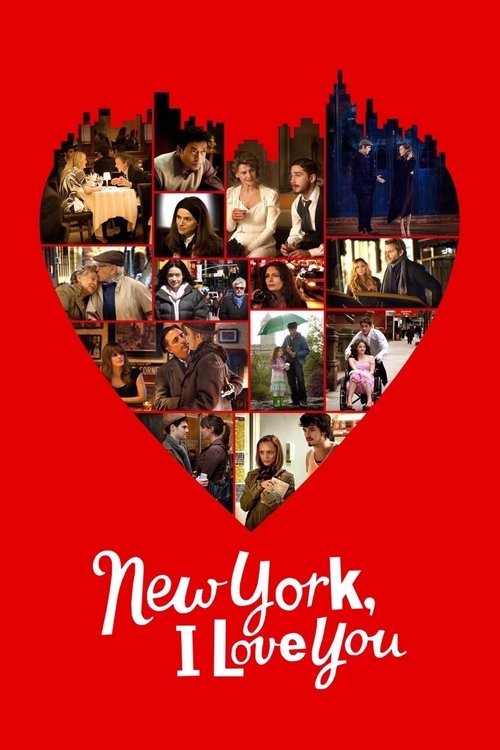
New York, I Love You (2008)
Directed by Yvan Attal
No — New York, I Love You is not especially woke, scoring 22 out of 100 on our wokeness meter.
New York, I Love You arrives as the second installment of the Cities of Love franchise, a portmanteau of eleven shorts stitched together with skyline montages and a wandering videographer who drifts through the other stories.
Consciousness Markers
The ensemble is genuinely multicultural (Irrfan Khan, Maggie Q, Shu Qi, Julie Christie, Eli Wallach), and critics singled out the 'multicultural emphasis' as a chief asset. However, this diversity is organic to a New York city-portrait rather than a self-conscious representational program.
The film's cross-cultural casting and interracial pairings give it a cosmopolitan texture, but it offers no commentary on race or racial injustice as a theme.
Several segments were directed by women (Natalie Portman, Scarlett Johansson's debut), and the film carries a 'woman director' keyword, but the content is romantic vignettes rather than a feminist thesis.
The vignettes are light romantic sketches with no preachy or didactic messaging; the film aims to charm rather than instruct.
No LGBTQ+ characters, relationships, or themes appear in any of the eleven segments.
No environmental or climate themes appear in the film.
No critique of wealth, capitalism, or class structures is present; the Diamond District and Upper East Side are simply backdrops for romance.
No body-positivity themes or messaging about body image appear.
No neurodivergent characters or themes of neurodiversity are present.
The film is a contemporary romance anthology with no historical subject matter to revise.
Why it received this score
New York, I Love You arrives as the second installment of the Cities of Love franchise, a portmanteau of eleven shorts stitched together with skyline montages and a wandering videographer who drifts through the other stories. The ensemble is deep and genuinely varied: Irrfan Khan, Maggie Q, Shu Qi and Julie Christie share the screen with Ethan Hawke, Andy Garcia, Cloris Leachman, and Eli Wallach. Two segments were directed by women, Natalie Portman and Scarlett Johansson, though Johansson's contribution was cut before release after a focus group registered its displeasure. The result is a city portrait that treats its cross-cultural pairings as ordinary texture, not as a statement.
Which is the film's quiet virtue. It casts a wide net and says almost nothing about it. Critically, the multicultural emphasis earned praise as one of the film's chief assets, and the interracial romances pass without a single line of commentary about race itself. There is no LGBTQ thread anywhere in the eleven segments, no environmental conscience, no indictment of the Diamond District or the Upper East Side, and no interest in the body or the mind as a subject for instruction. That leaves charm, lightly applied.
The critics were divided, as they tend to be with anthologies, and the box office was modest at under ten million worldwide. Roger Ebert observed that such a film cannot add up, only accumulate. He was correct. The vignettes want to flirt, not to argue, and at no point does the film mistake itself for a civic lesson. For a survey of this decade, that restraint reads as quaint. The film offers romance, a handsome city, and no instructions for living. We score accordingly, with the mildness it deserves.
Analysis generated by our Consciousness Algorithm


Synopsis
New York, I Love You delves into the intimate lives of New Yorkers as they grapple with, delight in and search for love. Journey from the Diamond District in the heart of Manhattan, through Chinatown and the Upper East Side, towards the Village, into Tribeca, and Brooklyn as lovers of all ages try to find romance in the Big Apple.
Questions about New York, I Love You
Is New York, I Love You woke?
No — New York, I Love You is not especially woke, scoring 22 out of 100 on our wokeness meter. That earns it a verdict of Based.
Does New York, I Love You have any woke elements?
2 of the 10 markers register at 30 or above, led by Representation Casting (50) and Racial Consciousness (30). On Representation Casting: The ensemble is genuinely multicultural (Irrfan Khan, Maggie Q, Shu Qi, Julie Christie, Eli Wallach), and critics singled out the 'multicultural emphasis' as a chief asset.
How does New York, I Love You compare to other 2008 movies?
It ranks #28 of the 212 films from 2008 we've scored; their average is 12. The wokest is Milk (68).
How is the Woke Score calculated?
An AI-assisted process researches the film and its reception, scores it 0–100 on ten markers, then combines those into one 0–100 Woke Score. It measures a specific set of 2020s cultural themes, not film quality.