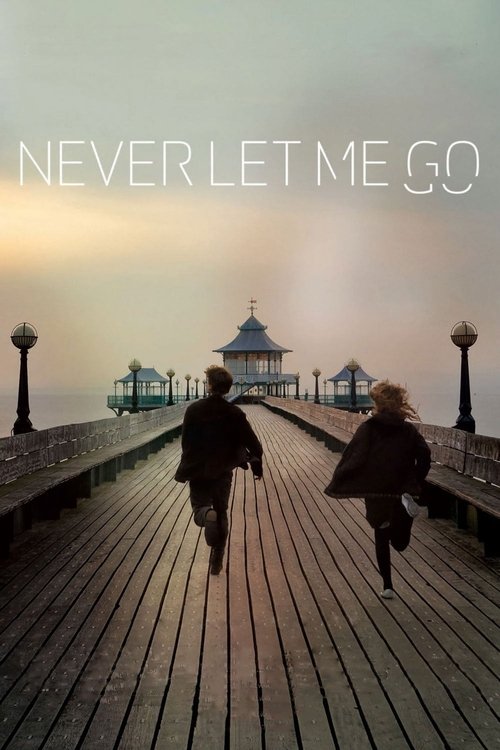
Never Let Me Go (2010)
Directed by Mark Romanek
No — Never Let Me Go is not woke, scoring 13 out of 100 on our wokeness meter.
Never Let Me Go arrives with a solemnity that is almost architectural.
Consciousness Markers
The premise critiques a society that manufactures a disposable class of beings to be harvested for the benefit of others, with the 'battery farm' comparison gesturing at systemic commodification, though it is framed as medical ethics rather than economic polemic.
The story is anchored by a female narrator and protagonist whose interior life drives the film, but it offers no explicit feminist thesis or gender-politics critique.
The film is deliberately restrained and understated, raising moral questions through quiet drama rather than preaching; only Miss Lucy's brief revelation carries any expository weight.
The cast is almost entirely white British performers; there is no deliberate diverse or color-conscious casting agenda at work.
The love triangle and relationships are entirely heterosexual; no LGBTQ+ themes or characters appear.
Race is never a subject of the film; the clone underclass is defined by biology, not ethnicity, and no racial consciousness is present.
No environmental or climate themes appear anywhere in the narrative.
No body-positivity themes or messaging are present.
Tommy's emotional outbursts are framed as existential anguish and sensitivity, not as neurodivergence or a condition to be named or celebrated.
The film is set in an alternate history, but this is speculative world-building rather than a reinterpretation of real history through a modern ideological lens.
Why it received this score
Never Let Me Go arrives with a solemnity that is almost architectural. Mark Romanek's adaptation of Kazuo Ishiguro's novel is a love story set among clones raised to donate organs, and it plays its speculative premise with the hush of a period drama. The cast is white British throughout, and the film makes no effort to color the arrangement with contemporary casting logic. There is no LGBTQ current in the Kathy-Ruth-Tommy triangle, no racial framing for the clone underclass, no climate anxiety, and no body-positivity or neurodivergence subplot. Tommy's outbursts read as existential grief, not a condition to be diagnosed and celebrated. These absences are not failures of nerve. They indicate a film with little interest in the cultural checklist of its own moment.
The softest progressive pulse comes from Kathy's narration. Carey Mulligan carries the film through her interior life, and the story belongs to her memory and endurance. That gives the picture a feminine center without a feminist thesis. The social criticism is likewise glancing. The clones are a disposable class, harvested for the comfort of others, and the battery-farm line invites a reading about commodification. But the film treats this as medical ethics and human rights, not as an economic sermon. It is too polite to eat the rich, and too sad to organize a boycott.
On the preaching scale, the film is nearly silent. Miss Lucy has a brief revelation, and the rest is conveyed through glances, beaches, and unspoken resignation. The alternate-history setting is pure speculative world-building, not a revisionist reading of real events. Romanek keeps the science fiction as a faint patina and lets the moral questions sit in the room without a lecture. The result is a restrained, beautifully acted exercise in quiet dread. It earns its sadness honestly and asks for no ideological receipt.
Analysis generated by our Consciousness Algorithm
Part of


Synopsis
As children, Kathy, Ruth, and Tommy spend their childhood at an idyllic and secluded English boarding school. As they grow into adults, they must come to terms with the complexity and strength of their love for one another while also preparing for the haunting reality awaiting them.
Questions about Never Let Me Go
Is Never Let Me Go woke?
No — Never Let Me Go is not woke, scoring 13 out of 100 on our wokeness meter. That earns it a verdict of Ultra Based.
Does Never Let Me Go have any woke elements?
Very few. None of the 10 markers reaches 30, the level where a marker counts as present; the highest is Eat the Rich at 20.
How does Never Let Me Go compare to other 2010 movies?
It ranks #63 of the 238 films from 2010 we've scored; their average is 11. The wokest is My Name Is Khan (84).
How is the Woke Score calculated?
An AI-assisted process researches the film and its reception, scores it 0–100 on ten markers, then combines those into one 0–100 Woke Score. It measures a specific set of 2020s cultural themes, not film quality.