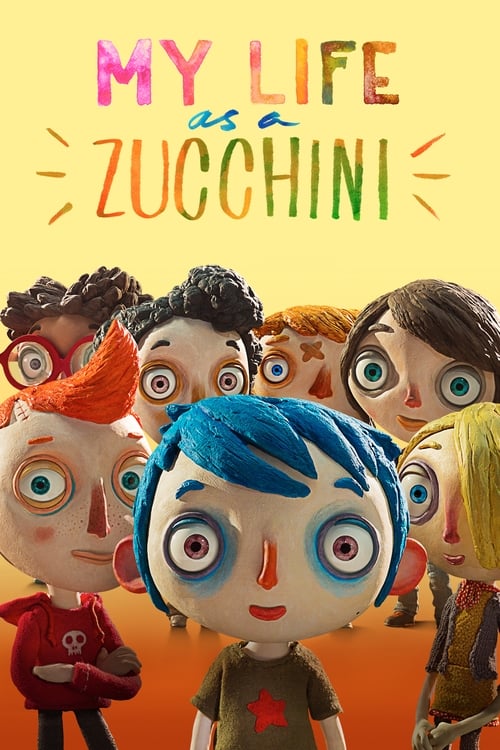
My Life as a Zucchini (2016)
Directed by Claude Barras
No — My Life as a Zucchini is not woke, scoring 7 out of 100 on our wokeness meter.
My Life as a Zucchini arrives from Switzerland with stop-motion puppets, a title that sounds like a side dish, and a body count.
Consciousness Markers
The orphanage ensemble includes children of varied appearances, but this diversity arises naturally from the setting rather than any deliberate representational program.
Camille is a resilient girl who outmaneuvers her abusive aunt, but the film frames this as character drama rather than a feminist statement.
The film is a gentle, observational portrait of childhood trauma and found family; it earns its emotion through story rather than preaching.
The aunt's custody bid is motivated purely by the money she'd receive, offering a faint note of greed critique, but it is a plot device rather than an economic argument.
No LGBTQ+ characters, themes, or subtext appear anywhere in the film.
Race is never addressed or thematized; the children's traumas are framed entirely around family and class.
No environmental or climate themes are present.
No body-positivity themes or messaging.
Raymond's estranged son is described as never talking to him, but this is not developed as a neurodivergence theme.
The film is a contemporary fictional story with no historical revisionism.
Why it received this score
My Life as a Zucchini arrives from Switzerland with stop-motion puppets, a title that sounds like a side dish, and a body count. A boy accidentally kills his alcoholic mother by closing an attic door on her, and the film then deposits him in a state orphanage filled with children whose parents are dead, imprisoned, or worse. This is grim material, and it is handled with a restraint that has become unusual. Nobody stands up to deliver a thesis. The camera simply watches.
The orphanage ensemble is visually varied, though the variety comes from the setting itself. Put twelve children in a room and you will get twelve faces. There is no casting program at work here, no checklist being serviced. Camille, the new arrival, is a tough and resourceful girl who outmaneuvers a grasping aunt, but the film treats that as character, not commentary. The aunt wants custody for the money she will collect, which registers as a small, sour note about greed. It is a plot device. It is not an argument about the economics of care, and it never pretends to be one. The customary apparatus of social instruction is simply absent from the proceedings.
The film builds its feeling honestly, through the slow accretion of small objects. A beer can refashioned into a toy boat. A kite bearing a drawing of a father as a superhero. A group photograph carried away from the place that made it. It never lectures, and it never asks for our approval. What remains is a modest, well-made picture about damaged children finding each other, and that is sufficient. The classification is straightforward. The file can be closed.
Analysis generated by our Consciousness Algorithm


Synopsis
After his mother’s death, Zucchini is befriended by a kind police officer, Raymond, who accompanies him to his new foster home filled with other orphans his age. There, with the help of his newfound friends, Zucchini eventually learns to trust and love as he searches for a new family of his own.
Questions about My Life as a Zucchini
Is My Life as a Zucchini woke?
No — My Life as a Zucchini is not woke, scoring 7 out of 100 on our wokeness meter. That earns it a verdict of Ultra Based.
Does My Life as a Zucchini have any woke elements?
Very few. None of the 10 markers reaches 30, the level where a marker counts as present; the highest is Representation Casting at 15.
How does My Life as a Zucchini compare to other 2016 movies?
It ranks #190 of the 285 films from 2016 we've scored; their average is 16. The wokest is 13th (92).
How is the Woke Score calculated?
An AI-assisted process researches the film and its reception, scores it 0–100 on ten markers, then combines those into one 0–100 Woke Score. It measures a specific set of 2020s cultural themes, not film quality.