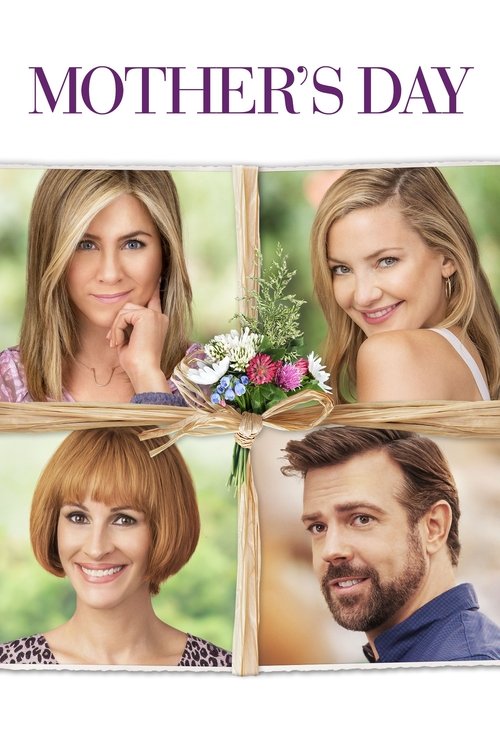
Mother's Day (2016)
Directed by Garry Marshall
Partly — Mother's Day is somewhat woke, scoring 44 out of 100 on our wokeness meter.
Garry Marshall's final outing as a director assembles a large cast in Atlanta and lets them orbit the gravitational pull of a greeting-card holiday.
Consciousness Markers
A lesbian couple (Gabi and her wife Max, raising a son) is a concrete plot strand, and the film stages a confrontation with their homophobic parents who must 'come to terms' with the relationship.
The ensemble is deliberately multi-ethnic, pairing a white woman with an Indian husband and including Black and Latina performers in supporting roles, though the diversity is largely decorative rather than thematic.
An interracial marriage and a subplot in which racist, homophobic parents are confronted and made to accept their daughters' choices give the film a mild racial-consciousness thread.
Single mothers, a career-driven author, and female friendship anchor the plot, but the film remains a traditional Garry Marshall rom-com that resolves women's arcs through romance and motherhood.
The bigoted-parents subplot carries some moralizing confrontation, but the film is too featherweight and diffuse to sustain genuine lecture energy.
No environmental or climate themes appear anywhere in the film.
No critique of wealth, capitalism, or class structures is present; the film is a mainstream studio comedy.
No body-positivity themes or commentary on body image are present.
No neurodivergent characters or themes are depicted.
The film makes no historical claims or revisions; it is a contemporary-set ensemble comedy.
Why it received this score
Garry Marshall's final outing as a director assembles a large cast in Atlanta and lets them orbit the gravitational pull of a greeting-card holiday. Three generations, several divorces, one widower, an adoption reunion, and a great deal of scheduling. The ensemble is studiously multi-ethnic: a white woman married to an Indian man, Black and Latina performers in the supporting ranks, an interracial marriage treated as unremarkable. Whether any of this constitutes a thesis is doubtful. It reads as a studio casting spreadsheet rendered in flesh.
Then there is the strand that gives the picture its only genuine spine of social argument. Kate Hudson's Jesse and her sister Gabi arrive with partners chosen against the wishes of Earl and Florence, parents whose racism and homophobia are presented plainly and then dismantled over a picnic table and a Skype call. Gabi's wife Max and their son are not a punchline. The film asks the older generation to accept their daughters, and it does so with a straight face. This is not nothing. It is, however, brief, and it sits inside a machine built to sell reconciliation as a Mother's Day card.
Elsewhere the film is content to be weightless. There is no environmental conscience, no quarrel with money or class, no interest in body image, no neurodivergent character, and no historical claim of any kind. Women here are single mothers, authors, and designers, and nearly all of them are resolved through a man, a marriage, or a child. The moralizing that does occur is soft-edged and quickly forgotten, more Hallmark than sermon. The critics were unkind, and the Razzie voters unkinder. Marshall died months later, leaving behind a pleasant, shapeless thing, faintly progressive by accident and entirely of its moment.
Analysis generated by our Consciousness Algorithm
Part of


Synopsis
Three generations come together in the week leading up to Mother's Day.
Questions about Mother's Day
Is Mother's Day woke?
Partly — Mother's Day is somewhat woke, scoring 44 out of 100 on our wokeness meter. That earns it a verdict of Woke-Adjacent.
What makes Mother's Day woke?
5 of the 10 markers register at 30 or above, led by LGBTQ+ Themes (60), Representation Casting (55) and Racial Consciousness (50). On LGBTQ+ Themes: A lesbian couple (Gabi and her wife Max, raising a son) is a concrete plot strand, and the film stages a confrontation with their homophobic parents who must 'come to terms' with the relationship.
How does Mother's Day compare to other 2016 movies?
It ranks #20 of the 285 films from 2016 we've scored; their average is 16. The wokest is 13th (92).
How is the Woke Score calculated?
An AI-assisted process researches the film and its reception, scores it 0–100 on ten markers, then combines those into one 0–100 Woke Score. It measures a specific set of 2020s cultural themes, not film quality.