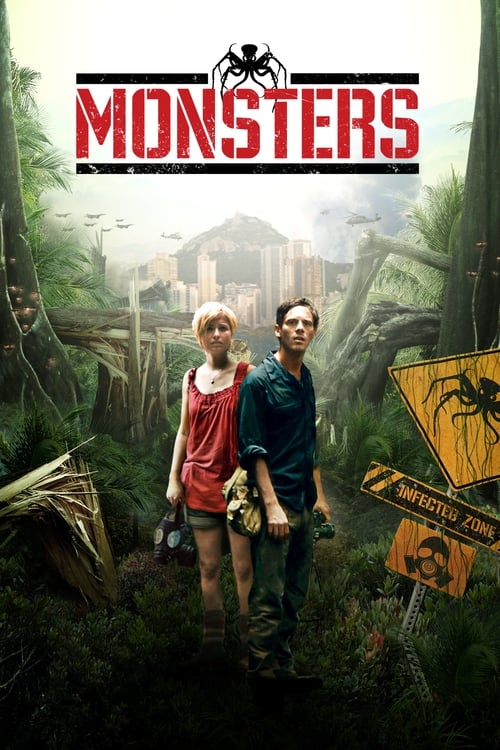
Monsters (2010)
Directed by Gareth Edwards
No — Monsters is not woke, scoring 9 out of 100 on our wokeness meter.
Gareth Edwards made his feature debut with a monster movie that declines to behave like one.
Consciousness Markers
The quarantine zone and border wall carry a faint immigration allegory that critics noted as 'sloppy politics,' but the film never articulates racial or border consciousness explicitly and treats the wall largely as scenery.
The leads are white American actors; the Latin American setting supplies countless local non-actors as organic set dressing rather than deliberate inclusive casting with commentary. No representational intent is foregrounded.
The film is deliberately atmospheric and quiet, focused on relationship drama and awe rather than messaging. Any political subtext is buried well beneath the surface; critics noted the premise is underused rather than lectured.
Samantha is a passive tourist bartered over and escorted to safety; her arc is about being moved from point A to B. No feminist framing or commentary is present.
No LGBTQ+ characters, themes, or subtext whatsoever.
No environmental or climate themes. The alien infestation is a monster-movie premise, not an ecological parable.
Journalist employer and military apparatus exist as plot furniture, not targets of economic critique. No eat-the-rich energy.
No body positivity content of any kind.
No depiction or discussion of neurodivergence.
No historical revisionism; the film is an original speculative fiction premise, not a reframing of real history.
Why it received this score
Gareth Edwards made his feature debut with a monster movie that declines to behave like one. The creatures arrive, half of Mexico is quarantined, and then the film settles into the quiet business of two people walking toward a wall. There is no sermon here. No character pauses to explain what the infestation says about us. The picture is content to let a giant dead thing in the water be ordinary, which is a rarer ambition than it sounds.
The casting deserves a moment. Edwards shot across five countries with a crew of six, and most of the faces on screen are locals who happened to be standing there when the camera rolled, their dialogue improvised on the spot. This is thrift, not representational intent. The film treats its Latin American setting as atmosphere, a backdrop of market stalls and checkpoints. The border wall gestures toward an immigration parable, though critics at the time dismissed the politics as sloppy, and they were not wrong. The allegory sits there unexamined, more scenery than argument.
Samantha, meanwhile, is escorted, bartered over, and moved from one point to another, her engagement ring traded for passage. Her arc is logistical. The film shows no interest in gender as a subject, no interest in sexuality, economics, ecology, or the interior lives of anyone who is not one of the two Americans at its center. Only mood remains, and mood is not a cause. A patient, melancholy road movie with tentacles, offering not a single lesson to be extracted from it. The classification is straightforward. There is very little here to classify.
Analysis generated by our Consciousness Algorithm


Synopsis
Six years ago NASA discovered the possibility of alien life within our solar system. A probe was launched to collect samples, but crashed upon re-entry over Central America. Soon after, new life forms began to appear and half of Mexico was quarantined as an infected zone. Today, the American and Mexican military still struggle to contain "the creatures," while a journalist agrees to escort a shaken tourist through the infected zone in Mexico to the safety of the U.S. border.
Questions about Monsters
Is Monsters woke?
No — Monsters is not woke, scoring 9 out of 100 on our wokeness meter. That earns it a verdict of Ultra Based.
Does Monsters have any woke elements?
Very few. None of the 10 markers reaches 30, the level where a marker counts as present; the highest is Racial Consciousness at 20.
How does Monsters compare to other 2010 movies?
It ranks #88 of the 238 films from 2010 we've scored; their average is 11. The wokest is My Name Is Khan (84).
How is the Woke Score calculated?
An AI-assisted process researches the film and its reception, scores it 0–100 on ten markers, then combines those into one 0–100 Woke Score. It measures a specific set of 2020s cultural themes, not film quality.