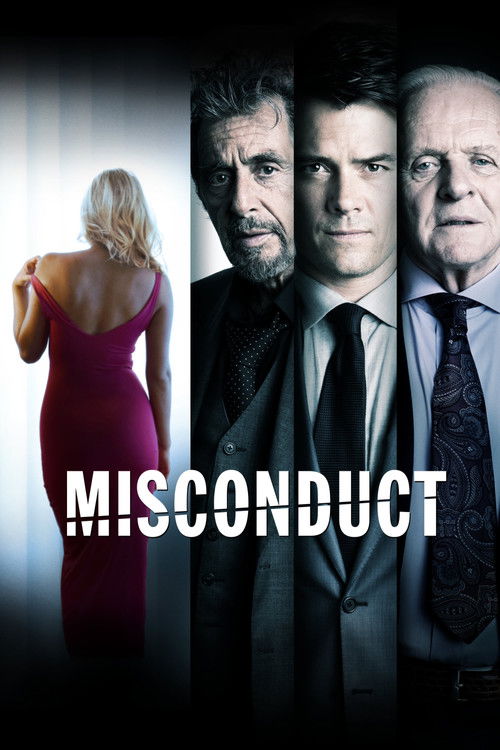
Misconduct (2016)
Directed by Shintaro Shimosawa
No — Misconduct is not woke, scoring 8 out of 100 on our wokeness meter.
The veneer of social consciousness in Misconduct is thin, a surprisingly fragile coating applied to a standard neo-noir framework.
Consciousness Markers
A corrupt pharmaceutical executive and a class-action lawsuit gesture at corporate malfeasance, but this is standard thriller plotting rather than a systemic anti-capitalist critique.
The cast includes a few minority performers (Lee Byung-hun, Skye P. Marshall, Gregory Alan Williams), but they exist naturally in the story with no commentary or representational agenda.
Female characters exist as victims and a complicit wife; there is no feminist framing or critique of patriarchy.
A by-the-numbers thriller that entertains rather than preaches; no overt moral lecturing to the audience.
No LGBTQ+ characters, themes, or subtext appear anywhere in the film.
Race is never a subject of the film; the diverse casting carries no racial consciousness.
No environmental or climate themes are present.
No body positivity themes or messaging.
No neurodivergent characters or themes.
The film is a fictional neo-noir and makes no historical revisionist claims.
Why it received this score
The veneer of social consciousness in Misconduct is thin, a surprisingly fragile coating applied to a standard neo-noir framework. We are presented with a series of high-stakes corporate battles and personal tragedies, but the film avoids engaging with the specific cultural anxieties of our current era. The characters, while existing within a diverse landscape, do not utilize their casting to advance any progressive agenda; their presence is purely functional. The subplot concerning the pharmaceutical executive and the class-action lawsuit reaches a meager twenty percent on the scale of social awareness. This is a generic thriller that uses corporate malfeasance as a mere plot device, not as a foundation for systemic critique.
The female characters are restricted to roles as victims or complicit spouses, scoring a modest eight for their representation. There is no feminist lens here, only the standard dramatic friction between ambition and survival. The narrative maintains a low lecture energy, functioning as a straightforward, if somewhat derivative, piece of entertainment. The film is caught between the desire to be a hard-edged drama and the pull toward contemporary progressive sensibility, settling somewhere in the middle with little conviction.
Ultimately, Misconduct is a competent, if uninspired, thriller. It is a movie that does not try to say anything important about the state of the world, which is perhaps its most commendable trait. It delivers the suspense expected of its genre, providing a functional, if unchallenging, viewing experience without overreaching its thematic boundaries.
Analysis generated by our Consciousness Algorithm
Part of


Synopsis
An ambitious lawyer finds himself caught in a power struggle between a corrupt pharmaceutical executive and his firm’s senior partner. When the case takes a deadly turn, he must race to uncover the truth before he loses everything.
Questions about Misconduct
Is Misconduct woke?
No — Misconduct is not woke, scoring 8 out of 100 on our wokeness meter. That earns it a verdict of Ultra Based.
Does Misconduct have any woke elements?
Very few. None of the 10 markers reaches 30, the level where a marker counts as present; the highest is Eat the Rich at 20.
How does Misconduct compare to other 2016 movies?
It ranks #170 of the 285 films from 2016 we've scored; their average is 16. The wokest is 13th (92).
How is the Woke Score calculated?
An AI-assisted process researches the film and its reception, scores it 0–100 on ten markers, then combines those into one 0–100 Woke Score. It measures a specific set of 2020s cultural themes, not film quality.