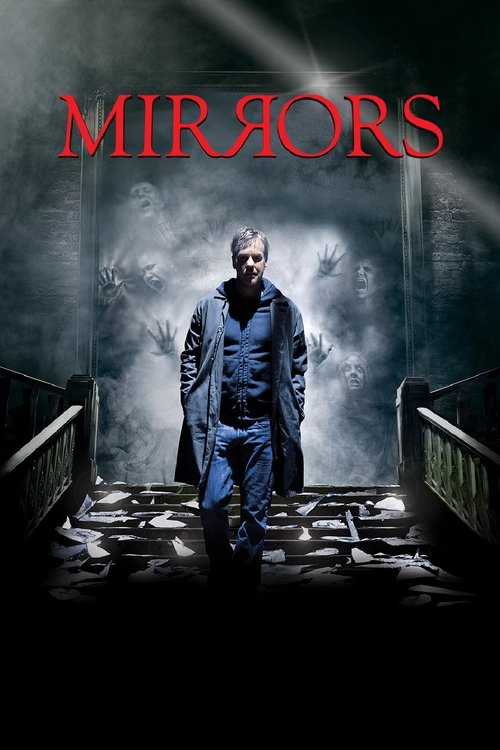
Mirrors (2008)
Directed by Alexandre Aja
No — Mirrors is not woke, scoring 6 out of 100 on our wokeness meter.
Mirrors arrives from 2008, an Alexandre Aja production that takes a 2003 South Korean horror film, keeps the mirrors, and discards nearly everything else.
Consciousness Markers
Paula Patton appears in a supporting role and the production was shot in Romania with local actors, but the casting is incidental and carries no commentary or deliberate diversity mandate.
No LGBTQ+ characters, themes, or subtext appear anywhere in the film.
The female characters function as endangered wives, sisters, and possessed children within a conventional supernatural horror framework, with no feminist critique or agency-driven arc.
Race is never addressed or thematized; the film has no racial consciousness whatsoever.
No environmental or climate themes are present.
The gutted luxury department store is a gothic setting, not a vehicle for class critique or anti-capitalist messaging.
The film's body horror (jaw-tearing, drowning) is the opposite of body-positive representation.
Anna Esseker's schizophrenia is framed as demonic possession to be exorcised by violence, a stigmatizing horror trope rather than affirming neurodivergent representation.
No historical events are reinterpreted or revised; the backstory is entirely fictional.
The film is a straightforward scare machine with no moralizing, messaging, or sermonizing of any kind.
Why it received this score
Mirrors arrives from 2008, an Alexandre Aja production that takes a 2003 South Korean horror film, keeps the mirrors, and discards nearly everything else. The result is Kiefer Sutherland as a suspended detective working nights in a burned-out luxury department store, discovering that reflective surfaces have opinions. The building is shot in Bucharest, standing in for a gutted Mayflower, and the production's Romanian crew fills out the edges of the frame with local faces. Paula Patton appears as the estranged wife, present and competent and given nothing to do beyond being endangered. This is casting as furniture arrangement, not statement, and we should call it what it is.
The film's cultural footprint is close to zero, and its ambitions are narrower still. It wants to scare you with jaw-tearing and drowning, and it does so with a certain grubby efficiency. Anna Esseker's schizophrenia is presented as a demon to be burned out of her with a gas line, a horror convention older than the multiplex that says nothing about contemporary sensibilities. Nobody in this film lectures. Nobody learns a lesson about society. The mirrors want a girl, the girl does not want to go back, the ex-cop forces her anyway, and then he dies and finds himself on the wrong side of the glass. That is the whole of it.
We are left with a competent, gloomy contraption that treats its people as meat and its audience as adults who came for the meat. It is not trying to improve anyone. In a season of films that treat the audience as a classroom, there is something almost restful about a movie this incurious about virtue.
Analysis generated by our Consciousness Algorithm


Synopsis
An ex-cop and his family are the target of an evil force that is using mirrors as a gateway into their home.
Questions about Mirrors
Is Mirrors woke?
No — Mirrors is not woke, scoring 6 out of 100 on our wokeness meter. That earns it a verdict of Ultra Based.
Does Mirrors have any woke elements?
Very few. None of the 10 markers reaches 30, the level where a marker counts as present; the highest is Representation Casting at 15.
How does Mirrors compare to other 2008 movies?
It ranks #129 of the 212 films from 2008 we've scored; their average is 12. The wokest is Milk (68).
How is the Woke Score calculated?
An AI-assisted process researches the film and its reception, scores it 0–100 on ten markers, then combines those into one 0–100 Woke Score. It measures a specific set of 2020s cultural themes, not film quality.