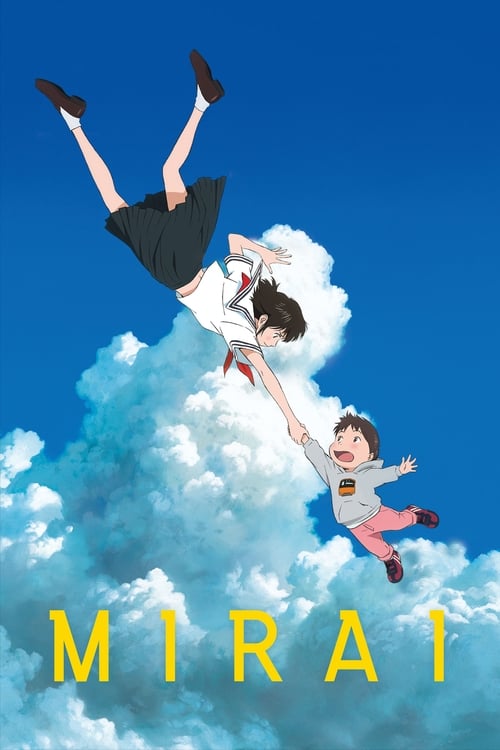
Mirai (2018)
Directed by Mamoru Hosoda
No — Mirai is not woke, scoring 9 out of 100 on our wokeness meter.
Mamoru Hosoda's Mirai concerns a four-year-old boy named Kun, his newborn sister, and the domestic upheaval that follows her arrival.
Consciousness Markers
The film mildly subverts traditional roles by making the mother a corporate executive and the father the work-from-home primary caregiver, but critics noted the father is portrayed as a clumsy, hapless caregiver, reinforcing rather than challenging gender norms.
The film is gentle and emotionally driven rather than preachy; it conveys its themes of family and sibling love through experience rather than explicit moralizing.
The cast is entirely Japanese, which is natural and unremarkable for a Japanese-produced anime film. There is no deliberate diversity or representation casting agenda.
There are no LGBTQ+ characters, themes, or subtext anywhere in the film.
The film contains no racial themes, commentary, or consciousness; it is a domestic family story with an all-Japanese cast.
There is no environmental or climate-related content in the film.
The film has no economic or anti-capitalist messaging; the family is comfortably middle-class and the story is purely interpersonal.
There is no body positivity theme or messaging present.
No neurodivergence themes or characters are present; Kun's tantrums are portrayed as ordinary toddler jealousy, not a condition.
The film briefly references a great-grandfather injured in World War II, but this is a personal family detail, not a revisionist reframing of history.
Why it received this score
Mamoru Hosoda's Mirai concerns a four-year-old boy named Kun, his newborn sister, and the domestic upheaval that follows her arrival. The child sulks, screams, and storms into the garden, where the family tree opens into a corridor of time. He meets the dog as a man, his sister as a teenager, his mother as a girl, and a great-grandfather whose leg was ruined in the war. The animation is warm. The emotions are real. None of this arrives with an argument attached.
The film's only faint gesture toward contemporary social arrangement is the household itself. The mother is a corporate executive. The father works from home and handles the child care. This inversion of the usual domestic script is presented plainly and then quietly undermined, since the father is drawn as a hapless bumbler who cannot soothe his own son. The picture notices the arrangement and declines to celebrate it. Beyond that, the film carries no racial commentary, no environmental sermon, no economic grievance, no interest in identity as a subject. It is a story about a boy learning that other people existed before him. The cast is Japanese because the film is Japanese. Nothing is being announced.
The picture is also remarkably free of lecturing. It trusts a tantrum, a train ride, and a bicycle to do the work that a lesser film would assign to dialogue. Lessons about family and sibling love arrive through experience, not instruction. The result is a modest, well-made domestic fantasy, sincere and almost entirely uninterested in the cultural battles of its moment. That restraint is its own quiet virtue. A sommelier would call this a clean, uncomplicated vintage, and there is nothing wrong with a clean vintage. Some bottles simply refuse to argue with the diner, and this one pours quietly, expects no applause, and lets the evening proceed without a single raised voice from the table. It was nominated for an Academy Award, which proves only that the Academy can occasionally recognize a small thing done well. The film ends. The child grows up a little. No one is scolded for anything, and the garden closes behind him without a lesson attached to the gate.
It remains a gentle piece of work, and gentle work has its place in the cellar, even if the sommelier finds himself reaching for something with more tannin.
Analysis generated by our Consciousness Algorithm


Synopsis
Four-year-old Kun struggles with jealousy after his newborn sister, Mirai, begins receiving most of his family’s attention. Retreating to the garden, he encounters Mirai as a teenager from the future and embarks on extraordinary journeys across his family’s past, gradually discovering new perspectives on love, belonging and what it means to become an older brother.
Questions about Mirai
Is Mirai woke?
No — Mirai is not woke, scoring 9 out of 100 on our wokeness meter. That earns it a verdict of Ultra Based.
Does Mirai have any woke elements?
Very few. None of the 10 markers reaches 30, the level where a marker counts as present; the highest is Feminist Agenda at 15.
How does Mirai compare to other 2018 movies?
It ranks #203 of the 325 films from 2018 we've scored; their average is 20. The wokest is Return (92).
How is the Woke Score calculated?
An AI-assisted process researches the film and its reception, scores it 0–100 on ten markers, then combines those into one 0–100 Woke Score. It measures a specific set of 2020s cultural themes, not film quality.