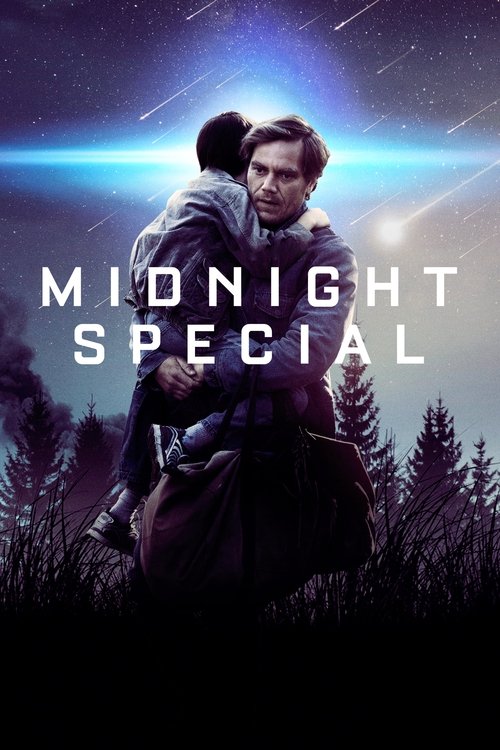
Midnight Special (2016)
Directed by Jeff Nichols
No — Midnight Special is not woke, scoring 5 out of 100 on our wokeness meter.
Jeff Nichols builds his fourth feature from two ideas: men driving back roads at night, and a boy who does not belong to this world.
Consciousness Markers
Kirsten Dunst's Sarah is largely a passive maternal figure, though her final act of cutting off her cult-traditionalist braid offers a faint gesture of self-liberation. The narrative remains a father-son story.
The cast is overwhelmingly white, led by Michael Shannon, Joel Edgerton, Kirsten Dunst, Adam Driver, and Sam Shepard, with only incidental background diversity. No deliberate representation agenda is present.
Nichols' film is a moody, restrained genre piece that prioritizes atmosphere over messaging; it preaches nothing.
There are no LGBTQ+ characters, themes, or subtext anywhere in the film.
Race is entirely absent as a theme; the film is a Southern Gothic chase narrative with no engagement with racial politics.
No environmental or climate themes appear; the satellite destruction is a plot device about surveillance, not ecology.
The antagonists are a religious cult and federal authorities, not capital or class structures. No economic critique is offered.
No body-positive themes or messaging are present.
Alton's photosensitivity and powers are framed as extraterrestrial biology, not neurodivergence or a metaphor for it.
The film is a fictional sci-fi thriller with no historical subject matter to revise.
Why it received this score
Jeff Nichols builds his fourth feature from two ideas: men driving back roads at night, and a boy who does not belong to this world. The result is a Southern Gothic chase picture that owes its DNA to Close Encounters and Starman, and it moves with the hushed, unhurried confidence of a director who trusts atmosphere over explanation. Michael Shannon spends most of the runtime looking like a man who has not slept since 2011, which is exactly right. The film is good. It is also, by the standards of our current cultural accounting, nearly empty.
The cast is white with a thoroughness that suggests neither intent nor oversight, just the demographic gravity of a Texas-set genre piece. No LGBTQ presence announces itself, and no subtext waits in the wings. Kirsten Dunst's Sarah is a mother who abandoned her son and then returns to him, a passive figure for most of the running time. Her final act, cutting the braid that marks her as property of a religious cult, is a small gesture of self-possession. The narrative belongs to the father and the boy, and it does not apologize for that. Race never enters the frame as a subject. The villains are a church and a federal apparatus, not a boardroom, so there is no economic sermon to deliver.
The satellite that Alton destroys is a surveillance device, not a climate omen, and the film has no interest in the planet's temperature. Alton's photosensitivity is alien biology, not a coded portrait of neurodivergence. There is no history here to rewrite and no body to celebrate. Most tellingly, the film lectures no one. It withholds its meaning to the last frame and lets the audience sit with the not-knowing. In an era of cinema that explains itself constantly, this restraint reads almost as a provocation. The sermon count is zero. That is the whole report.
Analysis generated by our Consciousness Algorithm
Part of


Synopsis
A father and son go on the run after the dad learns his child possesses special powers.
Questions about Midnight Special
Is Midnight Special woke?
No — Midnight Special is not woke, scoring 5 out of 100 on our wokeness meter. That earns it a verdict of Ultra Based.
Does Midnight Special have any woke elements?
Very few. None of the 10 markers reaches 30, the level where a marker counts as present; the highest is Feminist Agenda at 10.
How does Midnight Special compare to other 2016 movies?
It ranks #221 of the 285 films from 2016 we've scored; their average is 16. The wokest is 13th (92).
How is the Woke Score calculated?
An AI-assisted process researches the film and its reception, scores it 0–100 on ten markers, then combines those into one 0–100 Woke Score. It measures a specific set of 2020s cultural themes, not film quality.