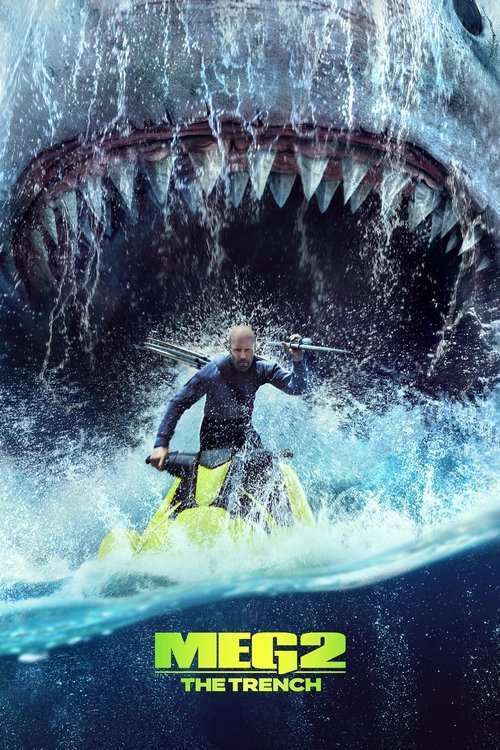
Meg 2: The Trench (2023)
Directed by Ben Wheatley
No — Meg 2: The Trench is not woke, scoring 12 out of 100 on our wokeness meter.
Meg 2: The Trench arrives as the second course in a franchise built on a simple proposition: large prehistoric shark, larger box office.
Consciousness Markers
A corrupt billionaire and a malevolent mining operation are villains, providing a mild eat-the-rich backdrop, though it is standard action-movie villainy rather than a systemic critique.
The cast is internationally diverse, with Chinese, Black, and Pacific Islander actors in prominent roles, but this reflects the film's Chinese co-production and global market strategy rather than a modern representation agenda.
Illegal deep-sea mining and an environmental crisis serve as plot devices, but the film does not engage with climate change as a crusade.
No LGBTQ+ characters, themes, or subtext are present.
The film has no feminist agenda; female characters are either villains, victims, or background support.
No racial themes, commentary, or consciousness are present.
No body positivity themes or messaging are present.
No neurodivergent characters or themes are present.
The film is not based on historical events and offers no revisionist history.
The film is a schlocky monster movie with no preachy or lecture-like energy.
Why it received this score
Meg 2: The Trench arrives as the second course in a franchise built on a simple proposition: large prehistoric shark, larger box office. The ensemble is genuinely international, drawing on Chinese, British, American and Pacific talent, though the arrangement owes less to a casting philosophy than to the financing structure behind it. A Chinese co-production needs Chinese stars. A global release needs global faces. The result is diversity as logistics, not as statement, and the film seems content with that arrangement.
The villains are a corrupt billionaire and an illegal deep-sea mining operation, which lends the proceedings a faint whiff of class resentment. Do not mistake it for a critique. Driscoll exists to be eaten. The mercenaries exist to be eaten. The mining exists to rupture the trench and release the monsters, which is the only function the film requires of an environmental crisis. Greed is punished because greed makes a convenient antagonist, not because anyone involved wishes to reorganize the economy.
Elsewhere the cupboard is bare. The women in this film are a dead wife remembered fondly, a billionaire who gets devoured, a traitor who gets devoured, and a security officer with perhaps four lines. No romantic subplot distracts from the sharks. No character pauses to educate the audience about anything at all. There is no queer subtext, no neurodivergent arc, no body-positive messaging, no reckoning with history, and no lecture waiting at the end of the tunnel. The film is a hundred and nineteen minutes of letting a very large fish eat people, and for that we should be grateful.
Analysis generated by our Consciousness Algorithm
Part of


Synopsis
An exploratory dive into the deepest depths of the ocean of a daring research team spirals into chaos when a malevolent mining operation threatens their mission and forces them into a high-stakes battle for survival.
Questions about Meg 2: The Trench
Is Meg 2: The Trench woke?
No — Meg 2: The Trench is not woke, scoring 12 out of 100 on our wokeness meter. That earns it a verdict of Ultra Based.
Does Meg 2: The Trench have any woke elements?
1 of the 10 markers register at 30 or above, led by Eat the Rich (30). On Eat the Rich: A corrupt billionaire and a malevolent mining operation are villains, providing a mild eat-the-rich backdrop, though it is standard action-movie villainy rather than a systemic critique.
How does Meg 2: The Trench compare to other 2023 movies?
It ranks #135 of the 200 films from 2023 we've scored; their average is 24. The wokest is Origin (84).
How is the Woke Score calculated?
An AI-assisted process researches the film and its reception, scores it 0–100 on ten markers, then combines those into one 0–100 Woke Score. It measures a specific set of 2020s cultural themes, not film quality.