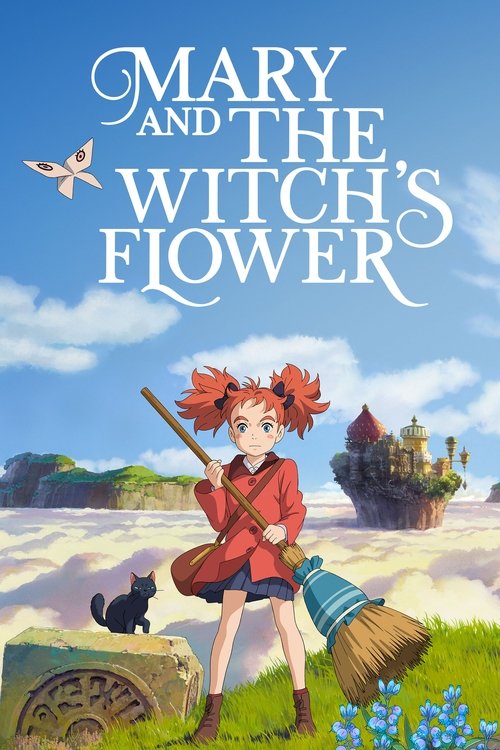
Mary and The Witch's Flower (2017)
Directed by Hiromasa Yonebayashi
No — Mary and The Witch's Flower is not woke, scoring 10 out of 100 on our wokeness meter.
A gentle adaptation of Mary Stewart's 1971 children's book, this is the sort of film that arrives with impeccable pedigree and no interest in the cultural weather of its release year.
Consciousness Markers
Mary is a capable and powerful protagonist who achieves self-actualization, though the narrative remains within traditional fantasy tropes rather than offering a critical feminist deconstruction.
The film relies heavily on traditional fantasy archetypes, offering no significant commentary on modern demographic representation.
The educational elements are focused on magic and chemistry, lacking the specific ideological weight of modern progressive lectures.
The setting is a forest, but the environmental elements are purely magical and do not function as a modern 'Climate Crusade' narrative.
The conflict is driven by mad science and personal ambition, not by a critique of modern economic or corporate structures.
There is no evidence of LGBTQ+ themes, characters, or subtext within the narrative.
The film contains no discussion or representation of racial issues or diverse racial groups.
There is no focus on body image, diverse body types, or challenging conventional beauty standards.
No characters exhibit or are discussed in relation to neurodivergent traits.
The film is a work of pure fantasy and does not attempt to revise or challenge established historical facts.
Why it received this score
A gentle adaptation of Mary Stewart's 1971 children's book, this is the sort of film that arrives with impeccable pedigree and no interest in the cultural weather of its release year. Studio Ponoc's first feature, directed by Hiromasa Yonebayashi, follows a bored red-haired girl into a forest, onto a broomstick, and up to a cloud-borne college of witches staffed by an expansionist headmistress and a chemist with a transformation laboratory. The animation is lovely. The moral is that magic does not substitute for competence, and Mary throws away her final flower to prove it.
On the matter of social consciousness, the film is aggressively innocent. Mary is capable, saves the boy, bests the adults, and arrives at a quiet self-possession. That registers as mild feminine competence, not a manifesto. The supporting cast is stock fantasy furniture: the gardener, the housekeeper, the newspaper boy, the great-aunt with a secret. Nobody remarks on anyone's demographic particulars, and the film has no interest in starting. The forest is green and magical, its botany apolitical. The villains fall to their own laboratory hubris, which critiques ambition, not capital.
The film does lecture, in its mild way, but the lessons concern chemistry and listening to your elders. We find no sermon about representation, no revision of the historical record, no reckoning with body or mind. A well-made children's fantasy trusts its audience to enjoy a girl on a broomstick without a syllabus stapled to it. The result is charming, slight, and entirely of another era's disposition. It honors its Ghibli lineage, and it does so quietly, which may be the most subversive thing about it.
Analysis generated by our Consciousness Algorithm


Synopsis
Mary Smith, a young girl who lives with her great-aunt in the countryside, follows a mysterious cat into the nearby forest where she finds a strange flower and an old broom, none of which is as ordinary as it seems.
Questions about Mary and The Witch's Flower
Is Mary and The Witch's Flower woke?
No — Mary and The Witch's Flower is not woke, scoring 10 out of 100 on our wokeness meter. That earns it a verdict of Ultra Based.
Does Mary and The Witch's Flower have any woke elements?
Very few. None of the 10 markers reaches 30, the level where a marker counts as present; the highest is Feminist Agenda at 25.
How does Mary and The Witch's Flower compare to other 2017 movies?
It ranks #162 of the 309 films from 2017 we've scored; their average is 19. The wokest is I Am Not Your Negro (92).
How is the Woke Score calculated?
An AI-assisted process researches the film and its reception, scores it 0–100 on ten markers, then combines those into one 0–100 Woke Score. It measures a specific set of 2020s cultural themes, not film quality.