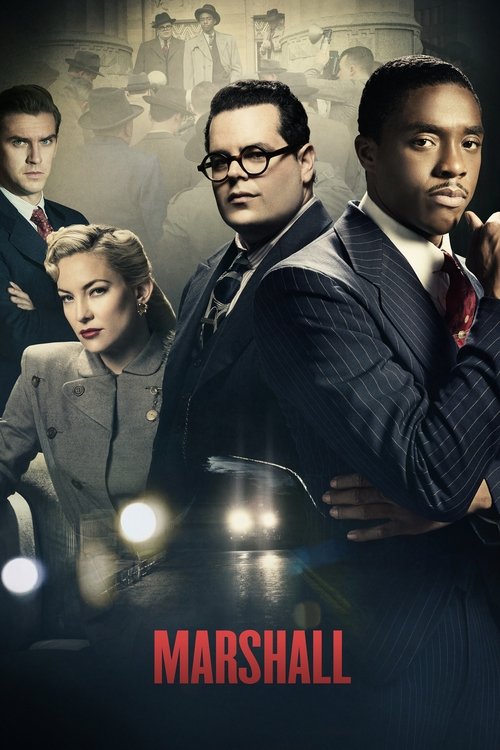
Marshall (2017)
Directed by Reginald Hudlin
Yes — Marshall is woke, scoring 64 out of 100 on our wokeness meter.
Marshall is an old-fashioned courtroom drama with a modern casting instinct.
Consciousness Markers
The entire plot is driven by racial injustice, NAACP advocacy, and the threat of lynching for a Black man accused of involvement with a white woman.
Chadwick Boseman leads as Thurgood Marshall with a predominantly Black principal cast in a historical civil-rights narrative, making representation central to the project.
Courtroom speeches and moral confrontations about racism give it a message-movie pulse, though it remains an old-fashioned legal drama rather than a preachy modern sermon.
No LGBTQ+ characters, themes, or subtext are present.
The film includes a female accuser and a female juror, but it does not advance a feminist agenda or critique patriarchy as a thematic priority.
No environmental or climate-related themes appear.
The film does not critique capitalism, wealth inequality, or class structures as a thematic concern.
No body-positivity themes or body-diversity messaging are present.
No neurodivergent characters or themes are depicted.
It is a conventional biographical drama based on a real case, not a revisionist reframing of history through modern ideological lenses.
Why it received this score
Marshall is an old-fashioned courtroom drama with a modern casting instinct. Chadwick Boseman plays Thurgood Marshall as an NAACP lawyer sent to Bridgeport, Connecticut, to defend Joseph Spell, a Black chauffeur accused of raping his white employer. The film surrounds Boseman with a predominantly Black principal cast and treats the civil rights stakes as the engine of the plot. Representation here is structural, not ornamental. The story does not pause to congratulate itself for placing Black faces at the center of a historical legal narrative. It simply proceeds, which is its own quiet statement.
The racial consciousness is thick enough to cut. Every beat turns on the danger of a Black man accused of intimacy with a white woman, the threat of lynching, and the NAACP's painstaking legal work. Courtroom speeches and moral confrontations give the film a message-movie pulse. It is not a modern sermon, but it knows how to deliver a lesson from the witness stand. The script flattens some characters, as reviewers complained, and the colorism of the era goes unexplored. Still, the injustice is not background decoration. It is the case.
The film stops short of other contemporary progressive markers. There are no LGBTQ themes. No feminist critique of patriarchy drives the narrative, even with a female accuser and a female juror. Climate concerns do not appear. Capitalism is not indicted. Body positivity and neurodivergence are absent. History is not revised through a modern ideological lens. This is a conventional biopic of a real case, respectful and well acted. It earns its social awareness, then retreats into procedure. That limits its cultural reach, but it also keeps the film from straining for relevance it does not need.
Analysis generated by our Consciousness Algorithm


Synopsis
Thurgood Marshall, the first African-American Supreme Court Justice, battles through one of his career-defining cases.
Questions about Marshall
Is Marshall woke?
Yes — Marshall is woke, scoring 64 out of 100 on our wokeness meter. That earns it a verdict of Woke.
What makes Marshall woke?
3 of the 10 markers register at 30 or above, led by Racial Consciousness (85), Representation Casting (70) and Lecture Energy (50). On Racial Consciousness: The entire plot is driven by racial injustice, NAACP advocacy, and the threat of lynching for a Black man accused of involvement with a white woman.
How does Marshall compare to other 2017 movies?
It ranks #10 of the 309 films from 2017 we've scored; their average is 19. The wokest is I Am Not Your Negro (92).
How is the Woke Score calculated?
An AI-assisted process researches the film and its reception, scores it 0–100 on ten markers, then combines those into one 0–100 Woke Score. It measures a specific set of 2020s cultural themes, not film quality.