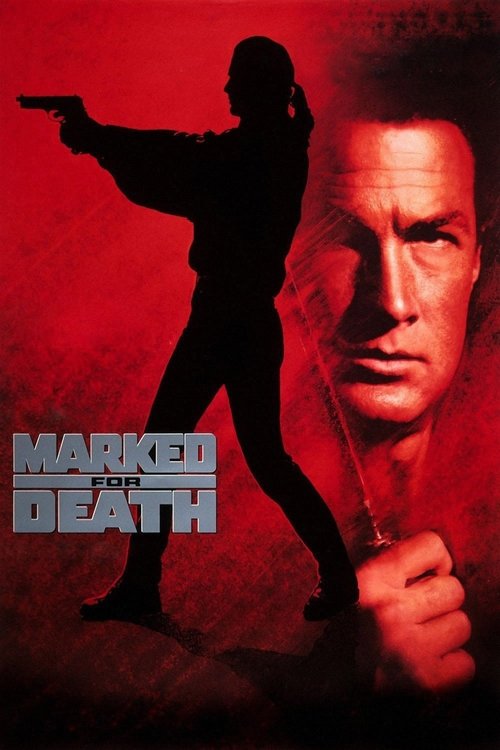
Marked for Death (1990)
Directed by Dwight H. Little
No — Marked for Death is not woke, scoring 6 out of 100 on our wokeness meter.
The contemporary action picture 'Marked for Death' offers a viewing experience of absolute cultural inertia.
Consciousness Markers
The cast includes Black actors in notable supporting roles (Keith David, Tom Wright, Basil Wallace), but this is standard 1990 genre casting rather than any deliberate representational agenda, and the Jamaican characters are largely framed as exoticized villains.
No LGBTQ+ characters, themes, or subtext of any kind appear in the film.
Women appear only as victims, sacrificial targets, or brief functional roles; there is no feminist framing or commentary.
The film engages race only through stereotypical villainy (Jamaican 'Posse' drug dealers practicing Obeah), which is the opposite of a racial-consciousness agenda.
No environmental or climate themes are present.
The film is a straightforward law-and-order revenge narrative with no critique of capitalism or wealth.
No body-positivity themes; the film is a conventional action vehicle centered on a physically dominant hero.
No neurodivergent characters or themes are depicted.
The film is a fictional contemporary action story with no historical revisionism.
The film is entirely action-driven and makes no preachy or didactic appeals to the audience.
Why it received this score
The contemporary action picture 'Marked for Death' offers a viewing experience of absolute cultural inertia. It is a film that engages its audience entirely through high-octane choreography and predictable law enforcement tropes, succeeding precisely because it refuses to address any of the progressive sensibilities currently dominating global cinema. We are presented with a narrative where conflict is resolved through ballistic efficiency and the rigid application of procedural rules. There is a total absence of modern social consciousness, which is perhaps the film’s most definitive, if unintentional, artistic achievement.
This is a straightforward revenge thriller. The characters operate within a strict moral binary. The film does not attempt to deconstruct power structures or explore systemic inequity; it simply treats them as obstacles to be eliminated by a determined protagonist. The representation of its diverse elements is purely functional, serving only to establish the threat or the setting. The thematic focus remains tightly bound to the tropes of the 'tough cop' returning home to restore order, a narrative framework so thoroughly exhausted it achieves a state of near-perfect cultural neutrality.
For those seeking commentary on social issues, environmental decay, or gender dynamics, the film provides nothing. It functions as a pure kinetic exercise. The script is heavy on visceral confrontation and light on intellectual engagement. It is a cinematic relic that exists outside the parameters of modern social debate, a rare and refreshing monument to pure, unadulterated genre commitment. It remains a structurally sound piece of action cinema, even if its lack of any progressive sensibilities renders it culturally insignificant in the present era.
Analysis generated by our Consciousness Algorithm


Synopsis
Just retired from the Drug Enforcement Agency, John Hatcher returns to his hometown and quickly discovers that drugs have infiltrated his old neighborhood. Determined to drive the dealers out, Hatcher crosses paths with a ferocious Jamaican drug lord who vows that Hatcher and his family are now marked for death.
Questions about Marked for Death
Is Marked for Death woke?
No — Marked for Death is not woke, scoring 6 out of 100 on our wokeness meter. That earns it a verdict of Ultra Based.
Does Marked for Death have any woke elements?
Very few. None of the 10 markers reaches 30, the level where a marker counts as present; the highest is Representation Casting at 15.
How does Marked for Death compare to other 1990 movies?
It ranks #31 of the 68 films from 1990 we've scored; their average is 9. The wokest is Nightbreed (60).
How is the Woke Score calculated?
An AI-assisted process researches the film and its reception, scores it 0–100 on ten markers, then combines those into one 0–100 Woke Score. It measures a specific set of 2020s cultural themes, not film quality.