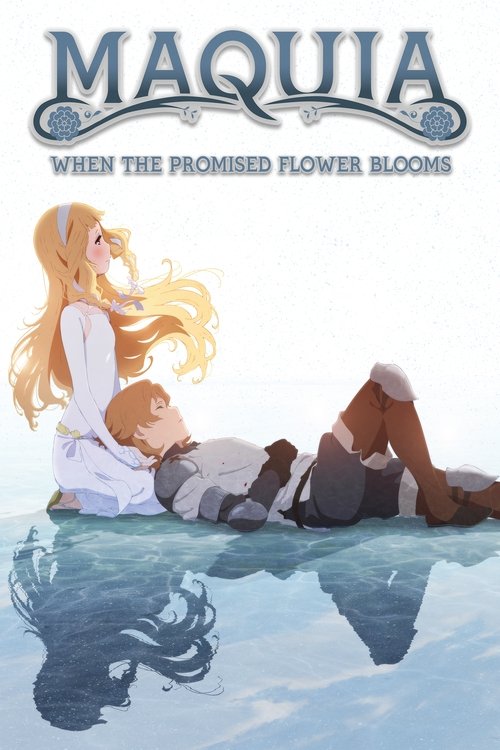
Maquia: When the Promised Flower Blooms (2018)
Directed by Mari Okada
No — Maquia: When the Promised Flower Blooms is not woke, scoring 10 out of 100 on our wokeness meter.
Mari Okada's directorial debut concerns an immortal girl from a long-lived clan who adopts a human infant and raises him across decades that she cannot feel and he cannot stop.
Consciousness Markers
A female director (Mari Okada) and a female protagonist anchor a story centered on motherhood and a woman's emotional agency, though the film frames this as universal parental love rather than an explicit feminist thesis.
The Iorph are a persecuted minority race hunted for their longevity, offering a faint allegory of oppression, but this is fantasy worldbuilding rather than commentary on real-world racial politics.
The film wears its themes of motherhood, aging, and loss earnestly, but it dramatizes them through emotion rather than delivering explicit moral instruction to the audience.
The voice cast is a standard Japanese anime ensemble with no particular emphasis on diverse or nontraditional casting; the notable behind-the-camera presence of a female director and character designer is a mild point but not a casting statement.
The imperial kingdom of Mezarte is portrayed as a power-hungry aggressor, but the critique targets war and dynastic ambition rather than capitalism or wealth inequality.
No LGBTQ+ characters, relationships, or themes appear anywhere in the story.
No environmental or climate themes are present; the ecological elements are purely fantasy set dressing.
No body positivity themes or messaging are present.
No neurodivergent characters or themes are depicted.
The film is an original high-fantasy work with no historical subject matter to revise.
Why it received this score
Mari Okada's directorial debut concerns an immortal girl from a long-lived clan who adopts a human infant and raises him across decades that she cannot feel and he cannot stop. The premise is engineered for grief, and the film delivers it with a straight face and a great deal of patience. The animation is handsome, the score by Kenji Kawai does its work, and the final act lands its emotional blows with professional precision. This is a film that knows exactly where the tears are and walks there without hurrying.
What it does not do is lecture. The themes of motherhood, aging, and loss are dramatized through decades of small domestic scenes, not announced from a pulpit. There is no LGBTQ content, no environmental sermon, no body positivity messaging, no neurodivergent representation, no historical record to correct. The Iorph are hunted for their longevity, which gestures faintly at persecution, but the oppression is fantasy furniture and carries no commentary on real racial politics. The kingdom of Mezarte is a power-hungry aggressor, though its sin is dynastic ambition and war, not the accumulation of capital.
The film's mild progressive texture comes from its authorship. A woman wrote and directed it, and a woman designed its characters. Its protagonist is a woman whose emotional life drives the plot, and the story treats parental love as a universal subject instead of a gendered burden. That is a quiet, uninsistent kind of cultural awareness. It never stops to explain itself, which is to its credit. The result is a sincere fantasy melodrama with almost no sermonizing and almost no agenda beyond making an audience cry. It succeeds at the latter. The former was never attempted.
Analysis generated by our Consciousness Algorithm


Synopsis
Fleeing the war, the immortal Maquia, graced with eternal youth, finds a baby abandoned in the forest and decides to raise it as her own child, sparking a moving story between a mortal and a being who does not age.
Questions about Maquia: When the Promised Flower Blooms
Is Maquia: When the Promised Flower Blooms woke?
No — Maquia: When the Promised Flower Blooms is not woke, scoring 10 out of 100 on our wokeness meter. That earns it a verdict of Ultra Based.
Does Maquia: When the Promised Flower Blooms have any woke elements?
Very few. None of the 10 markers reaches 30, the level where a marker counts as present; the highest is Feminist Agenda at 22.
How does Maquia: When the Promised Flower Blooms compare to other 2018 movies?
It ranks #191 of the 325 films from 2018 we've scored; their average is 20. The wokest is Return (92).
How is the Woke Score calculated?
An AI-assisted process researches the film and its reception, scores it 0–100 on ten markers, then combines those into one 0–100 Woke Score. It measures a specific set of 2020s cultural themes, not film quality.