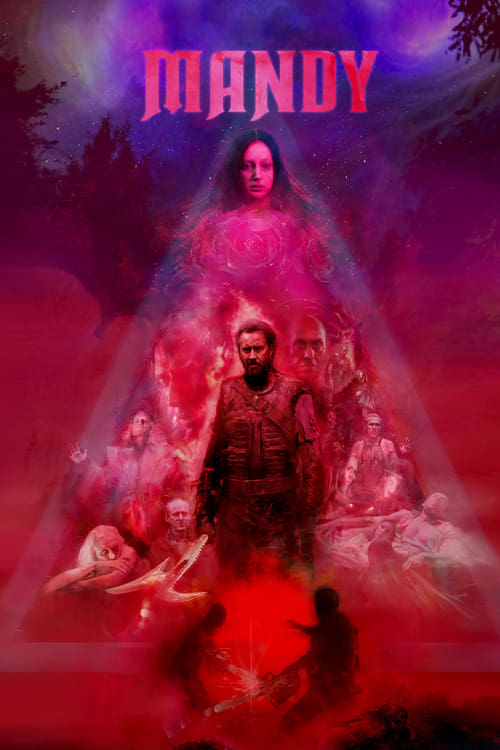
Mandy (2018)
Directed by Panos Cosmatos
No — Mandy is not woke, scoring 0 out of 100 on our wokeness meter.
Panos Cosmatos's Mandy arrives from 1983 by way of a bad VHS dream, all magenta haze, sulfur light, and Nicolas Cage in a lumberjack's grief.
Consciousness Markers
No deliberate diverse or representative casting; Bill Duke appears naturally in a supporting role without commentary.
No LGBTQ+ characters, relationships, or themes.
Mandy is largely a fridged catalyst for Red's vengeance; no feminist agenda or sustained gender-political commentary.
No racial consciousness or race-based themes; the cast's diversity is incidental.
The forest setting is aesthetic and atmospheric, not tied to environmental activism or climate messaging.
No anti-capitalist or eat-the-rich critique; the cult is a religious/psychedelic menace, not an economic one.
No body-positivity themes or messaging.
Red's alcoholism and trauma are not framed as neurodivergence.
The 1983 setting is stylistic; the film does not revise or reinterpret historical events.
The film is surreal, violent, and revenge-driven rather than didactic or lecture-oriented.
Why it received this score
Panos Cosmatos's Mandy arrives from 1983 by way of a bad VHS dream, all magenta haze, sulfur light, and Nicolas Cage in a lumberjack's grief. Red and Mandy share a cabin, a gentle routine, and an art practice. Then a cult leader with a bruised ego and a demonic biker gang destroy the arrangement. The film is a revenge machine fueled by LSD, chainsaws, and Johann Johannsson's final score. It is also uninterested in current social consciousness. The camera loves texture, violence, and the slow burn of a man forging an axe.
The cast includes Bill Duke as a friend with a crossbow and a warning, and his presence registers without any accompanying sermon on representation. Andrea Riseborough gives Mandy a sad, vivid interior before the plot converts her into a fridged catalyst for Red's rampage. The film does not turn that into gender-political argument, nor does it pretend to. The cult is a psychedelic religious menace, not a parable about capital. The forest is atmosphere, not climate activism. Red's alcoholism is grief and damage, not a lesson in neurodivergence.
The film leaves style and sensation: a 1983 setting used as a mood board, a chainsaw duel in a quarry, a severed head delivered with the timing of a punchline. The result is lurid, singular, and almost entirely free of progressive messaging. It wants to show a man in a blood-soaked shirt screaming into a burning church, and it does. For the sacred ledger of social awareness, Mandy is a desert. A beautiful, pulsing, axe-shaped desert.
Analysis generated by our Consciousness Algorithm


Synopsis
The Shadow Mountains, 1983. Red and Mandy lead a loving and peaceful existence; but when their pine-scented haven is savagely destroyed, Red is catapulted into a phantasmagoric journey filled with bloody vengeance and laced with fire.
Questions about Mandy
Is Mandy woke?
No — Mandy is not woke, scoring 0 out of 100 on our wokeness meter. That earns it a verdict of Ultra Based.
Does Mandy have any woke elements?
No. All 10 markers score zero.
How does Mandy compare to other 2018 movies?
It ranks #291 of the 325 films from 2018 we've scored; their average is 20. The wokest is Return (92).
How is the Woke Score calculated?
An AI-assisted process researches the film and its reception, scores it 0–100 on ten markers, then combines those into one 0–100 Woke Score. It measures a specific set of 2020s cultural themes, not film quality.