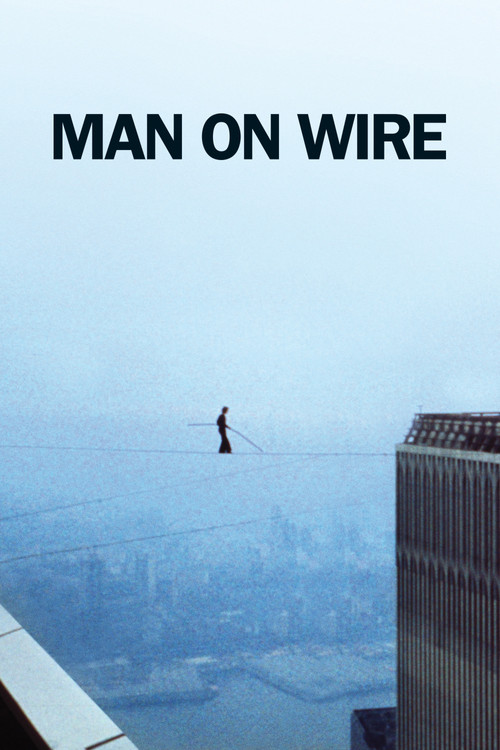
Man on Wire (2008)
Directed by James Marsh
No — Man on Wire is not woke, scoring 0 out of 100 on our wokeness meter.
James Marsh's 2008 documentary concerns a Frenchman who, in 1974, walked a wire strung illegally between the Twin Towers.
Consciousness Markers
The cast consists of the actual participants in a 1974 event — French and American men plus one woman — with no casting agenda or diversity mandate at work.
No LGBTQ+ characters, themes, or subtext appear anywhere in the documentary.
Annie Allix appears as a participant, but the film makes no feminist argument and treats the caper as an individual artistic obsession.
Race is entirely absent as a subject; the story is a French tightrope walker's stunt in New York with no racial commentary.
No environmental or climate themes are present.
The illegal wire-walk defies police and port authority, but it is framed as an artistic heist, not a critique of capitalism or wealth.
No body image or body positivity themes appear.
No neurodivergence is depicted or discussed.
The film faithfully recounts a documented 1974 event and deliberately avoids reinterpreting it, even omitting any mention of 9/11.
Marsh explicitly avoided injecting any message or moralizing, structuring the film as a suspenseful heist rather than a lesson.
Why it received this score
James Marsh's 2008 documentary concerns a Frenchman who, in 1974, walked a wire strung illegally between the Twin Towers. The film presents this as a heist picture, complete with reconnaissance, forged credentials, night guards, and a crew whispering into walkie-talkies. Philippe Petit narrates his own mythology with the serene vanity of a man who has never once doubted his place in history. He is charming. He is also insufferable in the way that artists who are correct about themselves tend to be.
The participants appear as themselves: Heckel, Blondeau, Allix, and assorted Americans who held doors open and looked the other way. Nobody is cast to make a point. Nobody explains what the stunt means for the broader struggle of any group. Annie Allix is present because she was there, loved him, and left him. The film does not convert her into an argument. Race never enters the frame. Neither does the environment, the body, the mind, or the economy, except insofar as a man must buy steel cable.
Craft is all that remains. Marsh withholds the 9/11 context entirely, a decision he defended on the grounds that the towers deserved one story untainted by their ending. It is a curious act of restraint in an era that rarely permits any. The suspense is genuine, the staging elegant, the outcome never in doubt and somehow still unbearable. There is no sermon here, no lesson appended to the final act, no instruction on how we ought to feel. Just a man, a wire, and 1,350 feet of nothing. We have classified it accordingly.
Analysis generated by our Consciousness Algorithm


Synopsis
On August 7th 1974, French tightrope walker Philippe Petit stepped out on a high wire, illegally rigged between New York's World Trade Center twin towers, then the world's tallest buildings. After nearly an hour of performing on the wire, 1,350 feet above the sidewalks of Manhattan, he was arrested. This fun and spellbinding documentary chronicles Philippe Petit's "highest" achievement.
Questions about Man on Wire
Is Man on Wire woke?
No — Man on Wire is not woke, scoring 0 out of 100 on our wokeness meter. That earns it a verdict of Ultra Based.
Does Man on Wire have any woke elements?
No. All 10 markers score zero.
How does Man on Wire compare to other 2008 movies?
It ranks #175 of the 212 films from 2008 we've scored; their average is 12. The wokest is Milk (68).
How is the Woke Score calculated?
An AI-assisted process researches the film and its reception, scores it 0–100 on ten markers, then combines those into one 0–100 Woke Score. It measures a specific set of 2020s cultural themes, not film quality.