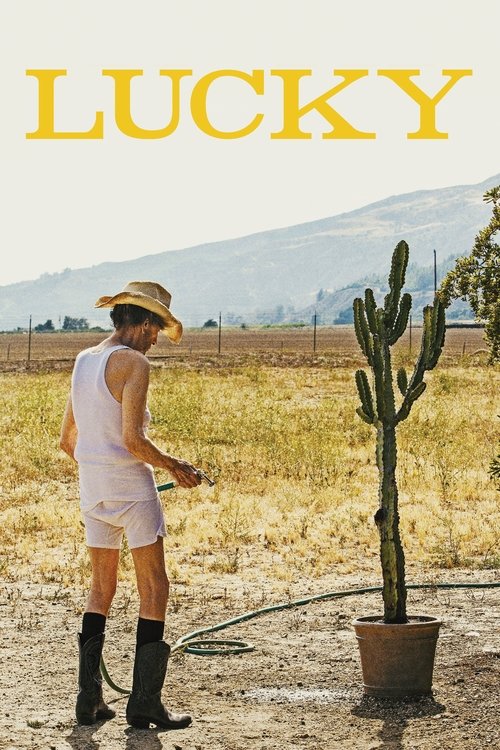
Lucky (2017)
Directed by John Carroll Lynch
No — Lucky is not woke, scoring 0 out of 100 on our wokeness meter.
Lucky arrives with a résumé that would tempt any classifier toward optimism: a ninety-year-old atheist protagonist, a desert town off the map, a supporting cast of oddballs circling the grave.
Consciousness Markers
The cast includes minority actors in supporting roles, but their presence is natural and uncommented upon, not a marker of modern representation casting.
No LGBTQ+ themes, characters, or subtext are present.
Female characters exist but are not vehicles for a feminist agenda; the film's focus is on male mortality.
Race is not a thematic concern; the film's conflicts are existential, not racial.
No environmental or climate-related themes.
No critique of capitalism or wealth inequality; the setting is a small desert town with no economic commentary.
No focus on body image or positivity.
No exploration of neurodivergence.
The film references WWII but does not revise or challenge historical narratives in a woke manner.
The film's monologues are existential and spiritual, not political lectures.
Why it received this score
Lucky arrives with a résumé that would tempt any classifier toward optimism: a ninety-year-old atheist protagonist, a desert town off the map, a supporting cast of oddballs circling the grave. The temptation passes quickly. John Carroll Lynch's directorial debut is a quiet character study, and the quiet is the point. Harry Dean Stanton wanders through Arizona buying milk and cigarettes, falls over, receives a clean bill of health from a doctor who seems faintly disappointed by it. The film has no thesis to deliver and no congregation to address. It watches an old man run out of time and finds the running out tolerable.
The supporting players are drawn from the character-actor wing of the profession, and their presence goes unremarked. Barry Shabaka Henley tends bar. Beth Grant runs the diner. Nobody explains who they are or why it matters that they are there. The closest the film comes to a sermon is Lucky's late monologue at Elaine's, where he announces that everything goes away, that we are left with nothing, and that the correct response to nothing is a smile. It is a spiritual claim, not a political one. Earlier, a Marine veteran recounts a Pacific beachhead and a child smiling amid the carnage, a detail offered as horror and mystery, not as an argument about empire.
This is a film about death, loneliness, a runaway tortoise named President Roosevelt, and Liberace on VHS. Its politics are the politics of a man who never married and has stopped expecting the world to explain itself. There is no representation arithmetic at work, no identity scaffolding, no environmental conscience, no economic grievance, no lecture. The camera holds on Stanton's face and lets him do the work. We are left with a modest, well-made elegy for a performer, released two weeks after his death, and it earns its sentiment honestly. Zero on every modern index. The film is not indifferent to the culture. It is simply older than it.
Analysis generated by our Consciousness Algorithm


Synopsis
Follows the journey of a 90-year-old atheist and the quirky characters that inhabit his off-the-map desert town. He finds himself at the precipice of life, thrust into a journey of self-exploration.
Questions about Lucky
Is Lucky woke?
No — Lucky is not woke, scoring 0 out of 100 on our wokeness meter. That earns it a verdict of Ultra Based.
Does Lucky have any woke elements?
No. All 10 markers score zero.
How does Lucky compare to other 2017 movies?
It ranks #281 of the 309 films from 2017 we've scored; their average is 19. The wokest is I Am Not Your Negro (92).
How is the Woke Score calculated?
An AI-assisted process researches the film and its reception, scores it 0–100 on ten markers, then combines those into one 0–100 Woke Score. It measures a specific set of 2020s cultural themes, not film quality.