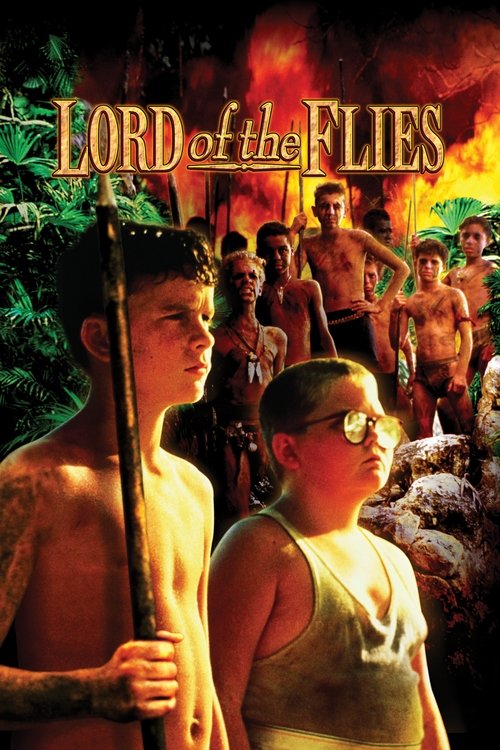
Lord of the Flies (1990)
Directed by Harry Hook
No — Lord of the Flies is not woke, scoring 0 out of 100 on our wokeness meter.
The 1990 adaptation of Lord of the Flies presents a rather grim study of adolescent regression.
Consciousness Markers
The film carries a heavy-handed allegorical lesson about human nature and society, but it is not a modern progressive social-justice lecture.
The cast is entirely male and overwhelmingly white, with no meaningful racial or ethnic diversity and no commentary on representation.
There are no LGBTQ+ characters, themes, or subtext in the film.
The film has no female characters and no feminist perspective or critique.
Race is not a theme in the film; the boys are uniformly presented as white military school cadets without racial commentary.
The island setting is incidental; there is no environmentalist message or climate crusade.
The story is an allegory about savagery and social breakdown, not a critique of capitalism or wealth inequality.
Piggy's weight is treated as a source of mockery and vulnerability, not as a body-positive theme.
No character is framed through neurodivergence or disability-awareness themes.
The film is a fictional adaptation of a novel and does not revise or reinterpret historical events.
Why it received this score
The 1990 adaptation of Lord of the Flies presents a rather grim study of adolescent regression. We find ourselves on a tropical island with a cast of white military school cadets who experience a slow descent into anarchy. The narrative functions as a dark allegory about the inherent defects of human nature. However, its modern cultural consciousness is remarkably unfocused. The film offers zero commentary on contemporary social issues. There is no exploration of gender dynamics or representation. The cast remains entirely male and racially homogenous. We are shown nothing about systemic inequality or climate concerns. The premise avoids critique of capitalism entirely.
The narrative presents the breakdown of society through a lens of primal savagery. The boys' conflict is focused solely on tribal dominance and survival instinct. The film does not engage with modern progressive sensibilities. Themes of systemic injustice or racial consciousness are entirely absent from the proceedings. The production gives little credit to current cultural awareness. The central conflict is not a critique of wealth disparity. Instead, it is a study of basic instinct. The movie provides no exploration of neurodivergence or LGBTQ+ subtext.
What remains is a heavy-handed exploration of man's capacity for destruction. The lesson about civilization is delivered with a palpable lecturing quality. The allegorical weight is felt, though it lacks any nuanced modern cultural critique. The film tells us about the failure of the boys to maintain order. It does so with a clear hand, even if the premise itself is wild. It is a challenging, if exhausting, piece of cultural viewing.
Analysis generated by our Consciousness Algorithm


Synopsis
When their plane crashes, 25 schoolboys find themselves trapped on a tropical island, miles from civilization.
Questions about Lord of the Flies
Is Lord of the Flies woke?
No — Lord of the Flies is not woke, scoring 0 out of 100 on our wokeness meter. That earns it a verdict of Ultra Based.
Does Lord of the Flies have any woke elements?
Very few. None of the 10 markers reaches 30, the level where a marker counts as present; the highest is Lecture Energy at 15.
How does Lord of the Flies compare to other 1990 movies?
It ranks #54 of the 68 films from 1990 we've scored; their average is 9. The wokest is Nightbreed (60).
How is the Woke Score calculated?
An AI-assisted process researches the film and its reception, scores it 0–100 on ten markers, then combines those into one 0–100 Woke Score. It measures a specific set of 2020s cultural themes, not film quality.