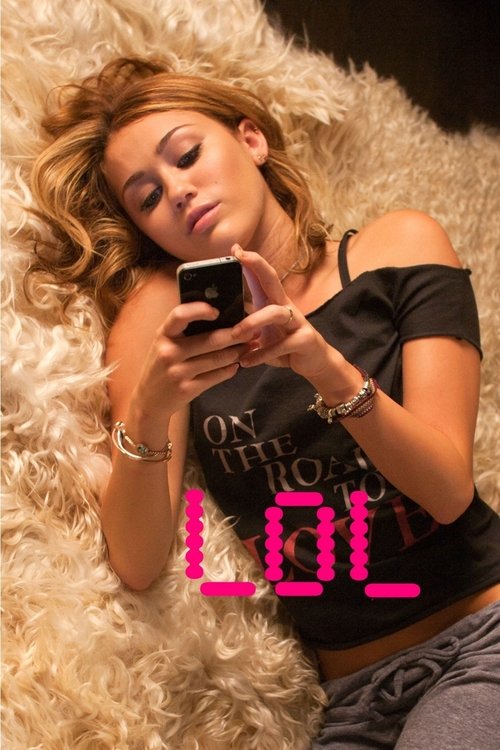
LOL (2012)
Directed by Lisa Azuelos
No — LOL is not woke, scoring 9 out of 100 on our wokeness meter.
LOL arrives in 2012 as a remake of a 2008 French film of the same name, both directed by Lisa Azuelos, who evidently found her own material worth a second pass.
Consciousness Markers
The film centers on a teenage girl and her mother, with a woman director, but it does not advance an explicit feminist critique or agenda.
The cast is predominantly white and there is no evident emphasis on diverse or inclusive casting as a thematic marker.
No LGBTQ+ characters, relationships, or themes appear in the film.
Race and racial identity are not addressed as themes in the story.
There is no environmental or climate-related content in the film.
The film contains no critique of capitalism, wealth inequality, or economic systems.
Body image, size diversity, or body-positivity themes are not present.
No neurodivergent characters or themes are depicted.
The film does not engage with historical events or revisionist historical narratives.
The film is a teen relationship drama and does not contain preachy or lecture-like messaging.
Why it received this score
LOL arrives in 2012 as a remake of a 2008 French film of the same name, both directed by Lisa Azuelos, who evidently found her own material worth a second pass. Miley Cyrus plays Lola, a Chicago teenager of ordinary appetites, and Demi Moore plays her mother, a divorcée who reads a diary she should not have read and learns that her daughter has a life. The plot assembles the standard furniture of the genre: a cheating boyfriend, a battle of the bands, a misunderstanding in a bathroom stall, a class trip to Paris where a virginity is surrendered with the tact of a plot point. It is shapeless, as Variety noted at the time, and charming in the way a suburban mall is charming, which is to say not at all, but agreeably enough.
On the ledger of social consciousness, the film is nearly bare. The cast is white by default, and nothing in the screenplay treats that as a subject worth raising. Race goes unmentioned. No queer characters appear. No climate anxiety, no critique of wealth, no meditation on bodies or on minds that work differently. What the film does possess is a structural interest in women: a woman wrote it, a woman directed it, and the central relationship is between a mother and a daughter, each granted her own frustrations and her own romantic entanglements. That is genuine, if modest, attention, and it earns a small credit in the feminist column. It stops there. Nobody in this movie is making an argument.
The release itself reads like a studio performing arithmetic against its own wishes: 105 theaters, seven cities, limited promotion, and an opening weekend that returned roughly the price of a mid-sized sedan. There is no sermon here, no finger raised, no lesson delivered to a chastened audience. For a film about a generation supposedly drowning in screens and slanguage, it is remarkably incurious about what that generation might think or want. We are left with a document of teenhood assembled from parts that were already four years past freshness when filming began. The audit closes at very nearly nothing, and for a film of this kind that is not a failure of nerve. It is simply a film with nothing on its mind.
Analysis generated by our Consciousness Algorithm


Synopsis
In a world connected by YouTube, iTunes, and Facebook, Lola and her friends navigate the peer pressures of high school romance and friendship while dodging their sometimes overbearing and confused parents. When Lola's mom, Anne, "accidentally" reads her teenage daughter's racy journal, she realizes just how wide their communication gap has grown.
Questions about LOL
Is LOL woke?
No — LOL is not woke, scoring 9 out of 100 on our wokeness meter. That earns it a verdict of Ultra Based.
Does LOL have any woke elements?
Very few. None of the 10 markers reaches 30, the level where a marker counts as present; the highest is Feminist Agenda at 15.
How does LOL compare to other 2012 movies?
It ranks #86 of the 230 films from 2012 we've scored; their average is 12. The wokest is Killing Them Softly (92).
How is the Woke Score calculated?
An AI-assisted process researches the film and its reception, scores it 0–100 on ten markers, then combines those into one 0–100 Woke Score. It measures a specific set of 2020s cultural themes, not film quality.