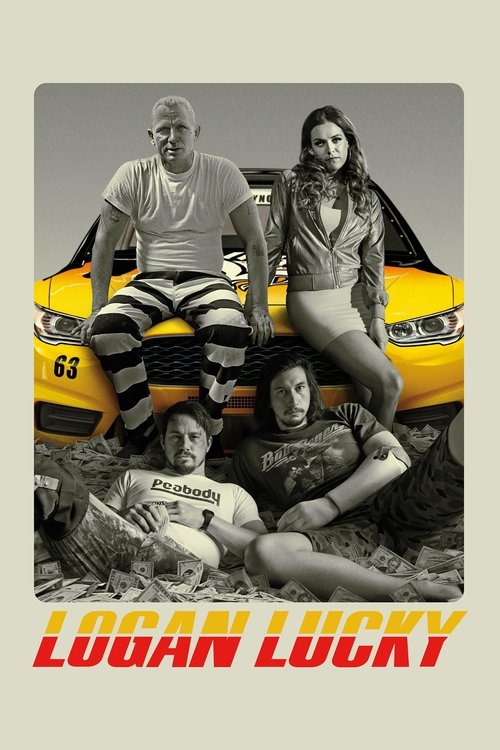
Logan Lucky (2017)
Directed by Steven Soderbergh
No — Logan Lucky is not woke, scoring 9 out of 100 on our wokeness meter.
Steven Soderbergh came out of retirement to make a caper picture about two West Virginia brothers robbing a NASCAR speedway, and he built it as an anti-glamour version of the Ocean's films.
Consciousness Markers
The heist targets a corporate speedway vault and contrasts working-class Logans with a wealthy NASCAR owner, but this is caper stakes rather than systemic anti-capitalist critique.
The cast is overwhelmingly white and able-bodied, with no deliberate diverse or inclusive casting agenda. Clyde's amputation is a character trait, not a representation-casting statement.
There are no LGBTQ+ characters, themes, or subtext in the film.
Female characters exist in the heist crew and law enforcement, but the film does not advance a feminist agenda or critique patriarchy.
The film does not engage with race, racism, or racial identity as a theme.
There is no environmental or climate-change messaging in the film.
The film does not promote body positivity or challenge conventional body standards.
No neurodivergent characters or themes are present; Joe Bang's brothers are simply written as dimwitted.
The film is a fictional caper and does not revise or reinterpret historical events.
Logan Lucky is a breezy entertainment with no preachy or didactic messaging.
Why it received this score
Steven Soderbergh came out of retirement to make a caper picture about two West Virginia brothers robbing a NASCAR speedway, and he built it as an anti-glamour version of the Ocean's films. Nobody dresses well. The technology is rubber bands, bleach, and gummy bears. The vault is emptied by vacuum pump, an arm disappears into the machinery, and the cash ends up buried in a yard. This is a heist film with dirt under its fingernails, running on regional texture and working-class fatigue, and it never pauses to explain its own significance.
The robbery does target a corporate speedway vault, and the screenplay pits the Logan clan against Max Chilblain, a preening NASCAR owner who mocks amputees from behind his wealth. That friction reads as class resentment, but it stays at the level of caper stakes. The rich man is a jerk, the poor men want his employer's cash, and the film has no ambition to dismantle anything larger than a pneumatic tube system. There is no argument about capital here, only about who ends up with the bag. The vacuum does the work, the insurer settles, and the moral ledger stays closed.
Everything else is amiable furniture. Clyde's missing arm, Joe Bang's dim brothers, the pageant subplot, the tetanus-shot romance: these are character details, not positions. The picture declines to moralize about bodies, identity, history, or the environment, and it declines to lecture. It simply wants to entertain, and it does, with an ensemble that seems happy to be there. For the purposes of classification, this is a film that keeps its politics in its pocket.
Analysis generated by our Consciousness Algorithm


Synopsis
Trying to reverse a family curse, brothers Jimmy and Clyde Logan set out to execute an elaborate robbery during the legendary Coca-Cola 600 race at the Charlotte Motor Speedway.
Questions about Logan Lucky
Is Logan Lucky woke?
No — Logan Lucky is not woke, scoring 9 out of 100 on our wokeness meter. That earns it a verdict of Ultra Based.
Does Logan Lucky have any woke elements?
Very few. None of the 10 markers reaches 30, the level where a marker counts as present; the highest is Eat the Rich at 15.
How does Logan Lucky compare to other 2017 movies?
It ranks #171 of the 309 films from 2017 we've scored; their average is 19. The wokest is I Am Not Your Negro (92).
How is the Woke Score calculated?
An AI-assisted process researches the film and its reception, scores it 0–100 on ten markers, then combines those into one 0–100 Woke Score. It measures a specific set of 2020s cultural themes, not film quality.