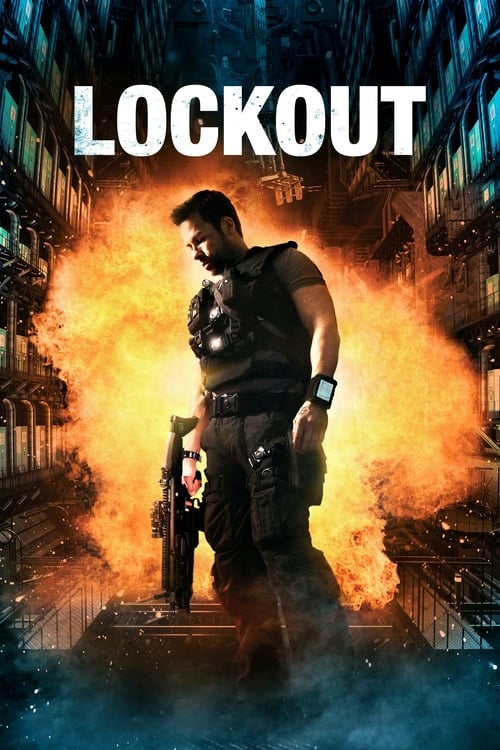
Lockout (2012)
Directed by Stephen St. Leger
No — Lockout is not woke, scoring 17 out of 100 on our wokeness meter.
Lockout arrives in 2012 with a Luc Besson script, a Guy Pearce smirk, and a French court judgment waiting for it three years down the road.
Consciousness Markers
The film offers a strong critique of unchecked government power and the oppressive nature of the orbital prison system.
Emilie is portrayed as a capable and resilient figure, but her role primarily serves as a plot catalyst for the male protagonist's journey.
The film relies heavily on a traditional, predominantly white ensemble, offering little in the way of meaningful diverse representation.
Mace's dementia is used as a plot device to create incoherence, rather than being explored as a nuanced character trait.
The setting is space, but the narrative focuses entirely on political and security crises, not environmental degradation.
There are no discernible LGBTQ+ themes, characters, or subtext present in the narrative.
The film makes no attempt to address or critique racial dynamics within its futuristic setting.
The focus is strictly on action and physical capability, with no commentary on body image or diversity.
The conspiracy is standard sci-fi fare and does not challenge established historical facts or narratives.
The film is driven by action and plot mechanics, lacking any didactic social commentary or philosophical monologues.
Why it received this score
Lockout arrives in 2012 with a Luc Besson script, a Guy Pearce smirk, and a French court judgment waiting for it three years down the road. John Carpenter would eventually win damages for the resemblance to Escape from New York, and the resemblance is not subtle. A wrongly convicted agent is offered his freedom in exchange for retrieving the President's daughter from an orbital penitentiary that has fallen to its inmates. The machinery is efficient. The characters are not complicated. Snow wisecracks through a hostage crisis the way a man orders coffee.
The film's politics are narrower than its premise suggests. The prison system here is run by the state for the state, and the inmates are used as test subjects without consent, which gives the story a decent, if familiar, suspicion of institutional power. That suspicion stops at the walls of the facility. The cast is overwhelmingly white, and the narrative has no interest in race, sexuality, or the body as a site of meaning. Maggie Grace's Emilie is competent and survives on her own initiative, though her function is to be rescued and to soften the hero. The one portrayal of mental deterioration is played for plot utility. A confused man rambles a code, and the film moves on.
It carries itself without sermons, which is its saving grace and also its limitation. There is a glance at the ethics of stasis confinement and nothing more. No speeches. No lessons. Besson's fingerprints show in the efficiency, not the ideology. The result is a serviceable B-movie with a decent anticapitalist sneer, a mostly indifferent social imagination, and a leading man who deserved better material. The classification is straightforward. The rewatchability is a separate question, and the answer is no.
Analysis generated by our Consciousness Algorithm


Synopsis
Set in the near future, Lockout follows a falsely convicted ex-government agent , whose one chance at obtaining freedom lies in the dangerous mission of rescuing the President's daughter from rioting convicts at an outer space maximum security prison.
Questions about Lockout
Is Lockout woke?
No — Lockout is not woke, scoring 17 out of 100 on our wokeness meter. That earns it a verdict of Ultra Based.
Does Lockout have any woke elements?
1 of the 10 markers register at 30 or above, led by Eat the Rich (55). On Eat the Rich: The film offers a strong critique of unchecked government power and the oppressive nature of the orbital prison system.
How does Lockout compare to other 2012 movies?
It ranks #53 of the 230 films from 2012 we've scored; their average is 12. The wokest is Killing Them Softly (92).
How is the Woke Score calculated?
An AI-assisted process researches the film and its reception, scores it 0–100 on ten markers, then combines those into one 0–100 Woke Score. It measures a specific set of 2020s cultural themes, not film quality.