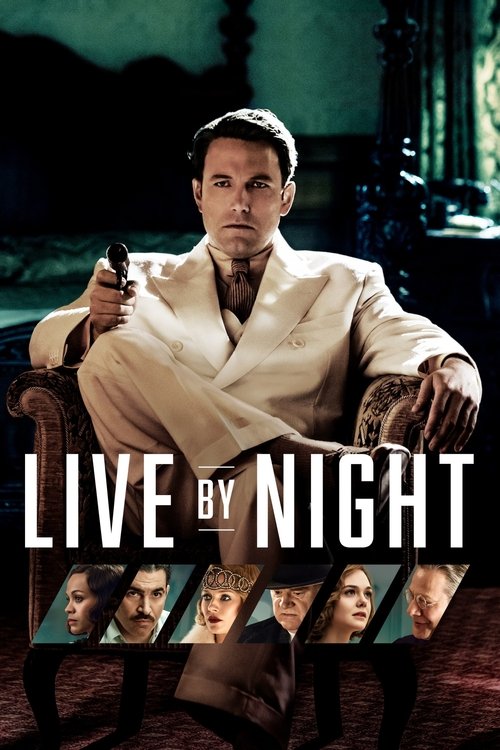
Live by Night (2016)
Directed by Ben Affleck
No — Live by Night is not especially woke, scoring 20 out of 100 on our wokeness meter.
Ben Affleck directs himself in a Prohibition-era crime saga that moves from Boston to Tampa's Ybor City, where a bootlegger named Joe Coughlin builds a rum empire, murders a chapter of the Ku Klux Klan, and eventually builds houses for the poor.
Consciousness Markers
The Ku Klux Klan is the villain, targeting immigrant and Cuban communities, and Joe wages a violent campaign against them; this is period-appropriate historical content rather than modern racial messaging.
The cast includes Zoe Saldaña and Miguel as Cuban characters, and the Ybor City Cuban community is central to the setting, though the film is anchored by a white Irish-American protagonist.
Elle Fanning's Loretta and Sienna Miller's Emma have arcs and some agency, but the narrative is overwhelmingly a male gangster saga centered on Affleck's Joe.
Loretta's preaching against alcohol and gambling provides mild moralizing, but the film is largely a conventional crime drama without overt sermonizing.
The film is a bootlegging and casino-building crime saga with no critique of capitalism; Joe's late-life charity is personal redemption, not economic commentary.
No LGBTQ+ characters or themes appear in the film.
No environmental or climate themes are present.
No body positivity themes or content.
No neurodivergent characters or themes.
The film is a straightforward period adaptation of a Lehane novel, not a revisionist retelling of history.
Why it received this score
Ben Affleck directs himself in a Prohibition-era crime saga that moves from Boston to Tampa's Ybor City, where a bootlegger named Joe Coughlin builds a rum empire, murders a chapter of the Ku Klux Klan, and eventually builds houses for the poor. The production is handsome. The suits are excellent. The film, however, arrives with the weary air of a project green-lit on reputation and finished on a schedule.
On the matter of representation, the Cuban community of Ybor City is woven into the setting, with Zoe Saldana and Miguel in supporting roles, though the camera never leaves the white Irish-American protagonist for long. Elle Fanning's Loretta and Sienna Miller's Emma are given arcs and flashes of agency inside a story that remains a male gangster chronicle. The Klan functions as the villain, targeting immigrants and Cubans, and Joe's campaign against them is bloody and satisfying. It is also period-accurate historical texture, not a modern sermon. The film has no interest in climate, body image, neurodivergence, or queer lives. It has no interest in queerness of any kind, which for a 2016 gangster picture is simply the default.
The economic imagination on display is entirely criminal and entirely uncritical: rum, casinos, narcotics, and a late turn toward charity that reads as personal penance, not political argument. Loretta's pulpit denunciations of drink and gambling supply the only moralizing, and even those are undercut by her private confession of unbelief. The result is a film that gestures toward social texture without committing to any argument, a well-tailored misfire that asks nothing of its audience except patience.
Analysis generated by our Consciousness Algorithm
Part of


Synopsis
A group of Boston-bred gangsters set up shop in balmy Florida during the Prohibition era, facing off against the competition and the Ku Klux Klan.
Questions about Live by Night
Is Live by Night woke?
No — Live by Night is not especially woke, scoring 20 out of 100 on our wokeness meter. That earns it a verdict of Based.
Does Live by Night have any woke elements?
2 of the 10 markers register at 30 or above, led by Racial Consciousness (40) and Representation Casting (35). On Racial Consciousness: The Ku Klux Klan is the villain, targeting immigrant and Cuban communities, and Joe wages a violent campaign against them; this is period-appropriate historical content rather than modern racial messaging.
How does Live by Night compare to other 2016 movies?
It ranks #78 of the 285 films from 2016 we've scored; their average is 16. The wokest is 13th (92).
How is the Woke Score calculated?
An AI-assisted process researches the film and its reception, scores it 0–100 on ten markers, then combines those into one 0–100 Woke Score. It measures a specific set of 2020s cultural themes, not film quality.