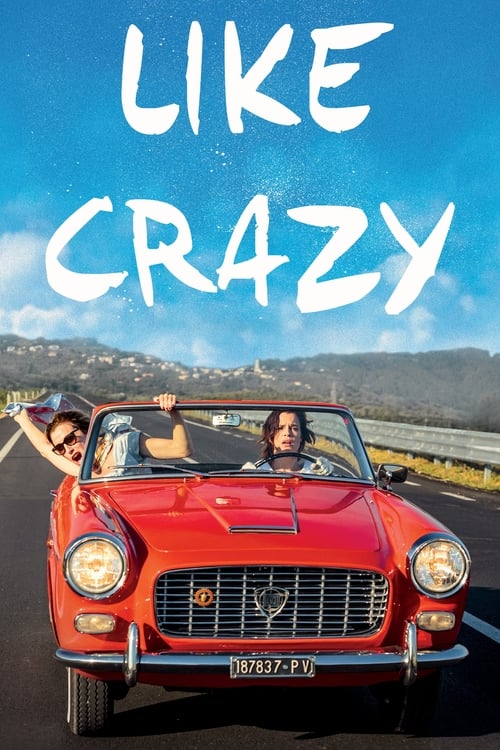
Like Crazy (2016)
Directed by Paolo Virzì
No — Like Crazy is not especially woke, scoring 31 out of 100 on our wokeness meter.
Paolo Virzi's Like Crazy, released in its native Italy as La pazza gioia, follows two women who meet inside a Tuscan psychiatric facility and then leave it together.
Consciousness Markers
The film is set in a mental institution and sympathetically portrays patients with mental illness, which can be seen as neurodivergence representation, though it predates the modern neurodiversity movement.
The film centers on two women and their friendship, and critiques patriarchal control through their experiences with family and institutions, but it is not explicitly feminist in a modern activist sense.
The film has some social commentary on mental health care, but it is delivered through character drama rather than preachy lecturing.
The cast is entirely white Italian actors, with no racial or ethnic diversity in prominent roles.
There are no LGBTQ+ characters or themes in the film.
The film does not engage with racial issues or racial consciousness.
There is no environmental or climate-related content.
The film does not critique capitalism or wealth inequality as a central theme.
There is no focus on body positivity or body image issues.
The film is a fictional contemporary story and does not revise historical narratives.
Why it received this score
Paolo Virzi's Like Crazy, released in its native Italy as La pazza gioia, follows two women who meet inside a Tuscan psychiatric facility and then leave it together. Beatrice is a wealthy, voluble fantasist. Donatella is a withdrawn young mother with a history of institutional care. The film sends them into the Italian countryside in a borrowed van, and the resulting road movie is warm, episodic, and content to let its leads carry the weight. Valeria Bruni Tedeschi and Micaela Ramazzotti are given room to be messy, and they take it.
The film's political instincts are modest and largely structural. It places two women at the center of a story that belongs to them, gives their friendship the seriousness usually reserved for romance, and lets the men in their lives (a violent husband, a cold father, a series of indifferent officials) stand as obstacles instead of saviors. That is a quiet critique of patriarchal control, though it arrives dressed as character drama and never announces itself as a thesis. The setting inside a mental institution does more visible work. Patients are shown as funny, cruel, tender, and fully human, and the film treats their conditions with sympathy instead of spectacle. It predates the vocabulary now used to discuss such things, but the impulse is recognizable.
The film's omissions are instructive. The cast is uniformly white and the story has no interest in race, class warfare, environmental anxiety, or the politics of the body. Its social commentary on mental health care surfaces through plot and performance, never through speeches. The result is a humane, well-acted, faintly old-fashioned picture, one that stirs progressive feeling without ever organizing it into a program.
Analysis generated by our Consciousness Algorithm


Synopsis
Two mental patients with opposite personalities ditch their Tuscan hospital and embark on an unpredictable exploration of the real world.
Questions about Like Crazy
Is Like Crazy woke?
No — Like Crazy is not especially woke, scoring 31 out of 100 on our wokeness meter. That earns it a verdict of Based.
Does Like Crazy have any woke elements?
2 of the 10 markers register at 30 or above, led by Neurodivergence (50) and Feminist Agenda (35). On Neurodivergence: The film is set in a mental institution and sympathetically portrays patients with mental illness, which can be seen as neurodivergence representation, though it predates the modern neurodiversity movement.
How does Like Crazy compare to other 2016 movies?
It ranks #38 of the 285 films from 2016 we've scored; their average is 16. The wokest is 13th (92).
How is the Woke Score calculated?
An AI-assisted process researches the film and its reception, scores it 0–100 on ten markers, then combines those into one 0–100 Woke Score. It measures a specific set of 2020s cultural themes, not film quality.