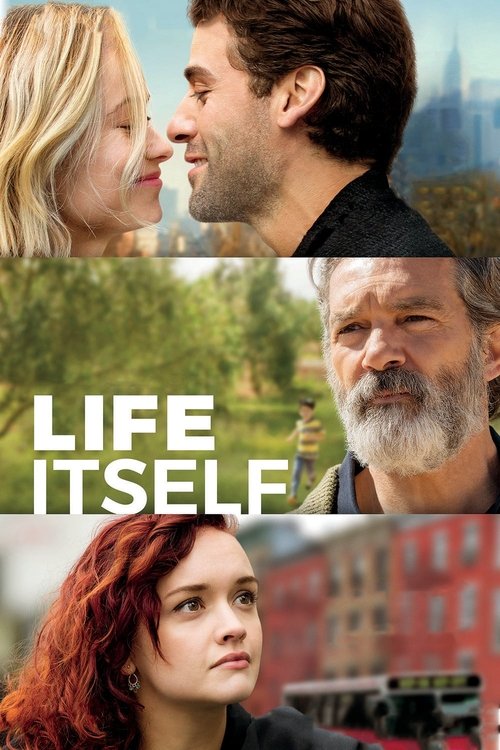
Life Itself (2018)
Directed by Dan Fogelman
No — Life Itself is not woke, scoring 14 out of 100 on our wokeness meter.
Dan Fogelman's Life Itself arrives with the confidence of a man who believes he has solved something, and the reception suggests he has not.
Consciousness Markers
The ensemble is notably diverse, pairing Oscar Isaac, Samuel L. Jackson, and a Spanish-language storyline (Antonio Banderas, Laia Costa, Sergio Peris-Mencheta) with an intercultural Rodrigo/Shari romance. The diversity is present but largely incidental rather than a stated representational mission.
Heavy voiceover, an explicit 'life is the ultimate unreliable narrator' thesis, and a closing moral about finding love make the film preachy and spoon-fed, though its sermon is sentimental rather than social-justice oriented.
Abby's thesis on the unreliable narrator and the mother-daughter-granddaughter chain (Abby, Dylan, Elena) give women narrative weight, but the film frames them through sentiment and fate rather than any feminist argument.
Will's psychiatric hospitalization and therapy, plus Rodrigo's trauma-induced sleeplessness, put mental health on screen, but they are framed as grief and trauma rather than neurodivergent identity.
An intercultural relationship and an immigrant Spanish family feature, but race is never examined or commented upon as a social subject.
A mild class tension exists between the wealthy landowner Saccione and his worker Javier, but it is treated as personal jealousy and melodrama rather than an economic critique.
No LGBTQ+ characters, relationships, or themes appear anywhere in the intergenerational narrative.
No environmental or climate themes are present in the film.
No body-positivity themes or messaging appear in the film.
The film is a contemporary fictional melodrama with no historical subject matter to revise.
Why it received this score
Dan Fogelman's Life Itself arrives with the confidence of a man who believes he has solved something, and the reception suggests he has not. The film moves from a New York couple to an olive plantation in Spain, then back across a generation, tying every tragedy to a single bus. Samuel L. Jackson narrates. Then he stops narrating, and another narrator takes over, and the whole apparatus groans under the weight of its own cleverness. This is a film about the unreliable narrator in which the narrator is merely unreliable in the way that a faulty GPS is unreliable, which is to say constantly and without much insight.
The ensemble is genuinely varied. Oscar Isaac and Olivia Wilde anchor the American chapters; Antonio Banderas, Laia Costa, and Sergio Peris-Mencheta carry the Spanish ones; Samuel L. Jackson and Annette Bening drift through as structural devices. The Rodrigo and Shari romance crosses cultures without ever discussing what that crossing means, which is either restraint or avoidance depending on one's mood. Women hold the emotional architecture here, mothers and daughters and grandmothers arranged in a chain of grief, though the film treats them as vessels for sentiment rather than as people making arguments about anything. Will's psychiatric hospitalization and Rodrigo's sleeplessness put mental suffering on screen, framed as trauma and mourning, never as identity. There is a faint class friction between the landowner Saccione and his foreman Javier, but it resolves into jealousy and melodrama, not economics.
The film's true affliction is its voiceover. It explains, then re-explains, then delivers a closing thesis about love that lands like a greeting card stapled to a brick. Kate Erbland observed that the movie thinks you are stupid, and the diagnosis holds: every revelation is ladled out, every theme restated. The result is earnest, overlong, and strangely proud of its own contrivance, a melodrama that mistakes accumulation for meaning. Classification is straightforward. Nothing here sermonizes about history, climate, or bodies. It sermonizes about fate, and it does so at volume.
Analysis generated by our Consciousness Algorithm

Synopsis
As a young New York couple goes from college romance to marriage and the birth of their first child, the unexpected twists of their journey create reverberations that echo over continents and through lifetimes.
Questions about Life Itself
Is Life Itself woke?
No — Life Itself is not woke, scoring 14 out of 100 on our wokeness meter. That earns it a verdict of Ultra Based.
Does Life Itself have any woke elements?
1 of the 10 markers register at 30 or above, led by Representation Casting (40). On Representation Casting: The ensemble is notably diverse, pairing Oscar Isaac, Samuel L.
How does Life Itself compare to other 2018 movies?
It ranks #152 of the 325 films from 2018 we've scored; their average is 20. The wokest is Return (92).
How is the Woke Score calculated?
An AI-assisted process researches the film and its reception, scores it 0–100 on ten markers, then combines those into one 0–100 Woke Score. It measures a specific set of 2020s cultural themes, not film quality.