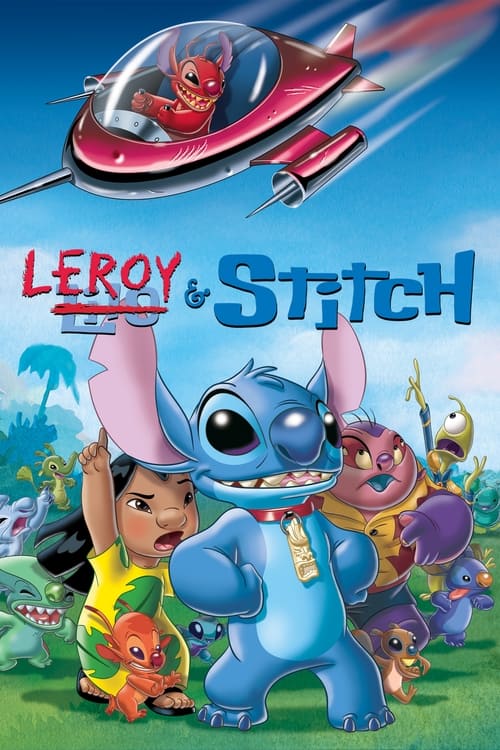
Leroy & Stitch (2006)
Directed by Bobs Gannaway
No — Leroy & Stitch is not woke, scoring 6 out of 100 on our wokeness meter.
Leroy & Stitch arrives as the fourth feature in the Lilo & Stitch franchise and the finale to the animated series, a 2006 direct-to-video affair in which Stitch, Jumba, and Pleakley are lured into Galactic Alliance posts while Dr. Hämsterviel escapes prison and forces the creation of a red clone army.
Consciousness Markers
The film centers a Native Hawaiian girl and features a diverse voice cast, but this diversity is inherent to the established franchise setting rather than a modern casting initiative.
Lilo is a capable young female lead and the Grand Councilwoman is a female authority figure, but the film advances no feminist thesis or commentary.
Hawaiian cultural touchstones like ʻohana and aloha are present as setting and sentiment, but the film makes no racial or social-justice argument.
No LGBTQ+ characters, themes, or subtext appear anywhere in the film.
No environmental or climate themes are present; the conflict is a galactic villain and his clone army.
There is no economic critique or eat-the-rich messaging; the antagonist is a megalomaniacal alien scientist.
No body-positivity themes or messaging appear in the film.
No neurodivergence themes or neurodiverse representation are present.
The film is a fictional sci-fi adventure with no historical subject matter to revise.
This is a breezy direct-to-video adventure finale with no preachy or didactic messaging.
Why it received this score
Leroy & Stitch arrives as the fourth feature in the Lilo & Stitch franchise and the finale to the animated series, a 2006 direct-to-video affair in which Stitch, Jumba, and Pleakley are lured into Galactic Alliance posts while Dr. Hämsterviel escapes prison and forces the creation of a red clone army. The plot runs on Elvis records, tiki necklaces, black holes, and a stadium battle. Its cultural inheritance is clear. Lilo is a Native Hawaiian girl, the setting is Hawaii, and the vocabulary of ʻohana and aloha carries the emotional weight. That inheritance supplies a modest baseline of representation and cultural texture. It does not arrive as a modern casting statement, nor does it build an argument about race or identity. The diversity is simply the world the franchise already established.
Elsewhere the film is quiet. There are no LGBTQ characters or themes. The environmental question never surfaces, since the black hole is a plot device and not a sermon on carbon. The villain is a megalomaniacal alien scientist, which leaves no room for an economic critique of the wealthy. Body positivity, neurodivergence, and historical revisionism are absent. The film is fictional space opera, and its history is confined to a scrapbook of genetic experiments. Lilo is capable and the Grand Councilwoman holds authority, yet the story advances no feminist thesis. Hawaiian cultural markers appear as sentiment, not as a racial justice platform. The tone stays breezy. This is a direct-to-video adventure meant to close a series, and it has no interest in lecturing its audience.
The result is a mild vintage. It has faint notes of island warmth, female competence, and communal loyalty, all poured into a familiar Disney TV animation vessel. The aftertaste is harmless and slightly thin. For those of us who catalog social consciousness with a sommelier's patience, Leroy & Stitch offers little to swirl and discuss. It is not offensive, not preachy, and not especially ambitious. It simply says aloha, ties up loose ends, and leaves the cellar.
Analysis generated by our Consciousness Algorithm
Part of


Synopsis
Lilo, Stitch, Jumba, and Pleakley have finally caught all of Jumba's genetic experiments and found the one true place where each of them belongs. Stitch, Jumba and Pleakley are offered positions in the Galactic Alliance, turning them down so they can stay on Earth with Lilo, but Lilo realizes her alien friends have places where they belong – and it's finally time to say "aloha".
Questions about Leroy & Stitch
Is Leroy & Stitch woke?
No — Leroy & Stitch is not woke, scoring 6 out of 100 on our wokeness meter. That earns it a verdict of Ultra Based.
Does Leroy & Stitch have any woke elements?
Very few. None of the 10 markers reaches 30, the level where a marker counts as present; the highest is Representation Casting at 20.
How does Leroy & Stitch compare to other 2006 movies?
It ranks #121 of the 211 films from 2006 we've scored; their average is 11. The wokest is An Inconvenient Truth (92).
Is Leroy & Stitch the most woke Lilo & Stitch (Animated) movie?
No. It ranks #4 of the 4 Lilo & Stitch (Animated) films we've scored; the wokest is Lilo & Stitch (28).