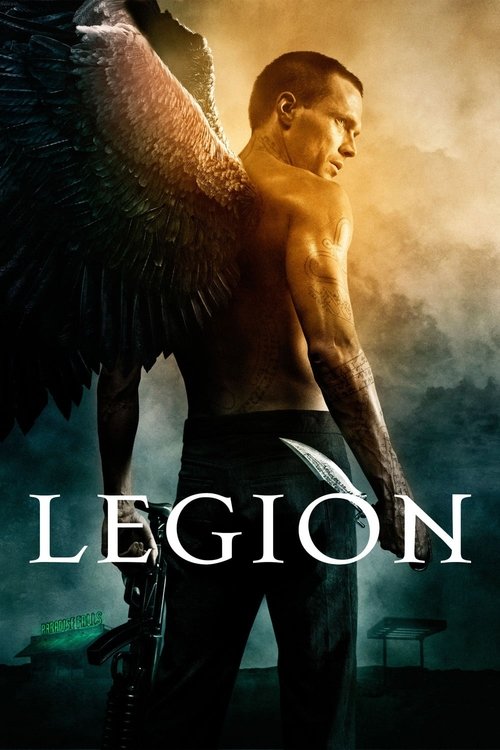
Legion (2010)
Directed by Scott Stewart
No — Legion is not woke, scoring 6 out of 100 on our wokeness meter.
Legion arrives from 2010 with the confidence of a film that treats the apocalypse as a genre exercise and not a warning.
Consciousness Markers
The cast includes Black actors Tyrese Gibson and Charles S. Dutton in prominent roles, but they exist naturally within the ensemble with no commentary on their race or identity, so this is ordinary casting rather than deliberate representation casting.
The film gestures at themes of faith and God's mercy versus wrath, but these are delivered as pulpy action-horror beats rather than preachy moral instruction.
Adrianne Palicki's Charlie is largely defined by her pregnancy and role as mother of the savior, and the female characters are mostly reactive; there is no feminist agenda at work.
There are no LGBTQ+ characters, themes, or subtext anywhere in the film.
The film engages no racial themes or commentary whatsoever; its conflict is entirely theological.
The apocalypse here is divine, not environmental; there is no climate messaging.
No economic critique or eat-the-rich sentiment appears; the enemy is God's angelic host, not capital.
No body-positivity themes are present.
No neurodivergent characters or themes are depicted.
The film is a supernatural fantasy with no historical subject matter to revise.
Why it received this score
Legion arrives from 2010 with the confidence of a film that treats the apocalypse as a genre exercise and not a warning. Scott Stewart directs a desert diner full of strangers as God's angels descend to end humanity, and the Archangel Michael (Paul Bettany) saws off his wings to defend a pregnant waitress and her unborn savior. The ensemble includes Tyrese Gibson and Charles S. Dutton. They are simply present, doing their jobs, with no narrative comment on their race, which is ordinary casting and nothing more. The theology is loud. The pacing is not. The whole affair plays like a sermon delivered to a congregation that quietly left an hour ago.
On the ledger of social consciousness, the entries are few. Charlie (Adrianne Palicki) exists to be pregnant and to be protected, a vessel with a name tag, and the film shows no interest in her interior life, which keeps any feminist reading at the level of a shrug. There is no LGBTQ presence, no racial argument, no environmental parable (the fire raining from the sky is divine, not industrial), and no economic grievance. The enemy is heaven, not capital. Body positivity and neurodivergence make no appearance. There is no history here to revise, only a Mojave that never existed.
Where the film does gesture toward instruction is in its theology, Michael's insistence that mercy outweighs wrath, delivered between gunfights and exploding boils. That is pulpy, not preachy. It wants to entertain and mostly fails at that too, landing at a 20 percent approval rating and a C- from audiences. It opened second behind Avatar, a fate worse than damnation. It leaves behind a curious artifact: a religious action film whose only discernible moral is the value of owning firearms, a point a critic at the time raised with some alarm. We classify it accordingly.
Analysis generated by our Consciousness Algorithm


Synopsis
When God loses faith in humankind, he sends his legion of angels to bring on the Apocalypse. Humanity's only hope for survival lies in a group of strangers trapped in an out-of-the-way, desert diner with the Archangel Michael.
Questions about Legion
Is Legion woke?
No — Legion is not woke, scoring 6 out of 100 on our wokeness meter. That earns it a verdict of Ultra Based.
Does Legion have any woke elements?
Very few. None of the 10 markers reaches 30, the level where a marker counts as present; the highest is Representation Casting at 15.
How does Legion compare to other 2010 movies?
It ranks #138 of the 238 films from 2010 we've scored; their average is 11. The wokest is My Name Is Khan (84).
How is the Woke Score calculated?
An AI-assisted process researches the film and its reception, scores it 0–100 on ten markers, then combines those into one 0–100 Woke Score. It measures a specific set of 2020s cultural themes, not film quality.