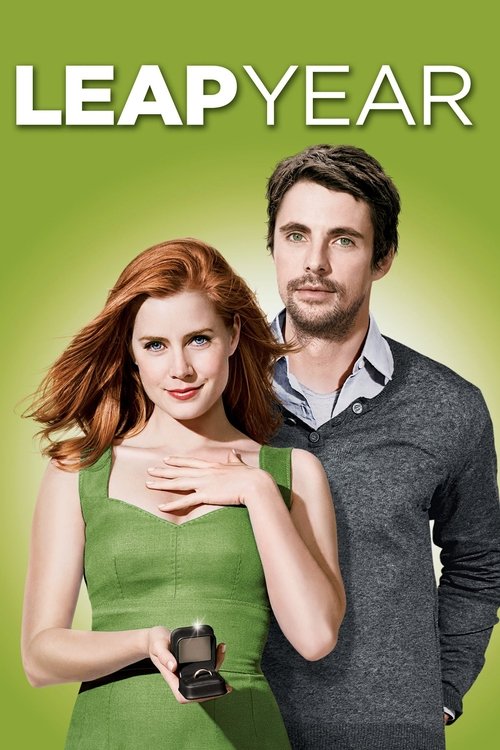
Leap Year (2010)
Directed by Anand Tucker
No — Leap Year is not woke, scoring 8 out of 100 on our wokeness meter.
Leap Year arrives from 2010 with the confidence of a film that believes it has found a novel premise: an American woman flies to Ireland to exploit a folk tradition permitting women to propose on February 29.
Consciousness Markers
The premise hinges on the Irish 'Bachelor's Day' tradition letting a woman propose, a mild inversion of gender roles, but the film remains a conventional rom-com in which the heroine chases a man and is rewarded with marriage. Critics, notably The Irish Times, called it 'reactionary.'
A minor subplot involves Declan's pub facing foreclosure and the community rallying to save it, and Jeremy's proposal is motivated by a co-op board's approval process. These are faint gestures at anti-materialism, not a coherent 'eat the rich' thesis.
The cast is overwhelmingly white, with no meaningful racial or ethnic diversity in principal or supporting roles. No casting choices appear designed to signal representation.
There are no LGBTQ+ characters, relationships, or themes anywhere in the film.
No engagement with race, racism, or racial identity. The film's cultural friction is entirely about Irish-vs-American stereotypes, not race.
No environmental or climate themes of any kind.
No body positivity themes; the film does not address body image or size acceptance.
No neurodivergent characters or themes are present.
No historical revisionism; the film is a contemporary-set romantic comedy with no historical narrative to revise.
The film is a light, formulaic rom-com that makes no attempt to deliver social or political messaging to the audience.
Why it received this score
Leap Year arrives from 2010 with the confidence of a film that believes it has found a novel premise: an American woman flies to Ireland to exploit a folk tradition permitting women to propose on February 29. Anna Brady, played by Amy Adams, is a Boston real estate stager who cannot extract a ring from her cardiologist boyfriend. The tradition functions as a gentle inversion of courtship protocol, and it is the only gender-role negotiation the screenplay is willing to entertain. The heroine still spends the running time pursuing a man across a damp countryside, and the reward remains a wedding. The Irish Times called the picture reactionary. That verdict holds up.
What follows is a road trip assembled from weather delays, ruined shoes, and a stolen suitcase. Declan O'Callaghan, the surly publican, agrees to drive Anna to Dublin for five hundred euro because his establishment faces foreclosure. The debt subplot gestures at community solidarity and the indifference of banks, though the film's interest in economics extends no further than a collection tin passed around a bar. Her romantic rival, Jeremy, proposes only because a co-op board prefers married applicants. Money and property intrude on love, briefly, and then depart without further comment.
The cast is uniformly white, the humor leans on shamrocks and accents, and no social question is raised that a montage cannot settle. There is no racial reckoning, no environmental sermon, no meditation on body image or neurodivergence. The film wants only to deliver two attractive people into each other's arms beside a cliff. Amy Adams remains winning. The film around her remains a Shamrock Shake, artificially sweet and authentically Gaelic in roughly the way a greeting card is authentic. Its cultural awareness is thin, its lecture energy absent, and its ambitions modest. We classify it accordingly and move on to the next vintage.
Analysis generated by our Consciousness Algorithm
Part of


Synopsis
When yet another anniversary passes without a marriage proposal from her boyfriend, Anna decides to take action. Aware of a Celtic tradition that allows women to pop the question on Feb. 29, she plans to follow her lover to Dublin and ask him to marry her. Fate has other plans, however, and Anna winds up on the other side of the Emerald Isle with handsome, but surly, Declan -- an Irishman who may just lead Anna down the road to true love.
Questions about Leap Year
Is Leap Year woke?
No — Leap Year is not woke, scoring 8 out of 100 on our wokeness meter. That earns it a verdict of Ultra Based.
Does Leap Year have any woke elements?
Very few. None of the 10 markers reaches 30, the level where a marker counts as present; the highest is Feminist Agenda at 15.
How does Leap Year compare to other 2010 movies?
It ranks #100 of the 238 films from 2010 we've scored; their average is 11. The wokest is My Name Is Khan (84).
How is the Woke Score calculated?
An AI-assisted process researches the film and its reception, scores it 0–100 on ten markers, then combines those into one 0–100 Woke Score. It measures a specific set of 2020s cultural themes, not film quality.