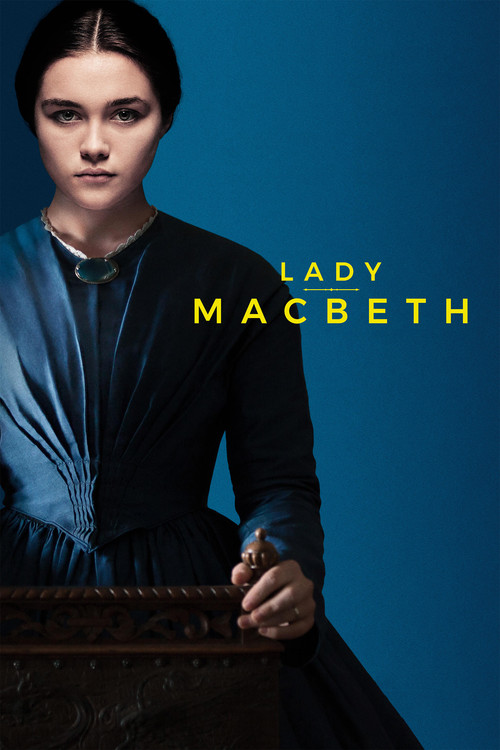
Lady Macbeth (2016)
Directed by William Oldroyd
Partly — Lady Macbeth is somewhat woke, scoring 44 out of 100 on our wokeness meter.
Lady Macbeth arrives in 1865 Northumberland with the manners of a restrained chamber drama and the pulse of a quiet horror film.
Consciousness Markers
The film employs deliberate colour-blind casting, placing Black actors in key roles (Naomi Ackie, Cosmo Jarvis, Golda Rosheuvel, Anton Palmer) in a Victorian English setting, a notable departure from traditional all-white period dramas.
The narrative centers on a woman's violent rebellion against patriarchal control and her commodification in marriage, though it presents her as a morally ambiguous anti-heroine rather than a straightforward feminist icon.
The film deliberately diversifies a Victorian English setting based on research suggesting greater historical racial diversity, challenging the conventional all-white portrayal of period dramas.
The colour-blind casting adds an implicit racial dimension to the themes of gender and class, but the film does not explicitly address racism or racial injustice in its plot.
The film critiques the aristocratic class system and the treatment of women as property, but its focus is on power and gender rather than a systemic anti-capitalist message.
The film is a restrained, show-don't-tell period drama that avoids explicit preaching, though its themes of gender and class carry implicit commentary.
No LGBTQ+ themes or characters are present.
No environmental or climate-related themes.
No body positivity themes.
No neurodivergence themes.
Why it received this score
Lady Macbeth arrives in 1865 Northumberland with the manners of a restrained chamber drama and the pulse of a quiet horror film. Its most modern gesture is the casting. Naomi Ackie, Cosmo Jarvis, Golda Rosheuvel, and Anton Palmer occupy key roles in a Victorian English household, a choice that disrupts the usual all-white pageant of the period piece. The film does not stop to explain this. It simply lets the faces inhabit the rooms, and in doing so it adds an implicit racial dimension to the existing themes of gender and class. That dimension remains subtext. The screenplay never turns it into a lesson about racism, which keeps the film from becoming a tract. The result is a work of social consciousness that trusts its images more than its dialogue.
The story follows Katherine, played by Florence Pugh, as she suffocates inside a marriage that treats her as purchased property. Her rebellion is violent, adulterous, and ultimately murderous. She is not offered as a feminist saint. She is an anti-heroine whose rage is understandable and whose actions are appalling. The film critiques the aristocratic order that owns her, but its target is power and gender, not capitalism as a system. There is no economic manifesto here, only the cold arithmetic of who gets to inherit the house. Oldroyd directs with static frames, natural light, and long, unblinking takes. The effect is severe and unsentimental. The film has no interest in telling us how to feel. It watches.
What the film lacks is equally telling. It has no LGBTQ current, no environmental sermon, no body-positive detour, no neurodivergent arc. Its historical revisionism lives in the casting and in the research suggesting a more diverse 19th-century England than costume dramas usually admit. That is a genuine challenge to convention, though it arrives without a speech. The film's cultural awareness is embedded, not announced. It is a chilly, precise, morally slippery piece of work. It does not lecture. It simply leaves us in the room with Katherine, and the silence is worse than any sermon.
Analysis generated by our Consciousness Algorithm


Synopsis
Rural England, 1865. Katherine, suffocated by her loveless marriage to a bitter man and restrained by his father's tyranny, unleashes an irresistible force within her, so powerful that she will stop at nothing to get what she wants.
Questions about Lady Macbeth
Is Lady Macbeth woke?
Partly — Lady Macbeth is somewhat woke, scoring 44 out of 100 on our wokeness meter. That earns it a verdict of Woke-Adjacent.
What makes Lady Macbeth woke?
4 of the 10 markers register at 30 or above, led by Representation Casting (75), Feminist Agenda (65) and Revisionist History (50). On Representation Casting: The film employs deliberate colour-blind casting, placing Black actors in key roles (Naomi Ackie, Cosmo Jarvis, Golda Rosheuvel, Anton Palmer) in a Victorian English setting, a notable departure from traditional all-white period dramas.
How does Lady Macbeth compare to other 2016 movies?
It ranks #20 of the 285 films from 2016 we've scored; their average is 16. The wokest is 13th (92).
How is the Woke Score calculated?
An AI-assisted process researches the film and its reception, scores it 0–100 on ten markers, then combines those into one 0–100 Woke Score. It measures a specific set of 2020s cultural themes, not film quality.