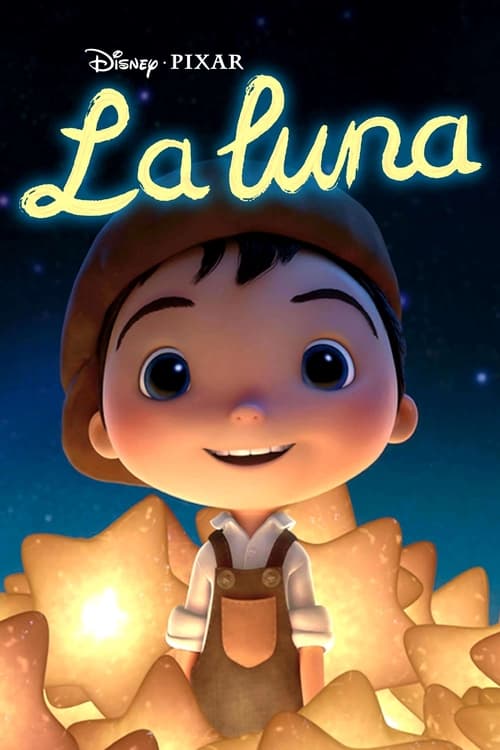
La luna (2012)
Directed by Enrico Casarosa
No — La luna is not woke, scoring 0 out of 100 on our wokeness meter.
La Luna is a wordless Pixar short from 2011, directed by Enrico Casarosa, in which three generations of Italian men row out to sea, climb a ladder to the moon, and sweep fallen stars into a crescent.
Consciousness Markers
The voice cast is small and Italian, cast for the characters' cultural specificity rather than any diversity initiative; no representation agenda is present.
No LGBTQ+ characters, themes, or subtext appear in this short about a boy, his father, and grandfather.
The narrative centers entirely on three generations of men and patriarchal tradition; no feminist critique or themes are engaged.
Race plays no role in this wordless Italian fable about lunar star-sweeping.
The moon-cleaning is a whimsical fantasy conceit, not an environmental allegory or climate message.
No economic or class critique; the family's labor is treated as charming tradition.
No body image themes are present.
No neurodivergent characters or themes appear.
No historical revisionism; the film is a fantasy inspired by Italo Calvino, not a reworking of real events.
The short is nearly wordless and gently observational, delivering no moral instruction or message-mongering.
Why it received this score
La Luna is a wordless Pixar short from 2011, directed by Enrico Casarosa, in which three generations of Italian men row out to sea, climb a ladder to the moon, and sweep fallen stars into a crescent. It is loosely based on Italo Calvino, which is the most intellectually ambitious thing about it. The film is charming, gentle, and entirely devoid of the cultural signifiers that occupy our current discourse.
We look for a diversity agenda and find an Italian family cast for cultural specificity. We look for a feminist critique and find a patriarchal tradition treated as a charming inheritance. The boy's independence is expressed by turning his cap backward, not by dismantling the gender binary. There is no racial commentary, no climate allegory (the moon is not a stand-in for carbon emissions), no economic critique (the family's labor is whimsical, not exploited), no body image themes, no neurodivergent characters, no historical revisionism. The film is nearly wordless and delivers no lecture. It is, in short, a film about sweeping.
This is not a failure. It is simply a film from a different era, or perhaps from no era at all, content to be a fable about a boy and his brooms. The cultural awareness on display is the awareness that a star is heavy and a rake is useful. We award it nothing on any of our ten markers, not out of hostility, but out of precision. It is a zero. A clean, lunar zero. And there is something almost restful about that.
Analysis generated by our Consciousness Algorithm
Part of

Synopsis
A young boy comes of age in the most peculiar of circumstances. Tonight is the very first time his Papa and Grandpa are taking him to work. In an old wooden boat they row far out to sea, and with no land in sight, they stop and wait. A big surprise awaits the boy as he discovers his family's most unusual line of work. Should he follow the example of his Papa, or his Grandpa? Will he be able to find his own way in the midst of their conflicting opinions and timeworn traditions?
Questions about La luna
Is La luna woke?
No — La luna is not woke, scoring 0 out of 100 on our wokeness meter. That earns it a verdict of Ultra Based.
Does La luna have any woke elements?
No. All 10 markers score zero.
How does La luna compare to other 2012 movies?
It ranks #193 of the 230 films from 2012 we've scored; their average is 12. The wokest is Killing Them Softly (92).
How is the Woke Score calculated?
An AI-assisted process researches the film and its reception, scores it 0–100 on ten markers, then combines those into one 0–100 Woke Score. It measures a specific set of 2020s cultural themes, not film quality.