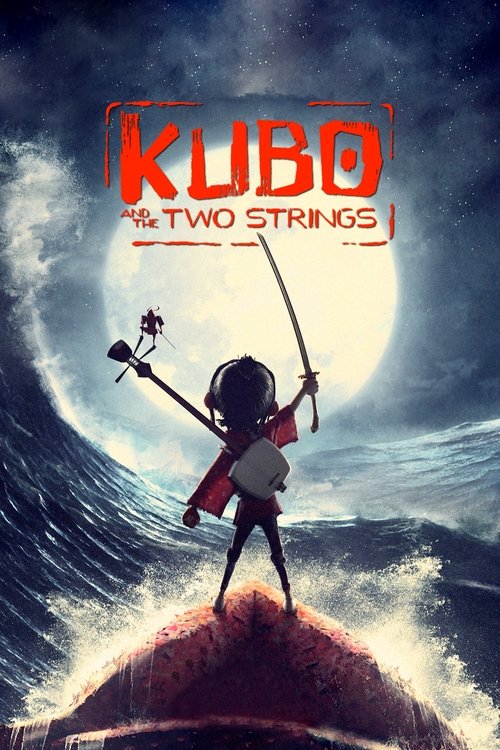
Kubo and the Two Strings (2016)
Directed by Travis Knight
No — Kubo and the Two Strings is not woke, scoring 9 out of 100 on our wokeness meter.
Kubo and the Two Strings is a stop-motion samurai fantasy of genuine visual discipline, and it arrives with a cultural dilemma stitched into its seams.
Consciousness Markers
Set in feudal Japan with an entirely Japanese cast of characters, yet voiced by a predominantly white ensemble (Theron, McConaughey, Fiennes, Mara, Parkinson), drawing whitewashing criticism; only George Takei and Cary-Hiroyuki Tagawa are of Japanese descent and both play minor roles.
Monkey/the mother is a capable warrior who defied the Moon King for love, and the twin Sisters are formidable antagonists, but the narrative remains a boy's quest centered on his father's samurai legacy rather than any feminist thesis.
The finale delivers a gentle moral that memories are the strongest magic and that compassion should be extended even to a defeated enemy, but it is woven into the story rather than preached at the audience.
The film authentically draws on Japanese culture (Bon Festival, samurai, ukiyo-e aesthetics) but never engages race as a theme; the whitewashing controversy is external criticism, not content within the film.
No LGBTQ+ characters, themes, or subtext of any kind.
No environmental or climate themes present.
No economic or class-based critique; the conflict is purely mythic and familial.
No body positivity themes; Beetle's hybrid form is a curse, not a body-acceptance narrative.
The mother's deteriorating mind and Beetle's amnesia are plot devices tied to magic and curses, not depictions of neurodivergence.
A fantasy set in a mythic feudal Japan; it makes no historical claims to revise.
Why it received this score
Kubo and the Two Strings is a stop-motion samurai fantasy of genuine visual discipline, and it arrives with a cultural dilemma stitched into its seams. Set in feudal Japan, it populates its world with Japanese characters and then hands most of their voices to Charlize Theron, Matthew McConaughey, Ralph Fiennes, Rooney Mara, and Art Parkinson. George Takei and Cary-Hiroyuki Tagawa appear, briefly, as though summoned to validate a guest list. The result is a film that borrows ukiyo-e, Bon Festival, shamisen, and samurai armor with reverence, while treating race as a subject it would prefer not to discuss.
The women here are not passive. Monkey is the reincarnated mother, a warrior who defied the Moon King for love. The twin Sisters are elegant and lethal. Yet the story remains Kubo's quest, and its emotional currency is his father's samurai legacy, his mother's sacrifice, and a boy's need to finish a story. This is not a feminist thesis. It is a myth with capable women inside it.
The finale offers a moral: memories are the strongest magic, and compassion should be extended even to a defeated enemy. The villagers choose mercy. The Moon King is stripped of power and becomes a harmless old man. The film does not pause to lecture. It folds the lesson into a climax of strings, lanterns, and ghosts. That restraint is its saving grace. Most markers of modern social consciousness are absent. No LGBTQ themes. No climate crusade. No eat-the-rich anger. No body positivity. No neurodivergence. No historical revision. What remains is a beautiful, melancholy fable with a whitewashed voice cast and a gentle humanist ending. A sommelier might call it a fine vintage with an awkward cork.
Analysis generated by our Consciousness Algorithm


Synopsis
Kubo mesmerizes the people in his village with his magical gift for spinning wild tales with origami. When he accidentally summons an evil spirit seeking vengeance, Kubo is forced to go on a quest to solve the mystery of his fallen samurai father and his mystical weaponry, as well as discover his own magical powers.
Questions about Kubo and the Two Strings
Is Kubo and the Two Strings woke?
No — Kubo and the Two Strings is not woke, scoring 9 out of 100 on our wokeness meter. That earns it a verdict of Ultra Based.
Does Kubo and the Two Strings have any woke elements?
Very few. None of the 10 markers reaches 30, the level where a marker counts as present; the highest is Feminist Agenda at 15.
How does Kubo and the Two Strings compare to other 2016 movies?
It ranks #158 of the 285 films from 2016 we've scored; their average is 16. The wokest is 13th (92).
How is the Woke Score calculated?
An AI-assisted process researches the film and its reception, scores it 0–100 on ten markers, then combines those into one 0–100 Woke Score. It measures a specific set of 2020s cultural themes, not film quality.