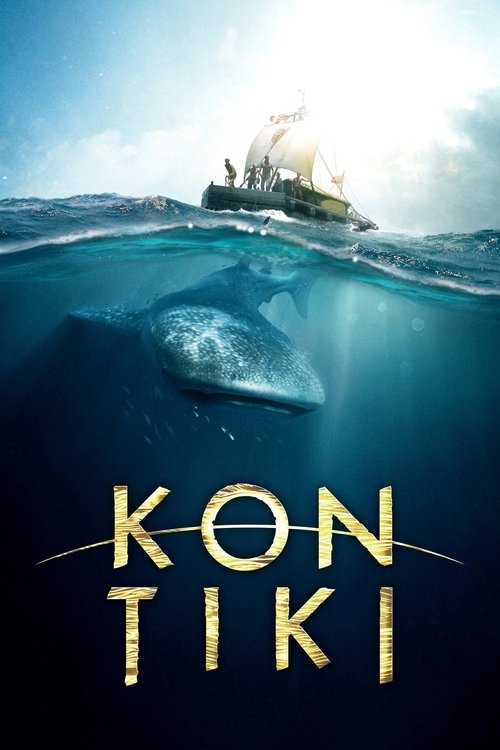
Kon-Tiki (2012)
Directed by Joachim Rønning
No — Kon-Tiki is not woke, scoring 2 out of 100 on our wokeness meter.
Kon-Tiki arrives as a sturdy piece of Scandinavian craftsmanship, a 2012 dramatization of Thor Heyerdahl's 1947 balsa raft crossing, and it conducts itself with the brisk efficiency of a vessel that knows exactly where it is going.
Consciousness Markers
The film touches on pre-Columbian settlement of Polynesia only as a period anthropological theory; it ignores Heyerdahl's own ethnocentric white-race speculations and casts no indigenous Polynesians, so no modern racial consciousness is present.
Liv Heyerdahl exists only as the estranged wife left behind, a conventional dramatic foil. No feminist framework or female agency is offered.
Casting is entirely white Scandinavian men, and the film was explicitly criticized for using Thai extras in place of indigenous Polynesians. There is no representation effort of any kind.
No LGBTQ+ characters, themes, or subtext appear anywhere in this 1940s expedition narrative.
The Pacific setting is backdrop and hazard, not an environmental theme; no climate messaging of any kind.
No critique of capitalism, wealth, or class appears in this survival adventure.
No body-positive themes or messaging about body image.
No neurodivergent characters, diagnoses, or themes.
The film dramatizes and invents episodes (the Watzinger conflict, the parrot, the maelstrom) for entertainment, but none of this reframes history through a modern ideological lens.
A by-the-book adventure yarn that shows rather than preaches; there is no didactic messaging or moralizing.
Why it received this score
Kon-Tiki arrives as a sturdy piece of Scandinavian craftsmanship, a 2012 dramatization of Thor Heyerdahl's 1947 balsa raft crossing, and it conducts itself with the brisk efficiency of a vessel that knows exactly where it is going. Six men, one macaw, four thousand three hundred nautical miles of open Pacific, sharks, storms, and a hemp-rope crisis engineered for the second act. The production was shot twice, once in Norwegian and once in English, which tells you most of what you need to know about its priorities. It wants to entertain two audiences, and it does. What it does not want is to argue.
The casting is uniformly Nordic, and the scenes set on Fatu Hiva were filmed in Thailand with Thai performers standing in for Polynesians, holding spears and weaving baskets that belong to neither place. The film also declines to mention Heyerdahl's own speculations about tall white bearded voyagers carrying civilization westward, a selective silence, though not one deployed in service of any modern racial argument. It is simply a gap. Agnes Kittelsen's Liv waits at home, estranged and patient, and the narrative has no further use for her.
The remaining categories go unfilled with a consistency that borders on the austere. No climate sermon, no class grievance, no body-image discourse, no neurodivergent subplot, no queer subtext, nothing that could be mistaken for a lecture. The invented material, a tearful Watzinger, a shark-fed parrot, a maelstrom lifted wholesale from Poe, is dramatic license and nothing more. This is a film about a raft. It stays a film about a raft.
Analysis generated by our Consciousness Algorithm


Synopsis
The true story about legendary explorer Thor Heyerdahl and his epic crossing of the Pacific on a balsa wood raft in 1947, in an effort to prove it was possible for South Americans to settle in Polynesia in pre-Columbian times.
Questions about Kon-Tiki
Is Kon-Tiki woke?
No — Kon-Tiki is not woke, scoring 2 out of 100 on our wokeness meter. That earns it a verdict of Ultra Based.
Does Kon-Tiki have any woke elements?
Very few. None of the 10 markers reaches 30, the level where a marker counts as present; the highest is Racial Consciousness at 5.
How does Kon-Tiki compare to other 2012 movies?
It ranks #188 of the 230 films from 2012 we've scored; their average is 12. The wokest is Killing Them Softly (92).
How is the Woke Score calculated?
An AI-assisted process researches the film and its reception, scores it 0–100 on ten markers, then combines those into one 0–100 Woke Score. It measures a specific set of 2020s cultural themes, not film quality.