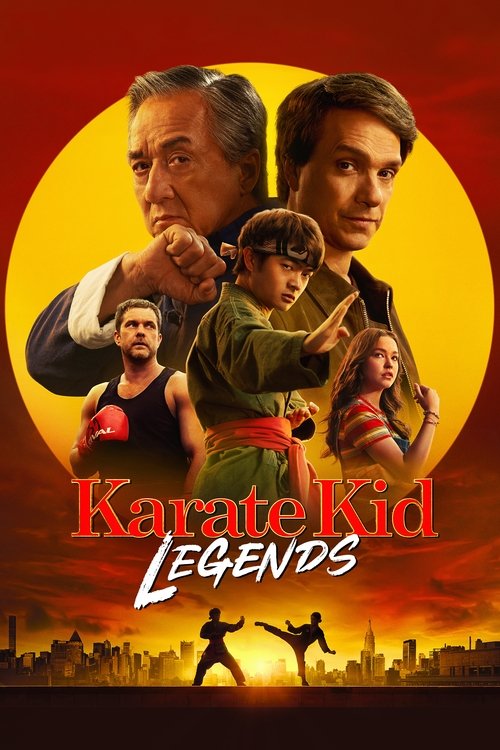
Karate Kid: Legends (2025)
Directed by Jonathan Entwistle
No — Karate Kid: Legends is not woke, scoring 17 out of 100 on our wokeness meter.
The sixth entry in a franchise that has now outlived two of its own reboots, Karate Kid: Legends arrives bearing the weight of continuity, nostalgia, and a Beijing kung fu prodigy named Li Fong who is relocated to New York after a family tragedy.
Consciousness Markers
The lead is a Chinese actor playing a Chinese character, with a notably diverse supporting cast (Jackie Chan, Ming-Na Wen, Shaunette Renée Wilson). However, the diversity is organic to the story of a Beijing kung fu prodigy rather than a deliberate representational statement.
The film touches on cultural identity and the immigrant experience of a Chinese boy adjusting to New York, and the merging of kung fu and karate traditions, but it frames this as personal growth rather than racial-justice commentary.
Mentor wisdom about discipline and overcoming fear is delivered in the traditional martial-arts-movie register, without the preachy social-instruction tone of a lecture.
Mia and Dr. Fong are present as a love interest and a working mother, but the film advances no feminist argument or gendered critique.
A loan shark and creditor serve as antagonists, and Victor's debt drives a subplot, but this is standard villainy rather than an anti-capitalist thesis.
No LGBTQ+ characters, relationships, or themes appear anywhere in the film.
No environmental or climate themes are present.
No body-positivity themes or messaging appear.
No neurodivergent characters or themes are depicted.
The film presents a straightforward fictional continuation of the franchise with no historical revisionism.
Why it received this score
The sixth entry in a franchise that has now outlived two of its own reboots, Karate Kid: Legends arrives bearing the weight of continuity, nostalgia, and a Beijing kung fu prodigy named Li Fong who is relocated to New York after a family tragedy. The setup is serviceable. Jackie Chan and Ralph Macchio share the screen for the first time, and the film asks us to watch two martial traditions merge into one, which it does with the solemnity of a treaty signing. The casting is diverse, with a Chinese lead, a Chinese-American mother, an African-American schoolteacher, and a supporting ensemble that reflects the actual demographics of the borough it depicts. None of this is announced. It simply is. That is the more elegant approach, and the film deserves credit for not turning its own ensemble into a press release.
Where the film engages with cultural identity, it does so through the immigrant experience of a boy caught between his mother's grief and his own. The script treats this as personal growth, not as a thesis. A loan shark named O'Shea menaces a pizzeria owner, and the debt subplot gestures at economic desperation without ever building a case against capital. The women in the film are a love interest and a working mother, both handled with competence and neither asked to carry an argument. There is no romance beyond the conventional, no identity beyond the stated, no sermon delivered from the mountaintop.
What remains is a martial arts film that respects its own rituals. The mentorship dialogue about discipline and fear is the standard register of the genre, delivered with a straight face and no evident desire to instruct the audience on how to live. It is a modest, well-mannered production. The final scene, in which two middle-aged men debate pizza regionalism and pitch a dojo-themed restaurant, suggests a film comfortable with its own silliness. The social consciousness on display is real but gentle, present in the faces on screen and absent from the script's intentions. We classify it accordingly and move on.
Analysis generated by our Consciousness Algorithm
Part of


Synopsis
After a family tragedy, kung fu prodigy Li Fong is uprooted from his home in Beijing and forced to move to New York City with his mother. When a new friend needs his help, Li enters a karate competition – but his skills alone aren't enough. Li's kung fu teacher Mr. Han enlists original Karate Kid Daniel LaRusso for help, and Li learns a new way to fight, merging their two styles into one for the ultimate martial arts showdown.
Questions about Karate Kid: Legends
Is Karate Kid: Legends woke?
No — Karate Kid: Legends is not woke, scoring 17 out of 100 on our wokeness meter. That earns it a verdict of Ultra Based.
Does Karate Kid: Legends have any woke elements?
1 of the 10 markers register at 30 or above, led by Representation Casting (48). On Representation Casting: The lead is a Chinese actor playing a Chinese character, with a notably diverse supporting cast (Jackie Chan, Ming-Na Wen, Shaunette Renée Wilson).
How does Karate Kid: Legends compare to other 2025 movies?
It ranks #127 of the 217 films from 2025 we've scored; their average is 26. The wokest is STRAW (92).
Is Karate Kid: Legends the most woke The Karate Kid movie?
No. It ranks #3 of the 6 The Karate Kid films we've scored; the wokest is The Next Karate Kid (35).