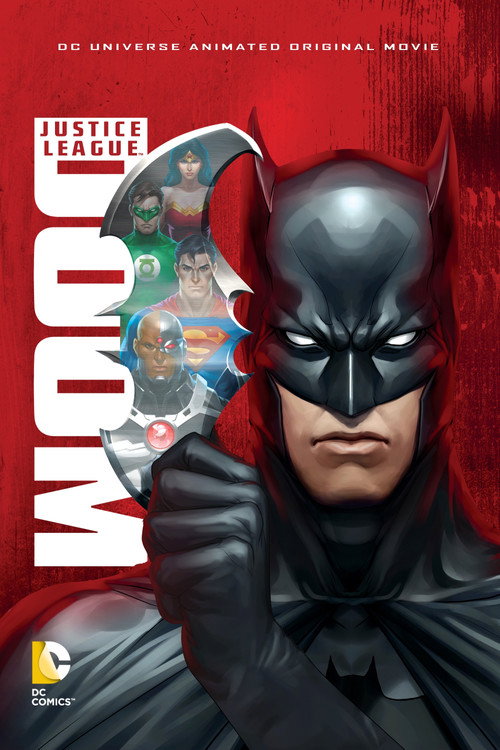
Justice League: Doom (2012)
Directed by Lauren Montgomery
No — Justice League: Doom is not especially woke, scoring 26 out of 100 on our wokeness meter.
Justice League: Doom arrives from 2012 as the thirteenth entry in the DC Universe Animated Original Movies, a direct-to-video adaptation of the Tower of Babel storyline, written by Dwayne McDuffie shortly before his death and directed by Lauren Montgomery.
Consciousness Markers
The League roster includes Cyborg (voiced by Bumper Robinson) and a Black-voiced Martian Manhunter (Carl Lumbly), and the Blu-ray even ships a featurette titled 'Their Time Has Come: Cyborg and the DC Universe's New Diversity.' Diversity is present and even merchandised, though the leads remain largely white.
Directed by Lauren Montgomery and featuring Wonder Woman, Cheetah, and Star Sapphire in action, but the story offers no feminist thesis — the women are combatants, not arguments.
A visibly multiracial team and Cyborg's elevation to full member gesture at representation, but the film contains no racial commentary or consciousness-raising.
The finale carries a mild moral debate about Batman's contingency files and institutional trust, but it is dramatized rather than preached.
No LGBTQ+ characters, relationships, or subtext appear anywhere in the film.
Vandal Savage's solar-flare doomsday plot is an apocalyptic supervillain scheme, not an environmental parable.
The villains are mercenaries hired for money, but the film makes no critique of capitalism or wealth.
No body-positivity themes; the cast is uniformly idealized superhero physique.
No neurodivergent characters or themes are present.
No historical revisionism; the plot is pure comic-book fiction.
Why it received this score
Justice League: Doom arrives from 2012 as the thirteenth entry in the DC Universe Animated Original Movies, a direct-to-video adaptation of the Tower of Babel storyline, written by Dwayne McDuffie shortly before his death and directed by Lauren Montgomery. The premise is sturdy: Batman has compiled contingency files on his colleagues, Vandal Savage steals them, and six hired villains use the plans to dismantle the League one member at a time. The animation is clean, the voice cast reprises roles from the animated series with evident affection, and the whole enterprise runs like a well-maintained machine. It is competent. It is also, by design, an exercise in which the stakes reset by the closing credits.
The roster includes Cyborg, voiced by Bumper Robinson, elevated to full membership in the final act, and Carl Lumbly's Martian Manhunter, and the Blu-ray ships a featurette titled "Their Time Has Come: Cyborg and the DC Universe's New Diversity." That is diversity as a bonus feature, packaged and sold alongside deleted scenes. The film itself offers no racial commentary. The team is multiracial the way an ensemble poster is multiracial. Similarly, Montgomery directs Cheetah and Star Sapphire through their action beats, and Wonder Woman spends much of the running time hallucinating and attacking bystanders, which is not a thesis about anything except nanomachines.
The final third stages a debate about Batman's files and the trust that binds an institution, and it is dramatized instead of preached, which is the correct instinct. Superman hands over the Kryptonite bullet. Batman quits. Nobody lectures the audience about surveillance or accountability, and the argument is left to breathe. For a film about gods who cannot be trusted with their own power, the restraint is notable. The sermon stays in the pulpit. A modest vintage overall. Drinkable, unremarkable, and best consumed without expecting the label to promise more than it delivers.
Thematic tags: sequel, book_adaptation, superhero. It continues Crisis on Two Earths, it adapts a published comic storyline, and it concerns costumed heroes. It won no Academy Awards, remakes nothing, invents no history, and never reached number one at the domestic box office, being a direct-to-video release. Classification complete. The ledger balances, as it always does, and we move on to the next bottle.
That last paragraph should not exist, and yet the classification demands it, so here it stands, a small monument to the solemn duty of cataloguing animated superhero product from a decade ago. The score for this one is unremarkable, as expected, and the shelf grows crowded with titles that were fine.
{"thematic_tags": ["sequel", "book_adaptation", "superhero"]}
Analysis generated by our Consciousness Algorithm
Part of


Synopsis
An adaptation of Mark Waid's "Tower of Babel" story from the JLA comic. Vandal Savage steals confidential files Batman has compiled on the members of the Justice League, and learns all their weaknesses.
Questions about Justice League: Doom
Is Justice League: Doom woke?
No — Justice League: Doom is not especially woke, scoring 26 out of 100 on our wokeness meter. That earns it a verdict of Based.
Does Justice League: Doom have any woke elements?
1 of the 10 markers register at 30 or above, led by Representation Casting (42). On Representation Casting: The League roster includes Cyborg (voiced by Bumper Robinson) and a Black-voiced Martian Manhunter (Carl Lumbly), and the Blu-ray even ships a featurette titled 'Their Time Has Come: Cyborg and the DC Universe's New Diversity.' Diversity is present and even merchandised, though the leads remain largely white.
How does Justice League: Doom compare to other 2012 movies?
It ranks #31 of the 230 films from 2012 we've scored; their average is 12. The wokest is Killing Them Softly (92).
How is the Woke Score calculated?
An AI-assisted process researches the film and its reception, scores it 0–100 on ten markers, then combines those into one 0–100 Woke Score. It measures a specific set of 2020s cultural themes, not film quality.