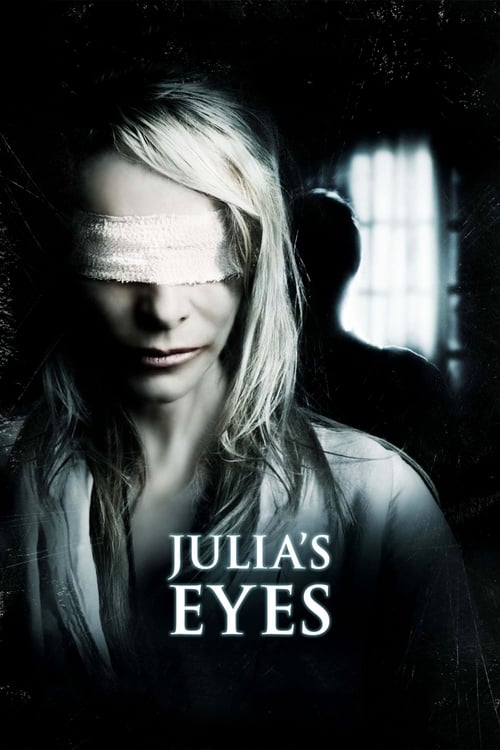
Julia's Eyes (2010)
Directed by Guillem Morales
No — Julia's Eyes is not woke, scoring 7 out of 100 on our wokeness meter.
Julia's Eyes arrives from 2010, premiered at Toronto and handed the opening slot at Sitges, produced by Guillermo del Toro, directed by Guillem Morales, and concerned almost entirely with the business of a woman losing her sight while a man in the walls photographs her.
Consciousness Markers
Julia is an active protagonist who investigates a crime, but the film operates within traditional thriller tropes rather than dismantling systemic gender inequality.
The film centers on a woman with a degenerative sight disease, which is a specific condition, but the casting does not engage in modern progressive representation beyond that singular plot device.
There are no explicit or coded LGBTQ+ themes present in the narrative or character development.
The film contains no discussion or representation of race or racial dynamics.
There is no environmental activism or commentary on climate change within the plot or setting.
The narrative focuses on personal mystery and medical procedures, showing no critique of economic systems or corporate greed.
The film focuses on the loss of sight and physical deterioration, not on challenging conventional body image standards in a modern, progressive manner.
Julia's condition is a degenerative sight disease, which is a sensory/physical ailment, not a recognized form of modern neurodivergence like autism or ADHD.
The film is a fictional psychological thriller and does not challenge any established historical narratives.
The film relies on suspense and psychological tension rather than didactic monologues or social commentary delivered in a lecture format.
Why it received this score
Julia's Eyes arrives from 2010, premiered at Toronto and handed the opening slot at Sitges, produced by Guillermo del Toro, directed by Guillem Morales, and concerned almost entirely with the business of a woman losing her sight while a man in the walls photographs her. It is a Hitchcock pastiche with a scalpel, and it has no interest in the cultural conversations that would arrive a decade later.
The film's engagement with progressive sensibilities is minimal and incidental. Julia is a woman who investigates a crime, which earns a modest nod in the direction of female agency, though she does so within the well-worn grooves of the stalker thriller, and the film never turns its gaze toward systemic grievance. Her degenerative eye disease supplies a specific medical condition and a great deal of suspense, not an argument about accessibility or accommodation. The villain's pathology, a man who needs women to be blind so that they will need him, is a psychological grotesque, not a thesis. There is no race here, no queerness, no climate, no class war, no body politics, no neurological diversity, no revision of any history. The film is too busy putting a flashlight in a corner.
To score such a picture is to admire its discipline. It commits to atmosphere and to the slow cruelty of its premise, and it declines every invitation to sermonize. The result is a lean, nasty, well-made thriller that will never be asked to speak at a panel. We can respect that. We can also note that it leaves us very little to classify. The remake rights, sold four times over in India and once in Korea, suggest the premise travels well precisely because it carries no ideological luggage at all. A quiet vintage. Almost nothing to decant.
Analysis generated by our Consciousness Algorithm
Part of


Synopsis
Julia, a woman suffering from a degenerative sight disease, finds her blind sister Sara hung in a basement. Despite all signs pointing to suicide, Julia decides to investigate what she intuitively feels is a murder case.
Questions about Julia's Eyes
Is Julia's Eyes woke?
No — Julia's Eyes is not woke, scoring 7 out of 100 on our wokeness meter. That earns it a verdict of Ultra Based.
Does Julia's Eyes have any woke elements?
Very few. None of the 10 markers reaches 30, the level where a marker counts as present; the highest is Feminist Agenda at 15.
How does Julia's Eyes compare to other 2010 movies?
It ranks #125 of the 238 films from 2010 we've scored; their average is 11. The wokest is My Name Is Khan (84).
How is the Woke Score calculated?
An AI-assisted process researches the film and its reception, scores it 0–100 on ten markers, then combines those into one 0–100 Woke Score. It measures a specific set of 2020s cultural themes, not film quality.