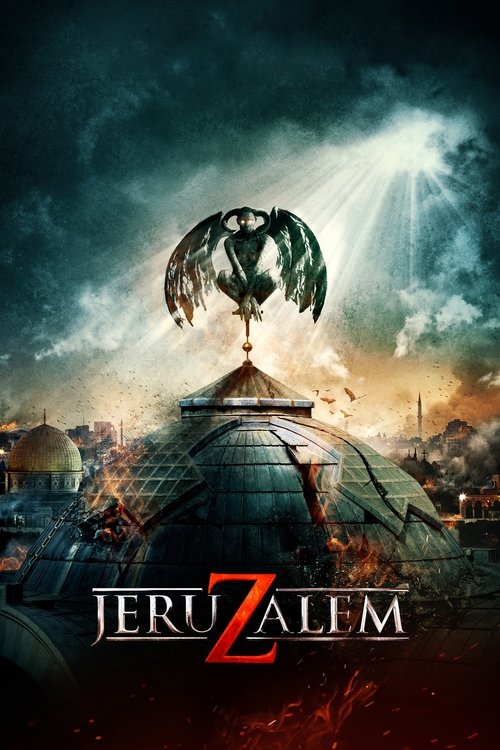
Jeruzalem (2016)
Directed by Doron Paz
No — Jeruzalem is not woke, scoring 8 out of 100 on our wokeness meter.
Jeruzalem presents a fever dream of biblical apocalypse and cheap scares, yet it survives the scrutiny of modern cultural priorities with a surprising degree of banality.
Consciousness Markers
The cast is largely Israeli with a Palestinian hostel-owning family (Omar and Fauzi) woven naturally into the Jerusalem setting; this is authentic to the locale rather than a self-conscious diversity mandate.
Two women (Sarah and Rachel) anchor the story, but they function as standard horror protagonists rather than vehicles for any feminist argument.
Israeli and Palestinian characters share the screen, but the film treats this as backdrop for a demonic apocalypse rather than engaging any racial or political consciousness.
Kevin delivers some exposition about Jinns, the Golem, and shared evil mythology, but it serves the plot rather than preaching a message to the audience.
No LGBTQ+ characters, relationships, or themes appear anywhere in the film.
No environmental or climate themes are present; the apocalypse here is biblical, not ecological.
No critique of capitalism, wealth, or class structures appears in the film.
No body-positive messaging or body-diversity themes are present.
A mental asylum and its patients appear, but strictly as horror set-dressing and demonic-possession fodder, not as neurodivergence advocacy.
The film draws on Talmudic and religious mythology (the gates of hell) as horror lore, not as a revisionist reframing of established history.
Why it received this score
Jeruzalem presents a fever dream of biblical apocalypse and cheap scares, yet it survives the scrutiny of modern cultural priorities with a surprising degree of banality. The premise, which involves American tourists stumbling into a demonic infestation in the Old City, is hardly innovative. We find characters navigating a setting where the presence of Israeli and Palestinian figures is treated as geographical detail, not as a platform for critical social commentary. The film’s engagement with its complex setting remains largely confined to the functional requirement of providing atmospheric dread. It is a horror piece first, and a vehicle for contemporary social introspection second. The few attempts at exploring cultural nuances, such as the interactions within the local hostel, feel authentic to the locale but lack the necessary progressive articulation to raise the overall cultural temperature.
The film’s narrative momentum relies heavily on its supernatural escalation. We receive exposition on Jewish, Islamic, and Christian mythologies, which Kevin delivers with an earnest enthusiasm that provides a modest lift to the film's intellectual ambitions. However, this sharing of folkloric knowledge is an act of plot service rather than a genuine attempt to lecture the audience on shared existential threats. The portrayal of gender within the narrative is strictly functional, relegating the central female protagonists to standard horror archetypes whose primary function is to witness the unfolding cosmic catastrophe. This approach ensures that no progressive sensibilities are awakened by the viewing experience.
Ultimately, Jeruzalem is a loud, chaotic exploration of the end of days that is culturally inert. It does not look inward to examine structures of power or identity, nor does it utilize its setting to force a conversation about modern sensibilities. The narrative is a relentless dive into the visceral, focusing on theological horror rather than any form of socio-political reckoning. We leave the theater feeling less enlightened and more simply exhausted by the sheer density of its biblical imagery. It is a film that mistakes setting for substance.
Analysis generated by our Consciousness Algorithm


Synopsis
When a couple of American young adults fly to Israel to visit the city of Jerusalem, a biblical nightmare falls upon the city.
Questions about Jeruzalem
Is Jeruzalem woke?
No — Jeruzalem is not woke, scoring 8 out of 100 on our wokeness meter. That earns it a verdict of Ultra Based.
Does Jeruzalem have any woke elements?
Very few. None of the 10 markers reaches 30, the level where a marker counts as present; the highest is Representation Casting at 15.
How does Jeruzalem compare to other 2016 movies?
It ranks #170 of the 285 films from 2016 we've scored; their average is 16. The wokest is 13th (92).
How is the Woke Score calculated?
An AI-assisted process researches the film and its reception, scores it 0–100 on ten markers, then combines those into one 0–100 Woke Score. It measures a specific set of 2020s cultural themes, not film quality.