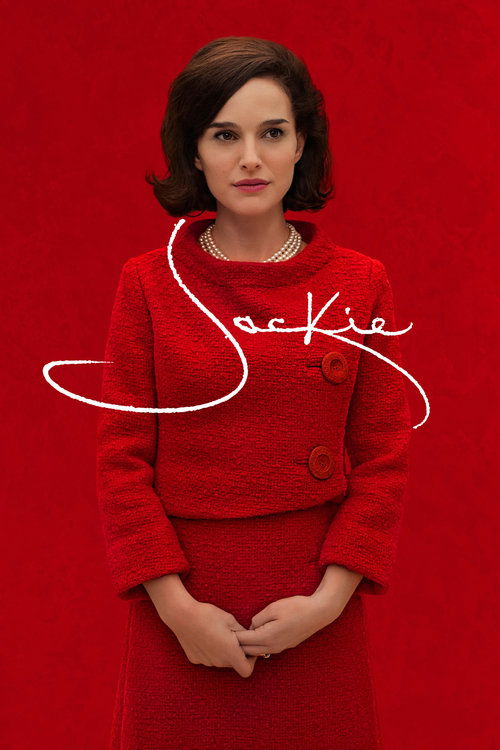
Jackie (2016)
Directed by Pablo Larraín
No — Jackie is not woke, scoring 14 out of 100 on our wokeness meter.
Pablo Larrain's Jackie arrives with the hushed reverence of a museum exhibit and the pulse of a hostage negotiation.
Consciousness Markers
The film is deliberately built around a woman's interior life and grief, the first of Larraín's trilogy of 'iconic 20th century women,' and Jackie asserts control over her own narrative and her husband's legacy. It is a female-centered character study rather than an explicit feminist polemic.
The film takes minor liberties with the historical record (e.g., the portrayal of Jackie's relationship with the Johnsons, and her informing her children of the death), but these are dramatic inventions rather than ideologically revisionist reinterpretations of history.
The film is an intimate, impressionistic character portrait rather than a message-driven work; it does not lecture the audience on social or political themes.
The cast is composed almost entirely of white actors portraying white historical figures of the Kennedy White House; there is no diverse or color-conscious casting to speak of.
The film contains no LGBTQ+ characters, themes, or subtext whatsoever.
The film engages no racial themes or commentary; it is confined to the white political elite of 1963 Washington.
There is no environmental or climate-related content in the film.
The film offers no critique of capitalism, wealth, or class structures.
No body-positivity themes or messaging are present.
The film does not depict or address neurodivergence.
Why it received this score
Pablo Larrain's Jackie arrives with the hushed reverence of a museum exhibit and the pulse of a hostage negotiation. Natalie Portman plays Jacqueline Kennedy in the days between Dallas and Arlington, chain-smoking in the East Room, rehearsing a funeral procession, and negotiating with a journalist over which portions of her grief are fit for print. The film is a character study of a woman curating her husband's legacy while her own composure comes apart in private. That is the entire project, and it is enough.
The picture is built around a woman's interior life, which places it in the company of Larrain's later portraits of Diana and Maria Callas. Jackie seizes the narrative and refuses to surrender it, and the film treats that refusal as a form of authority. Call this progressive by temperament, not by sermon. There is no speech about patriarchy, no thesis delivered to the camera. The cast is white because 1963 Washington was white, and the film has no interest in commenting on that fact. No racial reckoning, no environmental lament, no class warfare, no meditation on the body, no account of neurodivergence. Wealth is simply the wallpaper.
Where the film touches the historical record, it does so for drama, not doctrine. The frosty Johnsons and the scene of Jackie telling her children herself are inventions, and small ones. The film never lectures. It observes, and lets Portman's voice do the arguing. A restrained vintage, then. Dry, precise, low in sugar. The cellar is largely empty, but the one bottle on the shelf is genuinely good.
Analysis generated by our Consciousness Algorithm


Synopsis
An account of the days of First Lady, Jacqueline Kennedy, in the immediate aftermath of John F. Kennedy's assassination in 1963.
Questions about Jackie
Is Jackie woke?
No — Jackie is not woke, scoring 14 out of 100 on our wokeness meter. That earns it a verdict of Ultra Based.
Does Jackie have any woke elements?
1 of the 10 markers register at 30 or above, led by Feminist Agenda (35). On Feminist Agenda: The film is deliberately built around a woman's interior life and grief, the first of Larraín's trilogy of 'iconic 20th century women,' and Jackie asserts control over her own narrative and her husband's legacy.
How does Jackie compare to other 2016 movies?
It ranks #120 of the 285 films from 2016 we've scored; their average is 16. The wokest is 13th (92).
How is the Woke Score calculated?
An AI-assisted process researches the film and its reception, scores it 0–100 on ten markers, then combines those into one 0–100 Woke Score. It measures a specific set of 2020s cultural themes, not film quality.