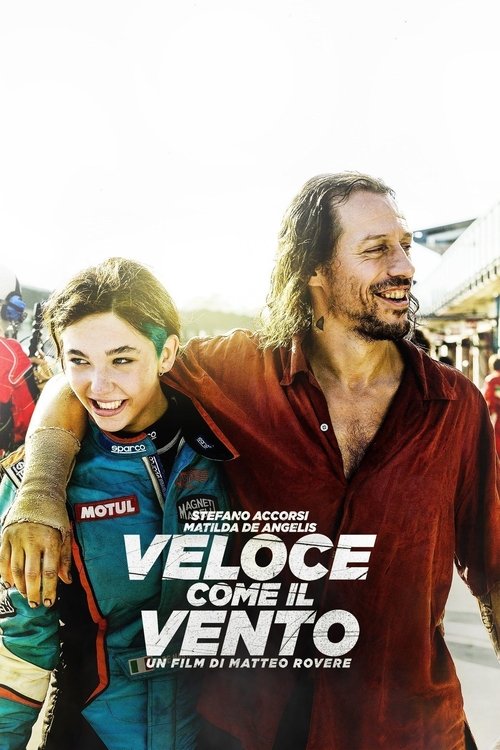
Italian Race (2016)
Directed by Matteo Rovere
No — Italian Race is not woke, scoring 12 out of 100 on our wokeness meter.
Matteo Rovere's Italian Race arrives bearing the modest credentials of a national sports drama, and it conducts itself with the quiet dignity of a film that has no interest in being anything else.
Consciousness Markers
A seventeen-year-old girl heads a male-dominated motorsport drama, a modestly unconventional lead for the genre, though the casting arises naturally from the story rather than as a statement.
Giulia's struggle to be taken seriously as a female driver in a male world carries a light feminist undertone, but the film frames it as a personal family drama rather than a gender polemic.
The film is a straightforward emotional sports drama that shows rather than preaches; any message about family is delivered through plot, not sermon.
No LGBTQ+ characters or themes appear anywhere in the film.
The film is entirely Italian and white; race is never a subject or presence.
No environmental themes; the film celebrates combustion engines without a hint of ecological anxiety.
No critique of wealth or capitalism; the racing world's money is simply the backdrop.
No body-positivity themes or messaging.
No neurodivergence is depicted or discussed.
Loosely inspired by rally driver Carlo Capone, but it makes no revisionist historical claims.
Why it received this score
Matteo Rovere's Italian Race arrives bearing the modest credentials of a national sports drama, and it conducts itself with the quiet dignity of a film that has no interest in being anything else. We follow Giulia De Martino, seventeen and preternaturally gifted behind the wheel, as she navigates the GT Championship under the wing of a father who is also her coach and, eventually, her absence. When the estranged brother Loris reappears, all frayed nerves and supernatural feel for the road, the film settles into a familiar rhythm of engines, arguments, and reconciliation. The machinery is loud. The emotions are louder. It is, in the grand tradition of the genre, a story about a family learning to be a family while driving very fast.
On the matter of social consciousness, the film is temperate to the point of reticence. Giulia occupies a male-dominated cockpit, and the screenplay glances at the friction of that arrangement without ever mounting a case. She wants to be taken seriously as a driver. The film agrees, then moves on. There is no broader thesis about gender, no sermon, no moment where a character pauses the race to explain the moral of the race. The Italian countryside, the white and wealthy, offers no occasion for commentary on race, class, or the climate, the last of which the film treats with the uncomplicated affection of a gearhead who has never once considered a carbon footprint.
What remains is a lean, competent melodrama of combustion and grief, loosely tethered to the real career of rally driver Carlo Capone. It preaches nothing, which in this climate is its own small virtue. We are left with a father, a daughter, a brother, and a checkered flag, and the suspicion that the film would be baffled to learn anyone expected more. Grade: merit, mild. Cultural freight: negligible. A perfectly respectable afternoon at the cinema, and not a moment of instruction to be found within it.
Analysis generated by our Consciousness Algorithm

Synopsis
Giulia De Martino is a pilot. At seventeen she participates in the GT Championship, under the guidance of her father Mario. But one day everything changes and Giulia has to face alone both the track and her own life.
Questions about Italian Race
Is Italian Race woke?
No — Italian Race is not woke, scoring 12 out of 100 on our wokeness meter. That earns it a verdict of Ultra Based.
Does Italian Race have any woke elements?
Very few. None of the 10 markers reaches 30, the level where a marker counts as present; the highest is Representation Casting at 25.
How does Italian Race compare to other 2016 movies?
It ranks #137 of the 285 films from 2016 we've scored; their average is 16. The wokest is 13th (92).
How is the Woke Score calculated?
An AI-assisted process researches the film and its reception, scores it 0–100 on ten markers, then combines those into one 0–100 Woke Score. It measures a specific set of 2020s cultural themes, not film quality.