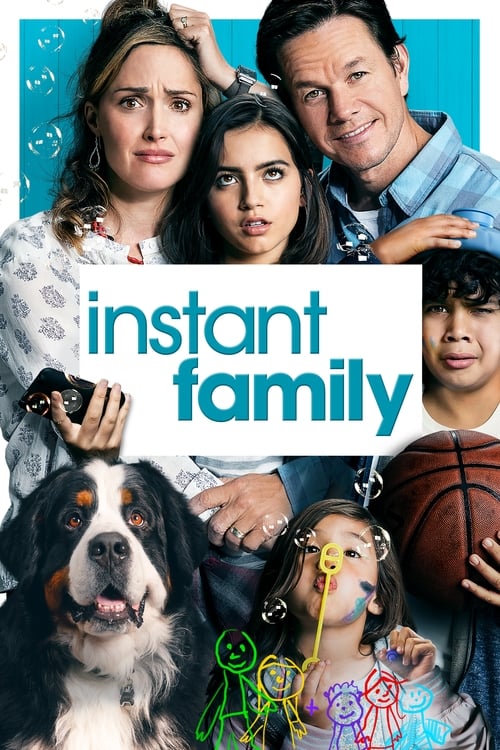
Instant Family (2018)
Directed by Sean Anders
No — Instant Family is not especially woke, scoring 30 out of 100 on our wokeness meter.
**Instant Family** arrives from Paramount with the soft, eager thud of a studio dramedy that wants very much to be liked, and largely succeeds.
Consciousness Markers
A white couple adopts three Latino siblings, with Octavia Spencer and Tig Notaro in supporting roles, giving the ensemble a naturally diverse makeup. The casting is inclusive but never foregrounded or commented upon as a statement.
The film earnestly advocates for foster care and adoption and includes support-group scenes that explain the system's goals, giving it a mild didactic streak. It is heartfelt rather than preachy, but the message-forward structure is present.
The cross-racial adoption of Latino children by a white couple introduces a racial dimension, and the birth mother's incarceration touches on social inequity, but the film treats these as emotional texture rather than consciousness-raising.
Ellie and Lizzie are forceful, well-drawn female characters and the social workers are women, but the film's concerns are parenting and family, not a feminist thesis. Female agency exists without an agenda attached.
Tig Notaro, an openly gay performer, appears in a supporting role and the TMDB keyword list includes 'lgbt,' but no character's queerness is a plot point or theme. The presence is incidental rather than substantive.
No environmental themes, imagery, or messaging appear anywhere in the film.
The film is a warm studio comedy about family formation with no critique of wealth, class, or economic systems.
No body-image, size-acceptance, or self-love themes are present.
Juan's emotional fragility is framed as trauma from the foster system, not as neurodivergence, and no character is identified or coded as neurodivergent.
The film is a contemporary family story with no historical revisionism of any kind.
Why it received this score
**Instant Family** arrives from Paramount with the soft, eager thud of a studio dramedy that wants very much to be liked, and largely succeeds. Mark Wahlberg and Rose Byrne play a childless couple who wander into a foster care orientation class and leave with three Latino siblings, one of them a furious fifteen-year-old. The casting is quietly inclusive, a diverse ensemble assembled without a press release attached. Nobody in the frame stops to announce the significance of it. The children are simply there, and the film loves them.
The real subject here is the machinery of foster care, which the film explains with the patience of a brochure. Octavia Spencer and Tig Notaro run the support group, dispensing hard truths about reunification and the limits of good intentions. These scenes carry a gentle lecturing impulse. They want us informed, maybe even inspired to make a phone call. The cross-racial adoption and the incarcerated birth mother add emotional weight, though the film treats them as texture, not argument. There is no environmental alarm, no assault on wealth, no meditation on body image, no coded neurodivergence. The villains are a predatory janitor and a system that is merely slow.
The remainder is a warm, sincere, faintly instructive thing, the cinematic equivalent of a well-meaning pamphlet with good jokes. It believes in families and says so, repeatedly, in rooms full of folding chairs. The result is pleasant, manipulative in the gentlest way, and entirely without ideology beyond the humane. It asks nothing of us but tears. It gets them. The whole enterprise sits comfortably in a long tradition of studio sentiment, with a modest modern gloss and no appetite for a fight. We have classified it accordingly. The vintage is mild, quaffable, and best consumed with a tissue.
{"thematic_tags": ["true_story"]}
Analysis generated by our Consciousness Algorithm
Part of


Synopsis
When Pete and Ellie decide to start a family, they stumble into the world of foster care adoption. They hope to take in one small child but when they meet three siblings, including a rebellious 15 year old girl, they find themselves speeding from zero to three kids overnight.
Questions about Instant Family
Is Instant Family woke?
No — Instant Family is not especially woke, scoring 30 out of 100 on our wokeness meter. That earns it a verdict of Based.
Does Instant Family have any woke elements?
2 of the 10 markers register at 30 or above, led by Representation Casting (40) and Lecture Energy (30). On Representation Casting: A white couple adopts three Latino siblings, with Octavia Spencer and Tig Notaro in supporting roles, giving the ensemble a naturally diverse makeup.
How does Instant Family compare to other 2018 movies?
It ranks #69 of the 325 films from 2018 we've scored; their average is 20. The wokest is Return (92).
How is the Woke Score calculated?
An AI-assisted process researches the film and its reception, scores it 0–100 on ten markers, then combines those into one 0–100 Woke Score. It measures a specific set of 2020s cultural themes, not film quality.