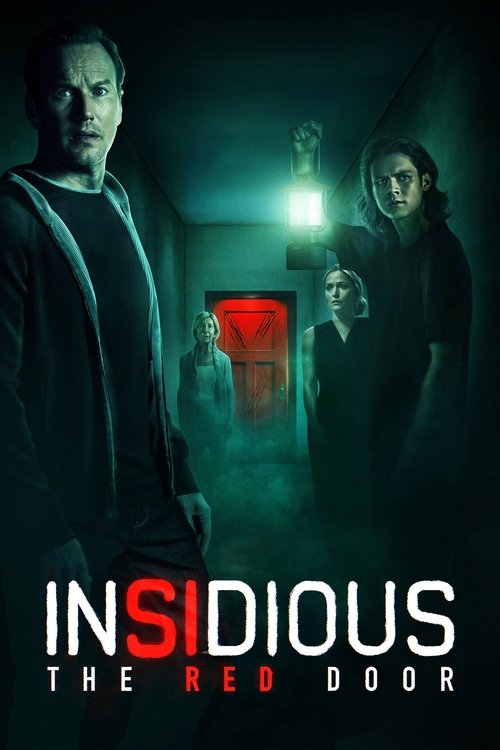
Insidious: The Red Door (2023)
Directed by Patrick Wilson
No — Insidious: The Red Door is not woke, scoring 6 out of 100 on our wokeness meter.
Insidious: The Red Door arrives as the fifth installment of a franchise that has already buried its share of bodies, and it does so with the grim efficiency of a funeral home that has stopped pretending to grieve.
Consciousness Markers
The supporting cast includes Black and Middle Eastern performers in significant roles, but the film makes no explicit representational statement.
No LGBTQ+ characters, themes, or subtext are present.
Female characters are present and occasionally proactive, but the film has no feminist agenda or gender-focused commentary.
No racial themes, commentary, or consciousness are explored.
No climate or environmental themes appear.
No anti-capitalist or eat-the-rich themes are present.
No body positivity themes or messaging are present.
Mental illness is mentioned as backstory for a character, but it is not framed through neurodivergence advocacy or representation.
No historical revisionism or reimagined historical narrative is present.
The film is a supernatural horror sequel and contains no preachy or lecture-like messaging.
Why it received this score
Insidious: The Red Door arrives as the fifth installment of a franchise that has already buried its share of bodies, and it does so with the grim efficiency of a funeral home that has stopped pretending to grieve. Patrick Wilson directs himself and a returning cast through the Further once more, this time with a father-son reconciliation at the center. The film concerns repressed memory, inherited trauma, and a red door that will not stay shut. None of this amounts to a social program. It is a haunted house with better lighting.
The supporting cast includes Sinclair Daniel and Hiam Abbass, both of whom perform capably and neither of whom is asked to carry a thesis. Their presence is welcome and unremarked upon. There is no commentary on race, no gender polemic, no environmental sermon, no economic grievance, no celebration of any body type, and no advocacy on behalf of the neurodivergent. Mental illness appears briefly as backstory, the institutionalization of Josh's father, and the film treats it as a source of family shame instead of a platform. This is a horror movie, and it knows it.
Instead we get a ghost story that wants to be about fathers and sons and mostly succeeds at being about jump scares. The film has no interest in instructing us. It has an interest in frightening us, and it manages that only intermittently, which is its own kind of failure. A sequel that neither scares nor preaches is left with the furniture of the genre: creaking doors, flickering lights, and a demon who has overstayed his welcome. The red door closes. In the post-credits scene the light flickers back on, because the franchise has bills to pay. Nothing here will offend anyone, which may be the most damning thing we can say.
Analysis generated by our Consciousness Algorithm
Part of


Synopsis
To put their demons to rest once and for all, Josh Lambert and a college-aged Dalton Lambert must go deeper into The Further than ever before, facing their family's dark past and a host of new and more horrifying terrors that lurk behind the red door.
Questions about Insidious: The Red Door
Is Insidious: The Red Door woke?
No — Insidious: The Red Door is not woke, scoring 6 out of 100 on our wokeness meter. That earns it a verdict of Ultra Based.
Does Insidious: The Red Door have any woke elements?
Very few. None of the 10 markers reaches 30, the level where a marker counts as present; the highest is Representation Casting at 15.
How does Insidious: The Red Door compare to other 2023 movies?
It ranks #175 of the 200 films from 2023 we've scored; their average is 24. The wokest is Origin (84).
Is Insidious: The Red Door the most woke Insidious movie?
No. It ranks #2 of the 6 Insidious films we've scored; the wokest is Insidious: Out of the Further (18).