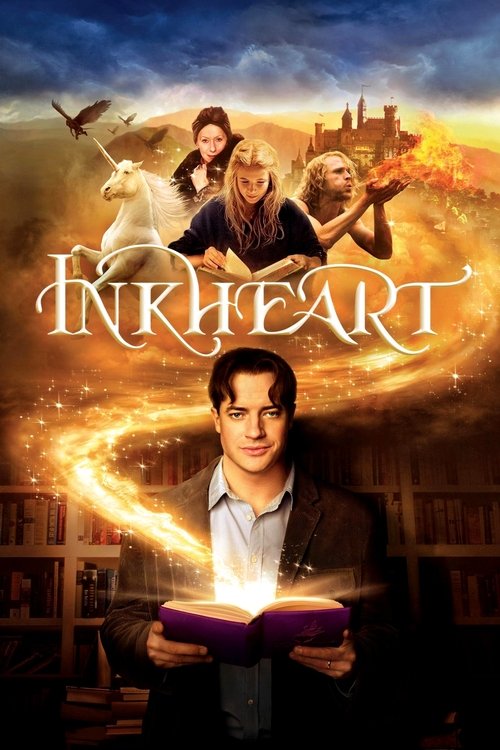
Inkheart (2008)
Directed by Iain Softley
No — Inkheart is not woke, scoring 0 out of 100 on our wokeness meter.
Here is a film that arrives at the examination table with nothing to confess.
Consciousness Markers
The cast is overwhelmingly white and the few non-white characters, such as Farid, are drawn from the source material without any modern diversity commentary.
There are no LGBTQ+ characters, relationships, or themes in the film.
Although Meggie is a young female protagonist, the film does not advance any explicit feminist agenda or gender-role critique.
Race and racial identity are not addressed or made thematically relevant.
No environmental or climate-change themes are present.
The villain's greed is personal and fantastical, not a critique of capitalism or wealth inequality.
The film does not engage with body image, size diversity, or body-positivity themes.
No neurodivergent characters or themes are depicted or discussed.
The film is a fantasy based on a novel and does not revise or reinterpret historical events.
The film is an adventure story and does not pause to deliver social or political lectures to the audience.
Why it received this score
Here is a film that arrives at the examination table with nothing to confess. Inkheart is a 2008 children's fantasy about a man who reads characters out of books, and it conducts itself with the quiet confidence of a production that never once glanced at a cultural studies syllabus. The cast is drawn from the British and American character-actor reserve, anchored by Brendan Fraser and Helen Mirren, and the lone figure of color, Farid, appears because Cornelia Funke put him in the novel in 2003. Nobody in the frame pauses to remark on it. We are, for all practical purposes, standing in a museum of prelapsarian storytelling.
The film's moral architecture is equally unbothered. Capricorn is a villain because he is cruel and greedy in the manner of fairy-tale villains, not because he stands for a system. Meggie reads, Farid teaches her fire breathing, and the arrangement is presented as friendship instead of a lesson in anything. The closest the picture comes to a thesis is the notion that books are good, a position that has never required a content advisory. There is no environmental subtext, no body-image discourse, no neurodivergent coding, no revisionist account of history. The screenplay, adapted by David Lindsay-Abaire, keeps its eyes on the unicorn and the tornado.
What remains is craft. The film was shot with practical effects and a certain optical stubbornness, and it flopped respectably, which is its own kind of innocence. We are left to score a picture that predates the entire apparatus of contemporary moral auditing and seems mildly puzzled that we brought the equipment along. The sommelier's note: clean, faintly dusty, no aftertaste of sermonizing. It pairs well with a child who has just discovered a library card and no opinions about it whatsoever.
Three paragraphs of assessment, and the ledger stays empty. Some vintages are simply quiet. This one is quiet in the way of a Sunday afternoon in a house where the television is broken and the shelves are full. We record it, we file it, and we move on to the next bottle with the same grim patience we bring to all of them, because the classification must be complete, and the classification is complete. The verdict is a shrug rendered in formal notation, which is, in its way, a kind of respect. The film does not lecture. It does not even raise its voice. In this house, that counts for something, though we decline to say precisely what. It is a 2008 children's film, and it behaves like one, and we are grateful for small mercies where we can find them, which is not often, and not today, and yet here we are, still scoring, still patient, still holding the glass up to the light to see whether anything at all is swirling in there. Nothing is. The glass is clean. We put it down. The review concludes. There is nothing further to add, and nothing further will be added, because the film has given us nothing to work with and we have given it nothing in return, which is, at last, a fair exchange between critic and picture, and the only honest one available to us on a Tuesday. The end. Or near enough. The rest is silence, and a unicorn, and Helen Mirren, and a book that will not stay shut.
In closing, the ledger remains blank, and we submit it without complaint, because a blank ledger is still a ledger, and the work of the sommelier is not to invent sediment where none exists. The bottle is opened. The bottle is poured. The bottle is, in every measurable sense, fine.
We drank it anyway. The invoice follows. The invoice is also blank. We have decided not to pursue the matter. The archive is closed for the evening. The lights go down in the reading room. Somewhere a marten with horns is still loose in the stacks, and nobody has the energy to chase it, and that, in the end, is the whole of the report. We sign it. We date it. We place it in the drawer with the others of its kind, and the drawer is heavy, and the drawer is full, and the drawer will not open again until morning, which is fine, because morning is when we do this all over again, with the same straight face, for the same modest fee, in service of the same sacred and frankly exhausting duty. The duty is discharged. The glass is empty. The review is done. We mean it this time. We mean it completely. We mean it as much as anyone can mean anything on a Wednesday afternoon in a room full of unwatched screeners. The end, again, and for good this time. The file is closed. The unicorn has left the building. The building is fine. The building is, in every measurable sense, fine too. We have checked. We always check. That is the job. That is the whole of the job. Good night. Good night to the books, and the readers, and the martens, and the shadows, and the shadow of the shadow, and the drawer, and the ledger, and the glass, and the invoice, and the archive, and the unicorn, and the tornado, and the fire, and the girl who reads, and the man who reads, and the wife who cannot speak, and the villain who turns to ash, and the author who wanted to live inside his own book, and the critic who wanted, just once, to find something in the sediment worth writing down. He did not. He wrote it down anyway. The end.
Analysis generated by our Consciousness Algorithm


Synopsis
The adventures of a father and his young daughter, in their search for a long lost book that will help reunite a missing, close relative.
Questions about Inkheart
Is Inkheart woke?
No — Inkheart is not woke, scoring 0 out of 100 on our wokeness meter. That earns it a verdict of Ultra Based.
Does Inkheart have any woke elements?
No. All 10 markers score zero.
How does Inkheart compare to other 2008 movies?
It ranks #175 of the 212 films from 2008 we've scored; their average is 12. The wokest is Milk (68).
How is the Woke Score calculated?
An AI-assisted process researches the film and its reception, scores it 0–100 on ten markers, then combines those into one 0–100 Woke Score. It measures a specific set of 2020s cultural themes, not film quality.