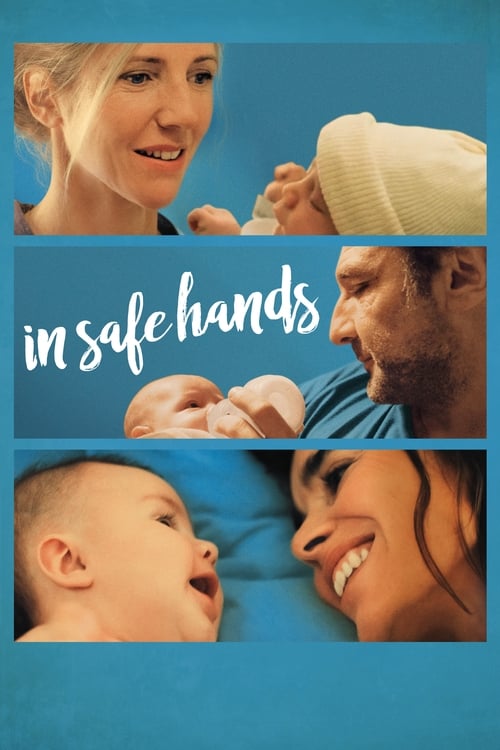
In Safe Hands (2018)
Directed by Jeanne Herry
No — In Safe Hands is not woke, scoring 9 out of 100 on our wokeness meter.
There is a baby, and the baby has no say in anything, which is the central joke of the French child-welfare system as observed here.
Consciousness Markers
The film centers on women's experiences of motherhood, birth, and adoption, and is directed by a woman, but it treats these as human drama rather than a programmatic feminist thesis.
The cast is a conventional French ensemble, largely white, with no evident effort to foreground underrepresented groups as a statement. Leïla Muse appears in a supporting role without the film making casting a talking point.
The film observes the adoption process with documentary-like restraint rather than preaching a message, though its sympathetic institutional gaze carries mild didactic warmth.
The film is a sympathetic portrait of the public child-welfare and adoption apparatus, implicitly valuing the welfare state, but it makes no critique of capitalism or wealth.
There are no LGBTQ+ characters, relationships, or themes anywhere in the narrative.
Race is not a subject of the film; the adoption and child-welfare story unfolds without racial commentary.
No environmental or climate themes are present.
Body image and body positivity are not addressed.
Neurodivergence is not a theme of the film.
The film is a fictional drama and makes no revisionist claims about historical events.
Why it received this score
There is a baby, and the baby has no say in anything, which is the central joke of the French child-welfare system as observed here. Jeanne Herry's camera parks itself in the neonatal ward at Brest and simply watches the machinery turn: the anonymous birth, the two-month window in which a mother may reclaim her child, the social workers who cradle the infant through its limbo, the prospective adoptive mother who has spent a decade losing arguments with her own body. Sandrine Kiberlain and Gilles Lellouche do the institutional labor with the flat competence of people who have filed these forms before. Nobody raises their voice. The film's restraint is its entire method, and it is a method that mostly works.
The social awareness on display is of the gentle European variety, the kind that trusts the state and asks only that we notice the people inside it. Women carry this story, and a woman directs it, though the film is content to let motherhood be a human predicament instead of a thesis. There is a quiet faith in public institutions here, an assumption that the adoption apparatus is staffed by decent people doing difficult work. That is a political position, lightly held. It never becomes an argument about money or class or who deserves what. The cast is a standard French ensemble, and the one performer of color appears without the film feeling obliged to comment on the fact, which is either admirable or merely unremarkable depending on your appetite for commentary.
What we get instead is procedural tenderness. The paperwork, the handoffs, the foster placement, the infant passed from arm to arm like a parcel nobody wants to drop. It is affecting, and it is careful, and it preaches almost nothing. A film like this arrives, does its modest, well-made business, and leaves. We have seen the type before. We will see it again. The classification proceeds accordingly, with low numbers and no hard feelings.
Analysis generated by our Consciousness Algorithm


Synopsis
Théo is given up for adoption by his biological mother on the very day he is born. After this anonymous birth, the mother has two months to change her mind… Or not. The child welfare services and adoption service spring into action… The former have to take care of the baby and support it during this limbo-like time, this period of uncertainty, while the latter must find a woman to become his adoptive mother. She is called Alice, and she has spent the last ten years fighting to have a child.
Questions about In Safe Hands
Is In Safe Hands woke?
No — In Safe Hands is not woke, scoring 9 out of 100 on our wokeness meter. That earns it a verdict of Ultra Based.
Does In Safe Hands have any woke elements?
Very few. None of the 10 markers reaches 30, the level where a marker counts as present; the highest is Feminist Agenda at 22.
How does In Safe Hands compare to other 2018 movies?
It ranks #203 of the 325 films from 2018 we've scored; their average is 20. The wokest is Return (92).
How is the Woke Score calculated?
An AI-assisted process researches the film and its reception, scores it 0–100 on ten markers, then combines those into one 0–100 Woke Score. It measures a specific set of 2020s cultural themes, not film quality.